Why Did Jesus Forgive The Paralytic Before Healing Him?

Man_through_roof_JamesTissot-56a0000e5f9b58eba4ae64deMoving into a new community can be difficult. Sure, meeting new people. Finding new friends. Learning the location of all the important shops and restaurants can be taxing. But the most difficult is setting up new internet service. The customer service for these places is often atrocious.

You do all the research, you figure out exactly which package fits your needs. You make the call.

“Hi, my name is Mike. I’m moving to the area and I’d like to know how much I can get this package for.”

“Thank you for calling today sir. I’d like to tell you about our special glass cleaner we sell.”

“Noooo, I don’t want that. I just want this internet package. Is it available at my address? And how much is it?”

“Wonderful, I can help you with this sir. What is your name?”

Gives name for the fourth time.

“Can I interest you in our 450 channel package. It comes with….” 15 minute spiel.

“No thank you…I just want this very specific package and that is all. Can you get that set up for me.”

“Oh, yes, sir. But first, can I interest you in….”

Grrrr…..

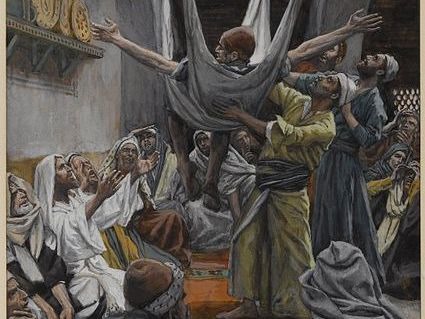
When you read the story of the paralytic in Mark 2:1-12 it almost seems as if Jesus is giving us an impression of a Suddenlink employee. It’s pretty clear that the pressing need for this guy is the lack of working legs. When Jesus says to the man, “Your sins are forgiven” it feels like he’s offering him glass cleaner instead of addressing the obvious reason for his rather disruptive house call.

I’ve preached this passage a couple of times before and each time I made the point here that our issue of sin is much more pressing than the issue of a physical malady. I still think that’s theologically true—but I actually think I was guilty of imposing something onto the text that isn’t there.

What Is Jesus Doing Here?

The truth is we don’t know why Jesus tied this man’s healing to being forgiven. In fact, it’s not a common thing for Jesus to do this. Rarely do we see these two tied together. If anything Jesus is pretty adamant about untying those (see Luke 13, John 9). So why does he connect them here? Is it because he had special knowledge of this guy? Was he a notorious sinner?

We don’t know. But there is one very important thing that does tie forgiveness and healing together; namely, they are both found in Jesus Christ. And that is the issue in this text. What Jesus does here is offensive to the religious leaders in the audience.

In the mind of the religious leaders, when Jesus said he forgave this guys sins it was a power grab at best and blasphemy at worst. Priest could forgive sins. But it had to be done in the temple and after a lengthy and detailed ritual. And lowering a dude through a roof isn’t part of that ritual. And they certainly aren’t in the temple. And Jesus isn’t a qualified priest.

What this situation does is press the issue of authority. This is a primary concern for Mark in the first few chapters. Even his referring to this guy as “son” is pointing to his authority. Mark establishes Jesus as having authority over everything. And here we see that Jesus has the authority not only to heal but also the authority to forgive sins.

The same word is used in 2:10 that is used in the first chapter when it says he taught with such authority. Now he says to them—knowing their thoughts (again something only God can do), “Which one is harder. To say to someone your sins are forgiven or to say, “rise up, take up your bed and walk”? Well theologically speaking it is to forgive sin. That is the bigger issue. But what Jesus is saying here is this. “Look, I could tell this guy all day long, ‘your sins are forgiven’ and I really can’t prove it can I? You could say the same thing. But if I say to a paralyzed man, ‘get up’ go walk home. Then you can see that can’t you. If he stays on his mat then you know I’m just a big liar. But what if he gets up? If he gets up then you know that I’ve not only got the authority to raise people from a mat but I’ve got the authority to speak spiritual life into dead hearts. I’ve got the authority to forgive sins.

Jesus is establishing his authority in the realm of forgiveness and in the realm of healing. And he is showing them that it isn’t confined to temple space. His authority is far-reaching. He can heal and he can forgive even in a house which is now desperately in need of a new roof.

Conclusion

Hopefully you don’t feel too ripped off because I didn’t give you an in depth answer to the title question. But that’s kind of the point. Forgiveness and healing are combined in this narrative because they are combined in the authority of Jesus. That is the point that Mark wants us to see. This isn’t meant to give us a point about the importance of forgiveness over against the importance of physical healing (you can make that point elsewhere, but it’s not here). And this isn’t meant to give us some sort of prescription for a healing ministry—as if someone is unable to be healed because they have sin in their life. That’s perhaps a point you could make from other places of Scripture, but not here. Mark combines these for one reason—Jesus’ authority over both.

And this is tremendous news for us. It means that the Christ who died for us is the one who is in authority over our healing and over our forgiveness. Aren’t you glad that it’s the loving and gracious Jesus who will say, “your sins are forgiven”? Aren’t you glad that it’s the star-hanging, world-tilting, son of Man who is making all things new?

What If Our Church Building Was a Field?

photo-1608830627092-d6920ddcd347 (1)

“When you reap the harvest of your land, do not reap to the very edges of your field or gather the gleanings of your harvest. Do not go over your vineyard a second time or pick up the grapes that have fallen. Leave them for the poor and the foreigner. I am the LORD your God” –Leviticus 19:9-10

In the Old Testament the people of God were taught to not squeeze every ounce out of the land that they could get. They were supposed to leave the margins of their field unharvested, they weren’t to pick up the stuff that fell on the ground, they were only to harvest once.

Why would you leave your field unharvested? Why not get every bit of grain you can? It’s yours. It’s your land. It’s yours to do with what you want. Not for the people of God. They were to leave this for the foreigner and the poor. Leave margins so that others can thrive.

I thought of this principle the other day while preaching in Luke 12. We were discussing the dude who had a good crop and so decided to build even bigger barns to store them. He clearly did not understand the principle of leaving his fields open for others to glean. His issue was that his treasure was in possessions—he measured success by stuff. Rather than pursuing the flourishing of others (leaving fields open to glean) he used every bit of his possessions for self-flourishing.

I also think it’s interesting that Jesus would share this illustration with this particular audience. Certainly there would have been wealthy (or formerly wealthy) people within their midst. Jesus reached a wide swath of people. But his audience would have been predominately poor. Why talk about the guy with big barns if none of the people there had this problem? I think it was similar to how Nathan shared a story with David after the king had raped Bathsheba. Had he came in directly David would have went into defensive mode. The same is true of Jesus’ audience. They could look at the guy with bigger barn philosophy and say, “what a fool”. But then Jesus, just as Nathan did with David, helped them see “you are that man”.

The way of the disciple is the opposite of the bigger barn philosophy.

33 Sell your possessions and give to the poor. Provide purses for yourselves that will not wear out, a treasure in heaven that will never fail, where no thief comes near and no moth destroys.

Use your possessions for the flourishing of others.

How This Relates to Our Local Church

God has blessed our congregation with a very large facility. (We are also thankful that it’s paid off). But the size of our facility is actually much bigger than what we need at this point. We’re hopeful for growth. We would love to see a fruitful harvest. But there is a ton of unused space. And sadly, these rooms have slowly filled up with stuff. We have many rooms which are unused.

What if we started thinking of our church building like a field? Would God call us to squeeze every bit out of our building for our own flourishing? Or would God be calling us to leave space for gleaning? What if we started thinking of the edges a bit differently? What would it mean for us to leave places within our building open for gleaning?

I don’t know the specific answers to these questions for our context. But I think it’s worth asking. And if I’m correct in my understanding of the Old Testament—it really doesn’t matter how vast our field is, we’re still supposed to leave space for others to thrive. We should think through how to use any blessing we have to create flourishing for others.

Photo source: here

Was Jesus Moved to Heal the Leper By Anger or Compassion

IMG_1609One of my favorite Greek words is splagchnizomai. It sounds like something you’d order in an Italian restaurant. But in reality it’s more like what happens after you eat Taco Bell—it means to be moved in the bowels. All kidding aside, it’s actually a rather emotional word. It’s to be moved by something so deeply that you feel it in the depth of your being. In the Scriptures splagchnizomai is what stirs Jesus to action. One of these places is Mark 1:41,

Moved with pity (splagchnizomai), he stretched out his hand and touched him and said to him, “I will; be clean.”

But there is a little problem here. Some manuscripts have the word orgistheis (moved by anger) instead of splagchnizomai (moved by compassion). What this means is that when we compile all the fragments we have from the Gospel of Mark 1:41 some of those read “anger” and some of them read “compassion”. You’ve noticed this if you are an NIV reader:

41 Jesus was indignant. He reached out his hand and touched the man. “I am willing,” he said. “Be clean!”

How do we determine which one is original? Today I hope to walk you through the process of making a decision like this. At the end of the day this is one of those places where we likely conclude with Metzger: “It is difficult to come to a firm decision concerning the original text”. But walking through the process can be incredibly helpful even if we cannot come to a firm conclusion.

External Evidence

The first thing to consider is the external evidence. There are thousands of manuscripts. Some are more reliable than others. As an example, if you were trying to determine the truthfulness of a story, should more weight be given to a person who lived in the region and only a few years removed or would you give more weight to a person who did not live in the region and was a couple decades removed from the event? In the case of biblical manuscripts sometimes they are several hundred years and thousands of miles away from the event.

All of these manuscripts are divided into text families. And scholars debate which family to give the most weight to, but most are in agreement that the Western texts are the least reliable. Here in Mark 1:41 the Western text family is the one which preserves “anger”. The weight, then, of external evidence falls towards a reading of “compassion” over “anger”. But there is more to consider.

Internal Evidence

The next thing to consider is internal evidence. This is where we get to put on our Scooby-Doo hats and do a bit of detective work. Here we ask questions of the text. What would have been more likely to be changed by a scribe? What reading is most consistent with the author?

Which translation makes you the most comfortable? A Jesus who responds to a leper with anger or a Jesus who responds to a leper with compassion? It’s kind of hard to imagine where a scribe would have changed the text to make Jesus angry, but it’s understandable how he would make him compassionate. Douglas Moo gives the defense of the NIV’s choice:

Simply because of a basic principle of textual criticism: prefer the reading that can best explain the others. In other words, we have to ask his question: as scribes copied the Gospel of Mark over the centuries, would they have been more likely to put the Greek word for ‘anger’ in place of the one for ‘compassion’? Or the reverse? The answer is clear: they would have been far more likely to substitute ‘compassion’ for ‘anger.’

There is also another line of internal evidence in favor of “anger” as the correct reading. When Matthew and Luke tell the story of this leper they do not record any emotion on the part of Jesus. Not compassion, not anger. In fact both Matthew and Luke refrain from having Jesus angry. But Mark doesn’t. Mark is more comfortable with orgistheis. But in the places where Mark does mention Jesus’ compassion—guess what happens? Matthew and Luke preserve the emotion of Jesus. Is the absence of emotion here in Matthew and Luke evidence that Mark’s original was “anger”?

Furthermore, look at the language and emotion Jesus uses throughout this passage. The words used in 1:43 are strong words often used of Jesus’ action of casting out demons. Verse 43 actually fits better with Jesus’ anger than his compassion/pity.

There is some pushback when it comes to internal evidence. One strong piece is that there are other places in Mark where Jesus is presented as angry and these are not changed. Why would a copyists change the words in 1:41 but not in the other places? Secondly, it’s possible that a scribe was too strongly connecting 1:43 to 1:41 and thus made an error. Philip Comfort argues somewhat persuasively:

But we must remember that the scribe who wrote ‘being indignant’ was the scribe of D (who is often followed by ita d). This scribe (or a predecessor) was a literary editor who had a propensity for making significant changes in the text. At this point he may have decided to make Jesus angry with the leper for wanting a miracle—in keeping with the tone of voice Jesus used in 1:43 when he sternly warned the leper. But this was not a warning about seeking a miracle; it was a warning about keeping the miracle a secret so as to protect Jesus’ identity.”

These arguments need to be considered but on the whole, the most convincing internal evidence is in favor of an “anger” reading. So what do you do when internal evidence argues with external evidence?

Conclusion

I have preached this passage before and I did not go down this path. I focused in on Jesus’ compassionate response to the leper. And I still think the fact that Jesus touched the untouchable speaks to the tender care of Jesus. But if I preached this passage today I think I’d also mention this “angry” alternative.

Why would Jesus be angry with the leper? Perhaps it was his lack of faith. That’s definitely a possibility. A very early commentator (Tatian) had this to say:

If you are willing, you can cleanse me. The formula is one of petition and the word is one of fear. That you are able to I know, but whether you are willing, I am not certain.’ Therefore, our Lord showed him two things in response to this double [attitude]: reproof through his anger, and mercy through his healing […] [The Lord] was angry with regard to this line of reasoning and so [he ordered] secondly, ‘Go show yourself to the priests, and fulfill that Law which you are despising.’ […] It is also said that [the Lord] was not angry with him, but with his leprosy”

I think there is also something to be said for Jesus’ anger at what has become of His beautiful creation. Anger should be a response to leprosy and anything else that destroys humanity. I like how James Edwards says this, “As though the leprosy were dispelled by holy wrath, Mark declares, ‘Immediately the leprosy left him and he was cured.’”

Whether Jesus was moved by compassion or anger the point remains. He lovingly restored that which was broken. In one sense anger is a proper response to brokenness—in another sense compassion is the most fitting response. I wonder if the Lord left us this little variant so that we’d have to wrestle with this balance.

A Strategy for Pastoring in Divided Days

photo-1598432405152-c0a42a5a3a8aImagine that you live in a day and age filled with a multitude of opinions and very much heat. Anger abounds. Society is at an unrest. There are many celebrities—faces of different movements—attempting to move the world in their particular direction. The gospel at times shines brightly through these figures at other times it is overshadowed. The church sees both success and is overcome by a party spirit and division.

No, I haven’t just described for you Christian Twitter. Nor am I trying to describe your own local church setting. I’m describing for you the religious landscape of the late 1700s. So many differing opinions in a changing age. Men like these:

Thomas Scott. A Socinian who mocked evangelical religion.

John Campbell. An influential philanthropist but a religious doubter.

William Wilberforce. A young man given over to politics but considering leaving that field and his friends to become more serious about religion.

John Ryland, Jr. A passionate young minister giving his energies to arguing with Arminians and a lust for celebrity. A modern day “cage-stage Calvinist”. 

Charles Simeon. A young pastor, 23, who was just given a charge of an influential church.

The Common Bond

How would you minister to such a diverse group of people? If you were planted in a location and given no small influence on the lives of each of these men, what would you do? Would you enter into controversy? Would you join the shouting? Would you discuss each branch of division and try to show error? Or would you have a different strategy?

There is one man who ties these stories together? John Newton. Many of them were influenced by Newton while he was at London (Scott was during his Olney stay). There was much diversity—and with it arguing—in the London of the late 1700s. Even in the group mentioned above some were Baptists, some Anglican, some were even part of heretical groups. All with passionate beliefs.

When Newton arrived in London he found a congregation that was strategically positioned among the wealthy of the city. Yet, their evangelical interests were stale. Newton set his eyes upon the poor—and really upon anyone who wanted to hear the gospel. As Moule observed, Newton “attracted the poor at once, and, more gradually, the wealthier people.” Eventually his congregation was filled with people of all theological and economic backgrounds. As he said they were made up of “various discordant parties…”

So what would Newton do? How would he preach? How would he influence his society through personal and public correspondence? This was his strategy:

“I say little to my hearers of the things wherein they differ, but aim to lead them all to aa growing and more experimental knowledge of the Son of God and life of faith in him.” Bull, 246

He seldom entered into the great controversies of his day. He just loved people and preached Jesus. When so many around him were talking about threats to the gospel, when the multitude were battling for position and to have their voice heard, when countless ministers had their whole ministries wrapped up in engaging controversy, John Newton stood firm in his resolve to “love men at first sight”. He loved people. He preached. Jesus.

Did it work?

You tell me.

Thomas Scott. Evangelical pastor who wrote one of the better apologetics of the 18th century.

John Campbell. Firm in his faith, gave much of his resources to evangelical causes to spread the gospel.

William Wilberforce. Known for his tenacious campaign to abolish the English Slave Trade.

John Ryland, Jr. Pastored two of the most prominent Baptist churches in England. Yet remains a little known, humble servant, who slowly plodded along as a faithful pastor of integrity.

Charles Simeon. Stayed at his church for 53 years, maintained his zeal, and was instrumental in founding the church mission society.

There are many other names which we could add to this list. Newton’s resolve to love transformed society. It even was instrumental in upending the abominable slave trade.

Love people of all parties. Preach Jesus to all parties. And just keep doing that humbly and lovingly over and over again. It’s a good strategy and we’d do well to follow it.

Photo source: here

PS: I think it’s important to mention that Newton’s strategy of “just preaching Jesus” was a far cry from how we hear that today. Today it often means don’t get involved in issues of justice but keep your hands clean. That most certainly wasn’t Newton’s strategy. He got his hands dirty but it wasn’t from slinging mud—it was from loving fellow-image bearers.