Why Your Online “Church” Isn’t Enough

And we urge you, brothers, admonish the idle, encourage the fainthearted, help the weak, be patient with them all. –1 Thessalonians 5:14

This is one of my favorite passages. It helps us see there are people in our midst who are idle, some who are fainthearted and others who are weak. A wise minister/counselor will use a different tool for each person.

We are to admonish the idle. The word there for “idle” isn’t a word that means idle as in lazy. It means undisciplined. It’s the busybodies that we see in 2 Thessalonians and just a little in 1 Thessalonians. These are people who are refusing to respond to the commands of the leaders—and quite likely not listening to the command that if a man wants to eat he needs to do work.

And so to these stubborn idlers, Paul says, “admonish them”. The word “noutheteo” means to put sense into someone’s head. This isn’t just a rant or a lecture or a finger pointing session where you get in somebodies face and start yelling at them. What Paul has in mind is patiently instructing someone with God’s Word. Showing someone how their lifestyle doesn’t match up with God’s Word. A strong encouragement. When someone is set in their ways and living in active rebellion you don’t coddle them with a message of grace and Jesus loves you. You admonish them.

But at the same time you don’t admonish the faint-hearted. As one person has said, “Wisdom dictated that they should not ‘warn the weak’ nor ‘encourage the idle’”. Instead we are to “encourage the faint-hearted”.

To encourage someone means to come alongside someone and speak to them. The picture is of someone crying on a park bench and another person comes up beside them, puts their arm around them, and just encourages them. The picture is of someone that is “small-souled”. They feel as if they don’t have what it takes to do that which is required of them. These are the ones that say, “I just can’t do this anymore. I just don’t have what it takes.” Such a person doesn’t need a kick in the pants, they need encouragement. They need the gospel to come alongside them and strengthen them.

The third group that Paul looks at is the weak. This is such a great picture. The weak are those that are literally strengthless. They can’t support their own weight. Their legs are buckling from underneath them. It might mean some sort of physical ailment. It’s the same word used in Romans 5, “While we were still helpless”.

And I love what Paul says to them. “Help them”. The word for help means “to hold oneself over against”. What Paul is saying is that we are to be the strength for those that have none. Be the legs for those that can’t get their legs underneath of them. This is of the solider wounded in battle and his brother in arms comes up beside him and walks with him. That’s the picture here. There are those in our midst that are like this.

You don’t admonish them. You don’t say, “get up and walk”. You also don’t just give them words. They need more than words of encouragement. They need you to walk for them for a season.

Of course it takes great wisdom to know where someone really is. I imagine that those that needed to be admonished could at times appear just like those that are weak. It’s not that their legs aren’t working it’s just that they are lazy bums and they haven’t used their own legs for so long they have become weak. So it takes a great deal of wisdom. But we are being encouraged here in our community to consider these things. People matter. Treat people according with where they are.

And this, my friends, is why your online “church” is never enough.

When I write articles, I may have specific audience in mind. There are times when I may write something a bitter stronger. In such a time I’m doing this in the hopes that someone who needs admonished will pick it up and the Lord will use it for His glory. At the same time I often write with the intention of helping those who need encouragement. That’s a vast majority of my writing. But I have no idea if the person reading it actually needs a kick in the pants. I have no way of personalizing and contexualizing articles in which I write.

I don’t really know you. (Unless I do).

The same is true of your online “pastor”. He doesn’t really know which tool is needed to help you grow in Christ. Thankfully the Spirit can and does use our work on social media and blogs and books and such. But you need more than this. You need those in your life who know whether you’re idle, faint-hearted, or weak. And that can only really happen in the context of a local church.

But let’s be honest here. The real reason why we can so easily substitute online church for local church is that our experience usually isn’t much different. Many of us aren’t actually known in our local church either. Whether it’s because the system and structure of our church isn’t conducive to such a thing, or we ourselves aren’t those who pursue actual life together, the problem is still the same. We aren’t known well enough to be given specific counsel with the proper tools needed.

Most come to church on a Sunday morning, share a few distant prayer requests, sit in on a bible study, sing a few songs, listen to a sermon, shake a couple hands, and then go home. We aren’t actually known nor do we pursue really truly knowing one another. Apart from the handshakes, the smell of an ushers coffee breathe, and the physical sensations of “being there”, what really is different between your local church experience and just staying home and watching a TV preacher. The music on television is probably better and so is the preaching. It can be catered to your own needs for that day. But it’s still not as good as being known in a local church.

We don’t see things correctly. The idle often think they’re weak. The faint-hearted rebuke themselves for idleness. We need another set of loving eyes to come alongside us and properly apply the gospel. And for that you need a local church. And for that to actually “work” and matter and do what it’s supposed to do—you need to pursue being known and to know others.

Be known.

Photo source: here

10 Chapters Which Shaped Me; A Dee Dah Day

I have read many books in my three plus decades of life. My favorite is still The Monster at the End of This Book. It’s pretty hard to top that classic. I’m certain that in some way every book I’ve read has shaped me. But not all of them have been incredibly memorable. I can still remember the main gist of most of the books I’ve read, but that isn’t true of chapters. Yet there are some chapters which have absolutely shaped and changed me. To this end, I agree with John Piper’s statement: “Books don’t change people, paragraphs do — sometimes sentences.”

What I’m going to do over the next few weeks, likely on Friday, is share with you ten chapters which have shaped me. Obviously what has shaped me more than anything are the words of Scripture. But what I intend to do here are share ten chapters which are from borrowed lights. It’s my hope that this will inspire you to pick up these books and at least read these life-shaping chapters.

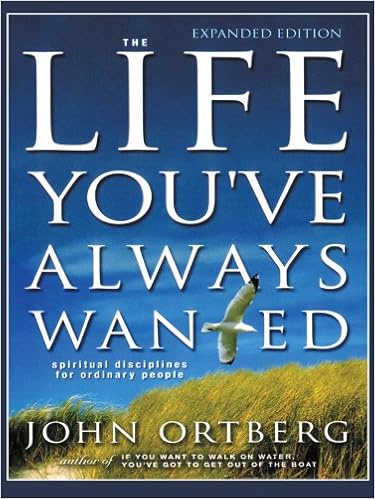
Chapter 4 of The Life You’ve Always Wanted

When I was a new believer, John Ortberg quickly became one of my favorite authors. His writing style captivated me. One book in particular which shaped me early on was his work on the spiritual disciplines. Ortberg focuses on some spiritual disciplines than one wouldn’t normally think of including in such a book. One of these disciplines is the practice of celebration, which is the fourth chapter of Ortberg’s book.

I’ll admit that there are likely a few things in the book, and even in this chapter that I might not fully subscribe to today. Nothing major, really. But I’d likely say things a bit differently and emphasize or deemphasize certain points. But this book and especially chapter four were foundational to my Christian growth. I believe there were seeds planted here which would later be watered by those like Sam Storms and John Piper—and my whole view of God and the Christian life would be altered.

Ortberg’s chapter begins with a story about his daughter Mallory. Mallory is filled with joy and excitement (much like my Hannah). She always did a dance that his family dubbed “the dee dah day dance”. Ortberg confesses that on one particular occasion he was annoyed by his daughter’s joyous dancing. He was in a hurry and didn’t have the patience for a Dee Dah Day dance. But when his daughter asked him, “why” it stopped him in his tracks. From this story Ortberg goes on to explain how God is actually the happiest being in the universe. His daughter was much like God in that moment. “God is the happiest being in the universe” (67), stated Ortberg.

This profoundly shaped the way I viewed God—and the way I thought God viewed me. For years I pictured God as a somewhat angry father who was just waiting for opportunities to be displeased with me. I never pictured him as being happy or filled with joy. “There is a being in this universe who wants you to live in sorrow, but it is not God” (68). God isn’t miserable, Satan is.

Ortberg goes on to suggest a few things for learning to practice celebration. Some of these are very helpful—like finding a joy mentor. I think today I’d likely add something a bit about how things like Bible reading and meditation can actually increase our joy in God. But at the time this was a paradigm shift for me. I began pursuing joy in a way that I hadn’t before. I started to realize that joy was actually a duty. I don’t think, I yet grasped what it meant to have joy in God (I’m still not sure I do), but this set me on a journey and laid a foundation which has been a key aspect of my walk with Christ.

Ortberg is a great author and his books are enjoyable. This book has some great insights that I’d still recommend even today. It might not be the first book I recommend on spiritual disciplines (Don Whitney’s would be). But I’d still encourage believers to give this a read, especially that fourth chapter.

You can pick up the book here. (Also, my copy of the book is the 1997 version—so I don’t know of any changes that have been made to the newer ones. That’s why the link will take you to the older one, but there is even a DVD series from this book you might want to check out).

Photo source: here

Read This! 12.13.18

Quarter of Churchgoers Don’t Take Day of Rest

Which I think also explains sagging attendance.

The Dangerous Gift of Discernment

This is a bit older, but worth a read if you haven’t read it.

10 Things You Should Know About the Kenosis Controversy

I kept hearing this in a class I took on John Calvin but never really studied it in depth.

7 Steps to Getting (And Keeping) Volunteers

That first step is a big one.

My Top 10 Theology Stories of 2018

I always enjoy reading this list each December.

Racism and the Legacy of Slavery Report

I’m happy this has been written.

The Pastor’s Wife Who Scraped Gum Off the Floor

Touching story.

4 Attitudes Killing Church Attendance

I feel like I already linked to this…if so, I’m sorry.

Is the OT still relevant today? Michael Kruger answers:

Is the Old Testament still relevant today? from credomag.com on Vimeo.

Simon the Magician and The Preacher’s Temptation

Now when Simon saw that the Spirit was given through the laying on of the apostles’ hands, he offered them money, 19 saying, “Give me this power also, so that anyone on whom I lay my hands may receive the Holy Spirit.” –Acts 8:18-19

There are quite a few blanks that we have to fill in for Simon’s story. Was his faith legit? Was his repentance real? I lean toward saying that his faith wasn’t legit and his repentance was more akin to that of Judas. But the thing he says which draws Peter’s ire is pretty clear. And it’s also pretty clear that it’s a temptation we pastors face as well.

The biggest problem for Simon is that as the Spirit is being doled out (and I’m slightly uncomfortable with that phrasing) he doesn’t want the Spirit—he wants to be able to dispense the Spirit. And that is where we pastors can be tempted to be just like Simon. It’s what we sometimes call Saturday Night Fever. Those times of desperation when the sermon isn’t coming together and we plead with the Lord to give us something to give to our people.

It’s true that our motivation matters. A shepherd with an empty pantry praying for miracle provision so his sheep don’t starve is different than the guy who is praying for abundance so his neighbor can envy his sheep pen. But I’ll admit that far too often self-interest is what motivates my midnight pleas for assistance. “Lord give me a Word so that I can give it to your people”. That has remnants of Simon’s requests in it.

Consider this great quote by John Owen: “If the Word does not dwell with power in us, it will not pass with power from us.” If I’m struggling with a Simonesque temptation then I’ll hear that quote and pursue the Word dwelling with power within me so that it’ll pass with power from me. That’s a bit more akin to Simon the Magician than Simon the Apostle.

You know there is an ever so subtle difference between wanting my kids to see me as a good dad and wanting to actually be a good dad. It’s the same for us preachers. Likewise there is a world of difference between wanting other to see the Spirit within us and actually having the Spirit dwell within us and working through us. It’s the difference between pursuing authenticity, or pursuing a thing (or Person) as it is, rather than pursuing a shadow of a thing.

We shouldn’t be surprised that a magician was trained in desiring the mere appearance of a thing. His whole life is built around the outer display not matching up to the inner reality. But God help us when we preachers become as magicians.

Photo source: here