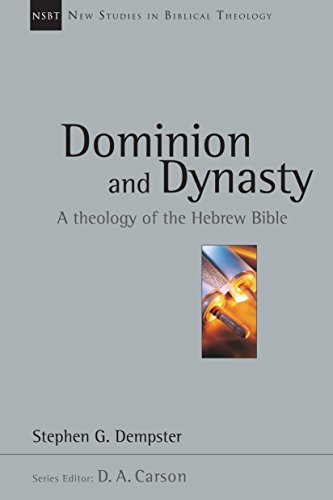
10 Chapters Which Shaped Me: Dominion and Dynasty

I have read many books in my three plus decades of life. My favorite is still The Monster at the End of This Book. It’s pretty hard to top that classic. I’m certain that in some way every book I’ve read has shaped me. But not all of them have been incredibly memorable. I can still remember the main gist of most of the books I’ve read, but that isn’t true of chapters. Yet there are some chapters which have absolutely shaped and changed me. To this end, I agree with John Piper’s statement: “Books don’t change people, paragraphs do — sometimes sentences.”

What I’m going to do over the next few weeks, likely on Friday, is share with you ten chapters which have shaped me. Obviously what has shaped me more than anything are the words of Scripture. But what I intend to do here are share ten chapters which are from borrowed lights. It’s my hope that this will inspire you to pick up these books and at least read these life-shaping chapters.

Chapter 1 and 3 of Dominion and Dynasty

I was assigned this book in my Hermeneutics class my second semester of seminary. This book is part of what is now one of my favorite book series: The New Studies in Biblical Theology. At the time my exposure of to the field of biblical theology was somewhat minimal. I had read a bit of Graeme Goldsworthy and an old book by Vos called Biblical Theology. The gospel-centered movement was in full swing and I was eating it up. But never before had I viewed the Bible the way that this book opened up my eyes to.

The main point of this book is that the Bible isn’t just a bunch of scattered texts but is one Text. That shouldn’t be such a revolutionary point to a guy raised in Baptist churches or who was firmly entrenched in the movement to say that every text points to Jesus, but the way in which Stephen Dempster made this point opened my eyes. I honestly didn’t even know at this point that the Hebrew Bible was in a different order to our English Bibles. Nor did I have any idea what the Tanakh was. I thought it was a Native American wrestler from the 90s.

Here is Dempster’s major point:

…just as an individual book within the canon can be read as a text with a beginning, a body, and a conclusion, with the various parts related to the whole and vice versa, so the canon should be read in the same way. (Dempster, 42)

From this point I was hooked. I cheated a bit by including two chapters here but it was the combination of the two which convinced me. It was one thing to buy into a theory of reading the entire Bible as if it was truly one story. It was quite another to see this put into practice. This is what blew me away in the third chapter.

Dempster tells the entire story of the book of Genesis in this third chapter, but he does it in such a way that the reader truly does see that all the stories are interwoven to tell one big story. He shows how Genesis really does lay the foundation for the rest of the Book. This isn’t just the beginning of time/Creation this is the opening chapter to the greatest book in the world. Seeing biblical theology done this way changed the way I see the Bible, the way I preach the Bible, and the way I see the world.

Though the book might be a bit scholarly for some I’d recommend anyone to give this a read—even if it takes a bit of wrestling and slow reading to understand the concepts. You might start with something like According to Plan, but I wasn’t truly able to see the beauty of doing biblical theology until I read through Dominion and Dynasty.

Read This! 12.20.18

How Should a Pastor Given an Account for Individual Souls

This is a link to a podcast, but it’s such an important question.

Shelter in the Shame Storm

Samuel James is one of my favorite writers, this is an example of why.

When the Soul Feels Its Worth

Such a great reminder.

An Open Letter to the Depressed Christian at Christmas

Thanks for writing this, David.

How to Listen Like a Counselor

A few tips at developing better counseling skills.

In Praise of (and in Defense of) Women’s Ministry

I really appreciated these thoughts by Jen Oshman.

There are some great Christmas-related dad jokes here:

Two Ways The Internet Can Mask Our Pride

I don’t spend nearly the time on social media I once did (that’s me saying I’m too busy for you chumps). But it seems to me that the #humblebrag has gone the way of the AOL disc. I’m grateful that we have to put up with fewer tweets where folks try to mask their pride with humility.

But this got me to thinking about the heart behind the humblebrag. And it also made me wonder if there are ways in which social media provides an unusual cover for pride. I can be a prideful goober who prides himself on people thinking that I’m humble and thoughtful and Christ-like in my interactions. I’ve been deeply convicted in recent months to be far more authentic—and not in the millennial-loving way of calling selfishness authenticity. I mean that I’ve been convicted that for much of my life I’ve been content to be seen a certain way instead of actually being a certain way. That’s the way of the Pharisee, plain and simple.

I want to share with you a couple of tricksy little areas where I’ve discovered covert pride. Maybe it’s just me on these things. Or maybe you’ll notice some of the same hidden roots of pride.

Hidden Pride in Facebook Groups

I’m in a few different Facebook groups which are mostly for pastors and church leaders. These are helpful in that they provide a private place to share some of the concerns or questions which we have. It’s helpful to talk to others and see what they do in similar situations. But I think it’s also a place where social media provides a unique opportunity for me to take a prideful position. What I mean is that it’s far more humble to seek counsel of an “I could punch you in the face” mentor than to ask a group of mostly anonymous and distant fellow pastors. I can ask a question and sift through the answers and take the ones I like. That’s much different than having an actual flesh and blood mentor where there is cost to the relationship. To not take advice from this guy is much different than just ignoring counsel on my computer screen. That doesn’t cost me a thing. Ignoring the counsel of someone who actually sees my life is a bit different.

So I can convince myself that I’ve done my due diligence and “sought counsel” but what I’ve really done is asked a question to a group of people who will give me a multitude of different answers. I get to pick the one I like. I get to ignore all the others with zero cost. And I can walk away from the whole thing thinking that I’m humble enough to be a question asker.

Hidden Pride in Not Responding

The ability to quickly block and ignore and shut off an argument on social media provides another unique opportunity for masked pride. And this one is also possible (and maybe even more frequent) in face to face conversations. Now it’s possible that refusing to engage another in an argument is a sign of wisdom and arrogance. You very well maybe following Proverbs 26:4. But it might also mean that you are actually not giving someone a chance to respond to your super-certain “gotcha”.

Let’s pretend that I just wrote a post on the errors of dispensationalism. (And because there are so many it’s going to be a lengthy article). Some silly person actually has the audacity to point out a few places where my understanding is lacking. But I realize this is the internet and people have the right (nay, the responsibility) to be complete morons. I can see the flaw in this fellas response to the article. And I realize that his argument doesn’t have a bit of merit, so I keep on scrolling and Proverbs 26 this fool. And this makes me feel all wise and humble because I’m not contributing to that one big food fight we call social media.

But here is what I’ve actually done. By not actually engaging this person in a discussion I’ve not allowed him to rebut my rebuttal. I get to keep my arrogant assumption that my rejoinder has silenced my opponent. But in reality he may actually have a response somewhere in there. But my pride simply has given myself the victory without actually engaging in battle. This isn’t giving a permission slip to engage in fruitless and foolish discussions. We need less of those. But maybe we actually need more thoughtful engagement where humility instead of pride is driving the bus. And humility will seek to actually understand and see if I can find truth in there somewhere, instead of the prideful assumption that this commenter is just one moron in the long line of internet trolls.

Conclusion

I’m still looking at this in my own life. I’d challenge you to do the same. Look for those places where pride is lurking in the shadows and pretending to be humble. As I said earlier I might be alone in this. After all I am the best at being prideful.

Thankfully the Spirit cuts through all the smoke. The gospel frees me up to take off the mask, acknowledge my stupid prideful heart, and actually pursue humility and honesty. And that’s where freedom is at. It’s being captivated and transformed by the gospel that will undo our pride and lead to actual fruitful interactions on social media and in real life.

Photo source: here

READ This! 12.18.18

Do the Gospels Borrow From Pagan Myths?

This claim pops up from time to time.

The Number 1 Reason for the Decline in Church Attendance

Bingo!

MultiChurch a More Biblical Version of Multisite?

This is kind of where I land.

Hard Times at Harvest

I’d be lying if I said I didn’t see this one coming.

Not Everything Needs a ‘Gospel Talk’

I appreciate the balance of this.

The Desperation that is Pastoral Ministry

Amen.

My Declaration of Faithful Disobedience

This is powerful stuff. And a reminder to pray for our brothers and sisters in China.

This is too close to reality to be incredibly funny: