Monday’s Ministry Musing: Angels and the Gospel

People are fascinated with angels.  This is not a new thing.  The church at Colossae (or at least false teachers there) had a fascination with angelic beings.  And I suppose they are quite fascinating.  But you want to know what is even more fascinating?  The gospel.

How crazy that angels long to “look into the gospel” (1 Pet. 1:12); we are bored with the gospel and long to look into angels.  What is even crazier is that this idiocy is probably part of what has the angels so baffled.  God redeems a humanity filled with idolaters, guilty of sin no less treasonous than the angels that he refuses to redeem.  The gospel indeed is precious.  If only we had the wisdom of angels to be enamored by all that Jesus Christ has done. 

I am saddened (though not surprised) that I would probably get a better hearing on a Sunday night with a series concerned with unlocking the mystery of the end times than I would a series unveiling the mystery of the gospel.  More people would probably take a class on angelology than they would on atonement. 

This is not surprising; angels are comfortable, the gospel isn’t.  You can talk to a stranger (even if he hates Christianity) about some angel named Gabriel.  Worse thing that will happen is that he will probably consider you a fruitcake and leave smiling.  But the gospel will get you killed.  I cannot remember reading of people getting persecuted to death for belief in angels.  And why would they?  Angels do not divide history.  Jesus does.  

Undoubtedly Satan, an angel himself, would be rather content with you spending your time concerned with angels instead of looking into what angels are concerned with; namely, the gospel of Jesus Christ.  What, then, is this thing that angels are concerned with?  “…that Christ died for our sins in accordance with the Scriptures, that he was buried, that he was raised on the third day in accordance with the Scriptures”.  This is what angels long to look into, and Satan longs to distract you from. 

This is filed under a Monday Ministry Musing isn’t it?  What does this have to do with ministry?  If you are one that preaches or teaches then you will face the temptation to assume the gospel and delve into flashy things, like angels.  But heed what Richard Baxter said:

Through the whole course of ministry we must insist upon the greatest, the most certain and necessary things, and be seldom and sparing upon the rest.  If we can but teach Christ to our people, we teach them all…Other things are desirable to be known, but these must be known or else our people are undone for ever. 

Yes, angels are cool.  But Jesus is much cooler. 

Why the Bible?

I’m sometimes asked about the relevance and/or importance of the Bible. After all, it is an ancient text that many consider outdated and irrelevant. In itself, this topic is vast enough and volumes of books have been written. But for now, I give a short answer of the importance and relevance of the Bible.

“God, our Maker, knows all about us before we say anything (Psalm 139:1-4); but we can know nothing about him unless he tells us. Here, therefore, is a further reason why God speaks to us: not only to move us to do what he wants, but to enable us to know him so that we may love him.” (J.I. Packer, Knowing God)

God is infinite. We are finite. His existence and being is totally incomprehensible to us unless he reveals himself to us. He gives us the revelation of his Word so that we can go to an authoritative source that he has secured so that we can know God.

The Scriptures are given to point us to God, more specifically, to point us to Jesus Christ. “You diligently study the Scriptures because you think that by them you possess eternal life. These are the Scriptures that testify about me.” (John 5:39).

You see, the Bible is God’s sure way of telling us who he is, revealing who Jesus is, and leading us to God through Jesus (John 14:6). And this is part of the reason why the Bible is relevant, important, and must be honored.

What a wonder it is that the Infinite, Holy, Absolutely Pure God would care enough to reveal himself to us so that we might know him!!!

Heresy, Error, or Truth? Irving’s Humanity of Christ

The point at issue is simply this: whether Christ’s flesh had the grace of sinlessness and incorruption from its proper nature, or from the indwelling of the Holy Ghost. I say the latter. I assert, that in its proper nature it was as the flesh of His Mother, but, by virtue of the Holy Ghost’s quickening and inhabiting of it, it was preserved sinless and incorruptible.

The above quote is by Edward Irving concerning the humanity of Christ.  Your task is twofold.  First answer whether this is heresy, error, or truth.  Secondly, if you believe it is heresy or error tell me why.  If you believe it truth, tell me why.
For clarity sake allow me to explain what Irving is saying in a very simple question.  Is Christ born with a sinless nature or is he sinless because of the power of the Holy Spirit?  Irving believed that Christ was born with the same corruptible flesh as His Mother but was sinless because of the work of the Holy Spirit. 
Every Tuesday for awhile we are going to be doing this exercise.  Sometimes I will attempt a response…other times I may not.  None of these are meant to “trap” or to expose you as a heretic.  These are simply to exercise discernment and deepen our theology.  In all things my aim will be to magnify (as you do with a telescope not a magnifying glass) the greatness of the gospel. 

Review of Your Church Is Too Small by John H. Armstrong

The name John H. Armstrong may ring a bell with a few of my readers.  He was the editor for a helpful book in the late 90’s called The Compromised Church: The Present Evangelical Crisis .  I had the wonderful opportunity to review his new book Your Church Is Too Small: Why Unity in Christ’s Mission Is Vital to the Future of the Church .  I cannot at this time offer my typical full review of the book.  The reason?  This book is causing me to think far too deeply to rush into a half-way done review.  I am still working through whether I “like” or “dislike” some of the things in the book.  It is causing me to rethink aspects of my theology and practice. 
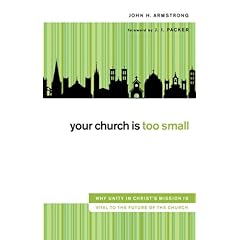
By way of review allow me to offer you a quick summary, a few helpful links, and a plea to buy the book and work through it. 

Quick Summary

  Armstrong has caught some flack in recent days.  His name was found among the McLaren’s, Bell’s, Miller’s, Warren’s, and Pagitt’s of our day in John MacArthur’s recent book The Truth War.  Armstrong has been sharply criticized for his move towards a broader ecumenism.  This book is perhaps a defense of that move. 

Armstrong’s major thesis is that our comfortable disunity with those in the body of Christ of different ecclesiology is sin.  In the first section Armstrong gives reason for such a broader unity.  He argues that the unity Christ calls for is not simply invisible unity but should be actually visible. 

In the second section Armstrong calls for a restoration of unity within the church and provides a few helpful pointers towards pursuing unity.  He identifies the enemy and begins paving a road towards a greater unity.

In the final section Armstrong outlines the “Missional-Ecumenical Church” as a new paradigm (or rather the recovery of an old one).  He gives a few comparisons to outline this new paradigm.  He closes the book by praying that the Lord may disturb us and call us toward that which he lays out in this book. 

What I cannot offer is my critique or commendation of this book.  I am still chewing on it. 

A few links:

http://www.yourchurchistoosmall.com/

http://johnharmstrong.typepad.com/

http://www.act3online.com/

Should You Buy It?

I would strongly suggest buying this book and thinking through some of the issues that Armstrong raises.  Whether you agree with him or not, you will learn much from what he has to say.  We do indeed need greater unity within the church.  I am not convinced of the sectarianism that is often rampant within our churches…but I am also working through whether or not I agree with that which Armstrong lays out.  I invite you to buy the book and work through this with me.