From the Pen of Newton: An Astonishing and Cheering Thought

After writing at length about discovering sin daily in his life and then lamenting that though he can see that his heart “is very deep and dark, and full of evil; but as to particulars, I know not one of a thousand!”, John Newton then bursts forth in doxology concerning the depth of grace.  Though our sinner is great Newton shows that our Savior is greater:

And if our own hearts are beyond our comprehension, how much more incomprehensible is the heart of Jesus! If sin abounds in us—grace and love superabound in him! His ways and thoughts are higher than ours, as the heavens are higher than the earth; his love has a height, and depth, and length, and breadth, which passes all knowledge! The riches of his grace are unsearchable riches! Eph. 3:8, Eph. 3:18, Eph. 3:19.

All that we have received or can receive from him, or know of him in this life, compared with what he is in himself, or what he has for us—is but as the drop of a bucket—compared with the ocean; or a single ray of light—compared with the sun. The waters of the sanctuary flow to us at first almost ankle deep—so graciously does the Lord condescend to our weakness; but they rise as we advance, and constrain us to cry out, with the Apostle, O the depth! We find before us, as Dr. Watts beautifully expresses it,

A sea of love and grace unknown,
Without a bottom or a shore!

O the excellency of the knowledge of Christ! It will be growing upon us through time—yes, I believe through eternity! What an astonishing and what a cheering thought—that this high and lofty One should unite himself to our nature, that so, in a way worthy of his adorable perfections, he might by his Spirit unite us to himself!

Could such a thought have arisen in our hearts, without the warrant of his Word (but it is a thought which no created mind was capable of even conceiving until he revealed it), it would have been presumption and blasphemy! But now he has made it known, it is the foundation of our hope, and an inexhaustible spring of life and joy. Well may we say, Lord what is man, that you should thus visit him!   (From Newton’s Letter Ten to Miss M).

Review of Excellence in Preaching by Simon Vibert

When I was in elementary school and just beginning to read my favorite books typically related to sports.  In those early years I gravitated towards books listing the top 10 shortstops, hitters in baseball, NFL rushers, hoop stars, etc.  I liked these books because they would assist my 4’3 fifth grade frame become a professional athlete.  Now some 20 years later I have long given up my dreams of filling stadiums for the sole purpose of marveling at my athletic prowess.  But could God ever use this preacher to fill an athletic stadium and provide the opportunity for gospel preaching?  And would I be assisted by a book listing the top 12 (plus the obligatory Jesus chapter) preachers of our day? 

Simon Vibert’s Excellence in Preaching is written with the hopes that looking at these twelve men will help

“preachers and their listening congregations have a better sense of why it is that some preachers connect hearers with God, inspiring, encouraging and motivating them to authentic Christian living, and enabling them to leave with a sense that through the preaching they have indeed met with the living Lord.” (13)

Vibert looks at the preaching ministry of Jesus and then twelve contemporary preachers: Tim Keller, John Piper, Vaughan Roberts, Simon Ponsonby, J. John, David Cook, John Ortberg, Nicky Gumbel, Rico Tice, Alistair Begg, Mark Driscoll, and Mark Dever.  In each chapter Vibert looks at a couple of sermons and tries to discover “What makes ______ a good communicator”.  He then closes up every chapter with a few bulleted points of application for preachers. 

Analysis

There is a positive and helpful aspect to this book and also one that could be relatively dangerous and unhelpful.  We will consider the dangerous first.

The dangerous aspect is not one that would catch Vibert off-guard as he seems to acknowledge this danger in a few places throughout the work.  With books like this there is always a danger of starting a “guru mentality or a cult following” (13).  John Piper (one of the subjects in the book) has written an entire book decrying the professionalism of ministry, entitled Brothers We Are Not Professionals.  Vibert’s book toes towards the pitfall of exalting superstar pastors at the expense of the “ordinary week-in, week-out preaching of the local church”.  (10) 

It has been pointed out before that many preachers that got their start in the 50’s and 60’s are cookie-cutter pastors.  The cookie-cutter that seems to be used for these pastors is the Reverend Billy Graham.  Some have even commented that these pastors hold their Bible like Rev. Billy and even though said pastor may have never been East of the Mississippi he speaks with a North Carolina accent just like Graham.  The danger then in a book like Vibert’s is that young pastors will take a shortcut by merely parroting the skills of successful pastors and thereby undercutting the work of the Spirit and neglecting the labor of honing their own unique giftedness.  If used in that way then this book is dangerous and unhelpful. 

Having said that I believe that Vibert does an adequate job of lifting up these succesful preachers and humbly considering the things that we can learn.  Yes, I wish that an entire chapter was given to dispelling the potential for this danger, but as a whole this book could be very beneficial to young pastors just beginning to preach. 

One of the things that Vibert does is list the specific sermon(s) that he analyzed for each chapter.  Given the media benefits of our day these sermons are readily accessible.  Thus a seasoned pastor could easily use this book as a guide for helping a younger pastor get his feet wet in preaching.  They could together listen to the sermons and then come up with their own bullet points and things to learn from the pastor under consideration.  Then the two could use Vibert’s chapter as a helpful launching pad for further discussion. 

Any pastor (new or seasoned) could benefit from this book, however.  I have been preaching for a little over ten years (hardly a veteran) and there was a great deal that I took away from this book.  Some things were reminders but there were some things that I had never really considered before that I think can make me a more effective communicator. 

Should You Buy It?

If you take to heart the danger inherent in the work then it could be vastly helpful.  It is not a theological treatise on preaching nor is it the only preaching manual that you should have in your library.  It is, though, widely beneficial.  It may even introduce you to the preaching ministry of some men that you have never heard of before.  I would suggest it as a helpful addition to any pastor’s library.

I received this book free from IVP.  You will have to buy it.  Thankfully the book is relatively inexpensive at Amazon (only 12.00).  Buy it here. 

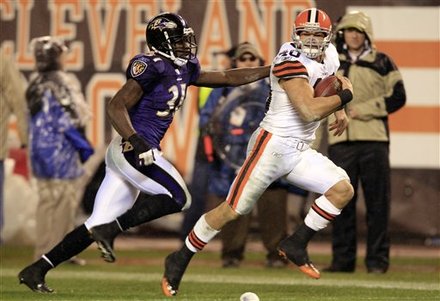
The Cleveland Browns and Christian Sanctification

Yes, being a Browns fan is a form of suffering—and suffering does tend to lead to sanctification.  But that is not the point here…

Yesterday, I listened to the Browns blow another winnable game to the Arizona Cardinals.  The Browns record this season is a deplorable 4-10.  Truth be told, however, if it were not for a few bonehead plays they could just as easily have a luck 8-9 wins.  (They are not good, they are not even close to a playoff team—but given their schedule this year they aren’t quite as bad as 4-10 would have us believe). 

The problem that I see with the Browns (and have noticed this problem for the past 3-4 years) is that rather than playing to win the Browns seem to be playing to “not lose”.  That is a subtle difference but it is huge; both in football and in life. 

One of the things that I have to do as a Browns fan is around week 12 or 13—when the Browns are already out of the playoff hunt—I pick a new team to cheer for.  I do not abandon the Browns I just become like every other Browns fan and wait for next season.  This year I am rooting for another underdog; namely, the Detroit Lions. 

Yesterday was a great comparison.  Down 27-21 with only a little time left in the game the Lions confidently and fearlessly put the game in the hands of Matthew Stafford and Calvin Johnson.  They marched down the field and won the game 28-27.  They were playing to win.

A few hundred miles East in Tempe Arizona the Browns and Cardinals were tied up at 17 with under two minutes left.  The Browns had the ball backed up deep in Arizona territory.  The Browns—as has been the case for most of the year—played to not lose.  They ran the ball, had a few dink and dunk passes that they probably hoped they would get luck on, and then ended up punting.  They eventually blew it in overtime having squandered what was once a 17-7 lead.  Why?  They played conservative and tried to “hold the lead”.  Same junk that has been happening all year.

Running to Win the Prize

What does this have to do with Christian sanctification?  In 1 Corinthians 9:24-27 the Apostle Paul says this:

Do you not know that in a race all the runners run, but only one receives the prize? So run that you may obtain it. Every athlete exercises self-control in all things. They do it to receive a perishable wreath, but we an imperishable. So I do not run aimlessly; I do not box as one beating the air. But I discipline my body and keep it under control, lest after preaching to others I myself should be disqualified.
(1 Corinthians 9:24-27 ESV)

In other words “race to win”.  You don’t get a prize for just showing up.  As David Garland notes, “they are to run as if their life depended on it.  It does”.  Many professing Christians are like the Browns, they are doing just enough to not lose the race.  Perhaps running aimlessly hoping that somehow they can blow enough time off the clock that they have a couple more points than the other team.  In the same way many believers do just enough (at least in their mind) to keep God happy—just enough to get them into heaven. 

That’s not the way Paul talks about living the Christian life.  Yes, I believe that we are held by grace and that none can snatch us out of the loving hands of Jesus.  But also firmly believe that the Scriptures teach the necessity of grace-driven effort in the Christian life.  Here Paul is saying we need to run to win the game and not to merely not lose. 

What does it look like to race to win?  Fundamentally, it is a daily grabbing hold of Jesus and resting in and enjoying everything that He has already purchased.  But it is a daily battle to believe the promises of God and to find satisfaction in the pleasures of God over and against all those fleeting pleasures that would turn our eyes away from the prize; namely, Jesus the Christ. 

So fight the fight of faith today as one that is trying to win the race and not merely not lose it.

For more on this I would suggest reading Tom Schreiner and A.B. Caneday’s excellent work The Race Set Before Us.  Or perhaps you would enjoy Dr. Schreiner’s more accessible work Run to Win the Prize.