I really like this:

(HT: 22 Words)
I really would like to work with Improv Everywhere:
I’m not sure this is meant to be funny, but I found it hilarious anyway:
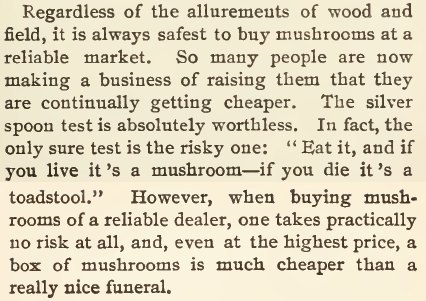
Very helpful mushroom advice from 1916:
I really like this:
(HT: 22 Words)
I really would like to work with Improv Everywhere:
I’m not sure this is meant to be funny, but I found it hilarious anyway:
Very helpful mushroom advice from 1916:
Justification: Five Views is edited by James K. Beilby and Paul Rhodes Eddy. The five different views are as follows:
Each contributor explains his view of justification for about 30 pages and then the other contributors offer responses. The conversation is cordial but it often felt like one of these would have been handy:
I agree with Tom Schreiner’s assessment:
It is both enriching and frustrating to have both biblical scholars and systematicians dialogue in the same book. On the one hand, it is enriching to have scholars from different disciplines interact with one another. Too often biblical studies scholars work in one corner and systematics professors in another and never does the twain meet! It is helpful, therefore, to see them interact with one another. On the other hand, since they are in different disciplines, it occasionally feels as if they are talking past one another.
I do not pretend to be anywhere near as advanced in my understanding of justification as men like Tom Schreiner or the contributors in this book. But I did notice that a few times it seemed as if everybody was talking about something different but using much the same words.
I am not saying that at the end of the day every contributor basically agrees. They have huge differences in their understanding. But what leaves the reader frustrated is that it seems that the contributors are talking about many different facets of justification and never even using the same tools to discuss them.
Perhaps the scope of the book is a bit too broad and the five views are too varied for this to really have a fruitful discussion. It may also be my own density in regards to the discussion. For me I felt that the essays were a bit too disjointed. It may have been better to have had a separate book (or perhaps separate and smaller chapters) on each facet of justification that was being discussed; i.e. a chapter on the meaning of pistis, a chapter on the Paul’s attitude toward Judaism, etc,. But as it stands I never felt as if the individual contributors really explained how their position is different from the others or why the differences matter.
Should You Buy It?
If you are new to discussions on justification in contemporary theology then I would not make this your first book into the discussion. Except for the first two chapters written by the editors. I felt that they did a tremendous job of framing the discussion and setting the discussion within its historical perspective.
However, if you are at least somewhat versed in the present discussions you will be helped by interacting (though not as much as one would like) with these varying viewpoints. The contributors are very cordial and fair with one another. And any reader will benefit from the first two chapters.
I’m not going to say rush out to your local bookstore to buy this book—but I do think that 15 bucks is a pretty reasonable price and for theology nerds like myself its a fun read and provides some helpful perspective.
You can buy it here.
A young convert that has taken up preaching—the Rev. Thomas Bowman—was quite timid in the pulpit. Part of it was his disposition, some of it may have been an unhealthy fear of man. To this young man Newton writes:
There is certainly such a thing as Christian prudence, and a remarkable deficiency of it is highly inconvenient. But caution too often degenerates into cowardice; and if the fear of man, under the name of prudence, gets within our guard, like a chilling frost, it nips every thing in the bud. Those who trust the Lord, and act openly with an honest freedom and consistency, I observe He generally bears them out, smoothes their way, and makes their enemies their friends, or at least restrains their rage; while such as halve things, temporize, and aim to please God and man together, meet with double disappointment, and are neither useful nor respected. If we trust him, He will stand by us; if we regard men, He will leave us to make the best we can of them… (From Letters of Newton, 123, emphasis mine)
“Temporize” is not a word that we use much anymore. In case you are not familiar with the word it means: to temporarily adopt a particular course in order to conform to the circumstances. By “halving things” Newton is speaking of taking the sting out of truth. He is referring to making things palatable at the expense of truth.
Those then who attempt to please both God and men end up disappointing both ends. They will not be useful to God and they will not be respected by men. Nobody respects a “yes, man” or a coward that refuses to speak truth as it is. So Newton (surprisingly to some) encourages this young man to fear the Lord, trust Him, and speak the truth with “honest freedom” and let God smooth out his rough edges.
I read this as a reminder to always check my conscience to determine if my “prudence” in a matter is really just cowardice. It is a running joke in our family that my answer to whether we can do something is usually “let’s wait” or “let’s let the dust settle”. Sometimes it’s prudence. Many times its cowardice. I want to have a heart and mind that is singularly focused on pleasing the Lord and as a result I want to live in humble boldness; because passive cowards are neither useful nor respected.
Death. Taxes. A Cleveland Browns losing season. Criticism. Four things that are pretty much inevitable. For those that engage in ministry criticism—whether unfounded or legit is inevitable. It really is true that you cannot please all of the people all of the time.
Consider the apostle Paul. Within the his recorded writings we can discern that Paul was taking criticism from many different opponents.  There were those of the legal variety who believed Paul was being loose on the law and too free in his grace. But then he often ticked off the other side too—those shouting race, unity, and love—believing the Paul was too light on grace and too strong on the law.
Those who were more legal in their understanding of the Scriptures would have loved the Paul of 1 Corinthians. They would have been the loudest members of the “Amen” choir as Paul exhorted the Corinthians to “purge the evil person from among you”. But as soon as Paul would say things like, “where sin increased, grace abounded all the more,” the amen’s would cease and the accusatory questions would begin. “So why don’t we just keep on sinning Paul? Your view of the gospel is directly opposed to the law. It has no regard for God’s holiness. If we follow your gospel then people will be all kinds of immoral”.
Of course at the same time that Team Legal is accusing Paul of subverting the law then Team Grace is clapping and registering for their seat in the “Amen” choir. They love hearing that grace covers over sin and that for those that are in Christ you cannot out sin his grace. But as soon as Paul would say things like “Let not sin therefore reign in your mortal body” then Team Grace would turn on him and accuse him of subverting the gospel.
You and I
If you are faithful in preaching the gospel you are going to upset those that are more legal in their understanding of the Scriptures AND you are going to upset those that herald a cheap grace that is marked by shallow unity and weak love. Both sides may argue with one another about the Scriptures but they will be united in their belief that you aren’t being faithful to the Scriptures.
The answer then is to keep preaching the gospel faithfully and ignore your critics.
Or is it…?
While it may be true that you are just faithfully preaching the gospel and those gospel haters are unfairly criticizing you, it may be just as true that you are wrong and only think you are faithfully preaching the gospel. You and I are just as prone to legalism and antinomianism in our lives and in our preaching as those that criticize us.
There are two chief dangers when it comes to criticism. First, is listening too much. Secondly, is not listening at all.
If you listen too much then you are going to ineffectively attempt to please everyone and as a result you will prove unfaithful in your sacred task of proclaiming the whole counsel of God. You need to faithfully proclaim the gospel and offend the antinomians as well as the legalists.
But not listening at all is just as deadly. There is a danger when getting leveled with criticism to assume that you are Paul and your detractors are one of the gospel-haters. But keep in mind that the antinomians and the legalists were pretty confident that Paul was the gospel-hater.
So what do you do with criticism? Three steps:
1. Humbly check your conscience. In Acts 23:1 among other places Paul references his “good conscience”. It seems that Paul was consistently listening to his conscience. If he had a nagging sense of guilt he dealt with it by the same gospel that he proclaimed. If you receive criticism get alone and get honest with yourself. Is their charge really baseless? Is it possible that you might have had a misstep? If so, clear your conscience by grace through faith and repentance.
2. Rest in grace. If this charge is baseless your conscience will remind you that there are a hundred other charges that are not baseless. You are held by grace whether this criticism is true or false. As Abraham Booth has said, “the Christian in such a predicament may just say, ‘Though I am free from the charge alleged, it is not owing to the superior holiness of my heart, but must be ascribed to divine, preserving care”. You do not need to needlessly defend yourself or your cause. Yes, humbly defend where it has a bearing on the gospel—but at the end of the day sleep well because grace reigns.
3. Live out the gospel you proclaim. The gospel reminds you that you do not have to be a perfect shepherd because Christ is. Our identity is wrapped up in the identity of the Good Shepherd who cares for us. Your fundamental identity before the Savior is not “pastor extraordinaire”; but it is child, bride, adopted, forgiven, servant, etc,. So by His grace and for His glory we must strive to grow and reflect Him. We do not strive to be accepted in his Kingdom as a pastor. We pastor because we are accepted in His kingdom.
I think following these steps is what Abraham Booth means by this:
“For even malevolent attacks and unfounded charges upon a Christian’s character, if his own temper is under proper government, may prove an occasion for promoting his best interests” (Booth, The Christian Pastors Manual, 97)