From the Pen of Newton: Not Being Content With a Little

…He has given us exceeding great and precious promises; has bid us open our mouths wide, and has said that He will fill them.  He would have us ask great things, and when we have enlarged our desires to the utmost, He is able to do exceeding more than we can ask or think.  May we be as wise in our generation as the children of this world.  They are not content with a little, or, even with much, so long as there is any probability of getting more.  As to myself, I am but a poor man in the trade of grace; I live from hand to mouth, and procure just enough, (as we say,) to keep the wolf from the door.  (John Newton to D. West from Letters of Newton, 130)

I think so long as I have an empty pack of jelly-beans, marshmallows, or any other sweets my children are not content until the bag is empty.  The same goes with other teeth-rotting products like soda.  Newton is saying that we should be like that.  We should never content ourselves with the level of promises that we have received but should be constantly pressing the Lord for more.  This is not selfish, stupid, or sinful this is holy, right, and good. 

May we be more like Jacob who wrestled with God until he received His blessing and less like Esau who flitted away the promise on a bowl of soup. 

—

Lest, I or Newton be misunderstood this is not fodder for your health and wealth TV preachers.  Jacob’s asking God to bless him had far more to do with covenant than it did with product.  This isn’t a call to “not let God go until he gives me my Mercedes”.  This is a call not be content until God destroys those feeble but boisterous desires for idols and replaces them with God-sized desires. 
Take More Than a Glance at Herbert’s The Glance

Earlier today I gave a few reasons why you should get to know George Herbert.  I gave you a couple of sample poems but this one I neglected to put in an already lengthy post.  For your benefit I have modernized the English but have not changed the words (i.e. “Vouchsaf’d” has become “vouchsafed”

     When first thy sweet and gracious eye
Vouchsafed even in the midst of youth and night
To look upon me, who before did lie
                         Weltering in sin;
       I felt a sugared strange delight,
Passing all cordials made by any art,
Bedew, embalm, and overrun my heart,
                         And take it in.
       Since that time many a bitter storm
My soul hath felt, even able to destroy,
Had the malicious and ill-meaning harm
                         His swing and sway :
       But still thy sweet original joy
Sprung from thine eye, did work within my soul,
And surging griefs, when they grew bold, control,
       And got the day.
       If thy first glance so powerful be,
A mirth but opened and sealed up again ;
What wonders shall we feel, when we shall see
                         Thy full-eyed love!
       When thou shalt look us out of pain,
And one aspect of thine spend in delight
More then a thousand suns disburse in light,
       In heaven above
(The Glance, From the Works of George Herbert)

I urge you to read through this slowly and think through what Herbert is saying—it is beautiful.  If “original joy” is enough to sustain us through many trials and temptations what “wonders shall we feel” when we are the objects of his “full-eyed love”.

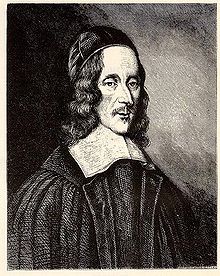
People You’ve Maybe Never Heard Of But Should: George Herbert

George Herbert was born in April of 1593 to a wealthy and artistic family in Montgomery, Wales.  Herbert attended Trinity College in Cambridge where he excelled in languages and music.  His intentions were to become an Anglican priest but his aims were thwarted when King James called him into parliament.  However, later in life (in his thirties) Herbert did take holy orders in the Church of England and became a rector of a little parish near Salisbury.  For the rest of his days Herbert faithfully served as the rector of Fugglestone St. Peter.  He died a month before his fortieth birthday of tuberculosis. 

Why You Should Know Him:

What sets Herbert apart from others is not only his stately nose undergirded by a faithful mustache, but also his beautiful poetry.  Herbert’s collection of poems entitled The Temple were given to Nicholas Ferrar instructing him to either use them for the “advantage of any dejected poor soul” or to burn them.  Thankfully Ferrar chose the former. 

Herbert also had a book of pithy sayings published after his death.  One of these sayings is probably familiar to you:  “His bark is worse than his bite”.  But more than anything Herbert’s poems are what set him apart from others.  Particularly cool are his “pattern poems” which take the shape of an object that the poem is about.  Regardless of the style, though, Herbert’s poems were always gospel-centered and aimed at promoting the beauty and majesty of Christ. 

Samples:

MY words and thoughts do both express this notion,
That LIFE hath with the sun a double motion.
The first IS straight, and our diurnal friend :
The other HID, and doth obliquely bend.
One life is wrapt IN flesh, and tends to earth ;
The other winds t’wards HIM whose happy birth
Taught me to live here so THAT still one eye
Should aim and shoot at that which IS on high—
Quitting with daily labour all MY pleasure,
To gain at harvest an eternal TREASURE.
(Colossians 3:3)

LORD, who createdst man in wealth and store,
    Though foolishly he lost the same,
        Decaying more and more,
            Till  he  became
                Most poor :
                With  thee
            O  let  me  rise
        As larks, harmoniously,
    And sing this day thy victories :
Then  shall  the  fall  further  the  flight  in  me.
My  tender  age  in  sorrow  did  beginne :
    And still with sicknesses and shame
        Thou didst so punish sinne,
            That  I  became
                Most thinne.
                With  thee
            Let me combine,
        And feel this day thy victorie,
    For,  if  I  imp  my  wing  on  thine,
Affliction  shall  advance  the  flight  in  me.
(Easter Wings)

Further Study:

There are many more poems from Herbert that will nourish your soul.  They are not only poetically brilliant but they also point to the fountain of life.  We live in a world of blogs and “quick reading” I invite you to look through some of Herbert’s poems and just sit awhile.  Read them a few times, they are profound and you will not catch everything on just a first glance. 

You can read the works of Herbert for free here:  The Works of George Herbert

Quick Review of A Quest for Comfort by William Boekestein

Baptist do not tend to do catechisms.  I don’t know why.  We should.  One particular catechism that is well written and quite helpful (though perhaps with a few baptistic tweaks) is the Heidelberg Catechism.  I knew very little about the catechism until I read The Good News We Almost Forgot by Kevin DeYoung.  Reading through this made me consider going through such a catechism.  As of now we are using Children’s Desiring God material for weekly Bible studies.  But that catechism remains in the back of my mind.

The Heidelberg Catechism and it’s benefits were brought to forefront of my mind again when I received a copy of William Boekestein’s latest children’s book The Quest for Comfort.  This children’s book chronicles the lives of the three men instrumental in writing the Heidelberg Catechism: Caspar Olevianus, Zacharias Ursinus, and Frederick III. 

You may be wondering who in their right mind would write a children’s book about three guys hardly nobody has heard of that wrote a little book that few people use anymore.  Boekestein offers a defense on the final page of the book saying, “this is no ordinary document, and the record of its birth is anything but boring”.  Boekestein then goes on to defend the importance of the Heidelberg Catechism. 

Previously I had reviewed Boekestein’s earlier children’s book; Faithfulness Under Fire.  In that review I noted that some of the material and some of the pictures might be a little too much for some children.  In this particular book there is very little that might fall into that category.  There is a picture of teenagers “drowning” but there isn’t much else that would provide such a caution. 

This book aims at teaching “us that deeply held beliefs and profound theological truths are worthy of the difficulties often faced defending them”.  Our children need to know that.  They need to be brought up knowing that there are some truths that are so precious they are worth fighting and even dying for.  This book helps children to discover that our “quest for comfort” often follows a road filled with suffering, but God is faithful and His gospel is worth it. 

Should You Buy It?

I may encourage a few families in our church (myself included) to begin going through the Heidelberg Catechism with their children.  If I do this I will certainly suggest that they read this children’s book with their kids first.  I know that my son would enjoy the book and would like to know the people behind the catechism that we are studying. 

You can buy it for only $7.50 and it is a great book to add to your family library. 

You may also want to read my review of Faithfulness Under Fire and also an interview that William kindly agreed to do with me.