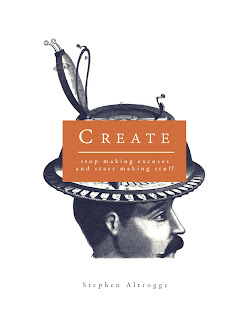
TweetNotes for Stephen Altrogge’s Create: Stop Making Excuses and Start Making Stuff

You can purchase this engaging and inspiring book for only $2.99 at Amazon.  If you are still on the fence I hope to encourage you to dole out the change tomorrow morning when I review the book. 

Yesterday I mentioned a new series here at Borrowed Light entitled TweetNotes.  Since this is project that needed a little creative boost to get off the ground it’s only fitting that Altrogge’s book would be the first.

1: Image-reflectors of the Joyous Creator are called 2 joyously create.

2: Those w/their identity rooted in God’s acceptance have no need to fear being creative.

3: Your sluggardly excuses for not getting started are lame.  #getstartedtoday

4: Babies produce more poop early on.  So will u.  #beokaywiththat

5: Spending time locked up in a cabin is 4 @unabombers.  Faithful, diligent plodding makes 4 creative work

6: Find a good routine. Make it a habit.  Otherwise you’ll watch TV.  #likeMatlock

7: If your project is honoring God, giving up is sin.  #dontgiveup

8: U need criticism; so don’t pout when God helps u through other people #likebloggers #peoplethatarenotyourmom

9: New ideas happen by living life.  So, live life.  #watchsunsets #holdhands #petpuppies #eatOreos

10: Stop waiting 4 people to reach out 2 u, serve others by actively sharing what God gives you 4 His glory.  #stophoarding

Today in Blogworld 5.31.12

A Graduation Message to a Digital Son From an Analog Dad

This one has been making the rounds the interwebs.  You’ve probably already read it but in case you haven’t it is a fun read.  It really shows the difference between the generations.  Oddly enough I think I may have more in common with the analog dad.

Dear Selfaholic

David Murray writes a note to himself about being obsessed with himself.


20 Things Pastors Hear in Counseling

I’ve heard, in various forms, many of these.  Every pastor ought to read through this list and consider how to respond biblically.  Even those that are not pastors will probably be confronted with a good number of these (maybe even in your own heart).  I would encourage everyone to read through these while the lights are on so you are more prepared when the lights go out.

13 Gospel-Centered Catch Phrases and 29 Bible Verses that Support Them

There are many gospel-centered catch phrases floating around these days.  I’m still trying to figure out how to do my gospel-laundry and eat my gospel-cereal in the morning.  All kidding aside it is important that as we become more intentional about assuming the gospel that we at the same time not assume that adding the word gospel makes something the gospel.  Eric McKiddie looks at 13 of these gospel-centered catch phrases and consider them biblically.  

Impressive:
  (HT: 22 Words)

Introducing TweetNotes

I would wager that every college and high-school student in America is vaguely familiar with CliffsNotes—even if they erroneously call the Cliff Notes.  These little survey’s have helped confused students navigate through the confusing Old English language of books like The Canterbury Tales.  Though some use them as a means to not read the original work they can be very helpful to grasp the overall structure and thought of a work of literature. 

Tony Reinke, in his helpful book Lit!, encourages readers to write all over their books and make them their own.  In his twelfth chapter he gives ten reasons to mark up a book.  His fourth reason states I write in my books to trace the skeleton of the book.  He continues

The publisher often leaves the reader with spacious white margins.  I fill those margins with my own notes as I trace the author’s arguments.  Often, after I have completed a chapter, I return to the first page of the chapter to jot down a simple summary.  My goal is to make a skeletal structure of the chapter more clear and obvious as I progress, especially in nonfiction books.  (Reinke, Lit!)

I have been doing things like this sporadically for years, but Reinke’s words here not only motivated me to be more intentional but they also gave me an idea to benefit not only myself but my readers. 

Introducing TweetNotes

For a little while now I have been more intentional in following Reinke’s advice.  After every chapter I have attempted to summarize the chapter in the form of a tweet (140 characters or less) and compile these to organize the entire argument of the book. 

The first TweetNotes will be posted tomorrow as I review and interact with Stephen Altrogge’s latest book Create: Stop Making Excuses and Start Making Stuff.  I hope to also go through many of the books that I have already read and compile TweetNotes for your benefit and mine. 

I encourage you to pick up a similar practice.  It keeps you engaged in what you are reading and it forces you to really chew on a chapter to digest it into 140 characters or less.

Today in Blogworld 5.30.12

The Tale of the Bicycle and the Typewriter

I found this little slice of history quite entertaining.  Here Justin Taylor interacts a little with Alister McGrath’s new biography on J.I. Packer.  One can only imagine how our world would have been different had Packer’s parents given him a bicycle instead of a typewriter. 

William Still Sermons Online

I have never listened to a William Still sermon.  However, I did greatly enjoy his little book The Work of a Pastor.  If his preaching is anything like his admonishments to other preacher then I figure these will be quality sermons to listen through. 

Newest Journal of Biblical Counseling Now Online

Volume 26 | Number 2 is now online.  Inside is an article by Timothy Lane on Addictions, Winston Smith on What’s Right about Sex, David Powlison on How Does Scripture Change You?, and a couple helpful articles for those dealing with a counselee with suicidal desires as well as an article on helping a teenager in crisis.  As with most everything CCEF puts out this is worthy of a read. 

Connecting Theological Depth with Missional Passion

Our church plans on implementing The Gospel Project this fall—at least in our children and youth departments.  If you have yet to hear about it (regardless if you are SBC or not) you really ought to check out this curriculum.  Here Ed Stetzer and Trevin Wax discuss the theological mindset that undergirds this project. 

I have yet to watch this but I am really interested to view it.  Justin Taylor interviews John Piper and his successor, Jason Meyer: