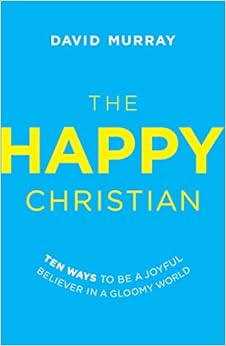
 1. What is your hope for this book?
I have two aims in this. First, I want to make Christians happier, to grow in Christian joy, not only because we’re commanded to, but also because of the demonstrated benefits of happiness in every aspect of our lives. Second, I want to draw non-Christians to the Christian faith by showing the positive benefits of joyful Christianity, not only for eternity, but also for everyday life.
The book identifies the causes of the demoralizing plague of negativity, both in society and the church, and proposes 10 biblical and practical methods to re-balance our attitude, outlook, words, and actions in a way that will lift the spirits of Christians, compel attention for the Christian faith, draw people to Jesus, and make the church a beacon of hope in a world of despair.
2. Why did you choose the word “happy” instead of “joyful”?
I understand why some people hesitate to use the word “happy.” Many Christians want to distinguish it from “joy”, probably because “happy” has become so associated with worldly views of happiness or even superficial Christian views of happiness. However, as I read the early church fathers, the reformers, the puritans, and other more recent Christian teachers such as Spurgeon, Lloyd-Jones, and John Macarthur, I realized that the best Christian minds in church history had no hesitation in using “happy” as descriptive of the Christian life. In fact it’s in the Bible in quite a few places (see your concordance!). Just because some people have abused the word, doesn’t mean we shouldn’t use it. Rather we need to reclaim it and fill it with biblical meaning and significance.
3. Which of your chapters do you think the church of today needs to hear the most?
The chapter on how to use the media, both as consumers and creators of it, is vital if we are to reduce the amount of damaging negativity in our diet. The other chapter I hope the church takes to heart is the chapter on biblical diversity where I make the case that including more diverse people (i.e. different colors, races, ethnicities) in our personal and church lives will be a net positive rather than a negative.
4. I notice that you make many secular references in your book. Even on the back of the book it says, “A unique combination of biblical teaching, scientific research, and personal biography”. You likely knew that some would be turned off by the inclusion of many secular sources. Please explain why you included so many secular resources.
That’s partly explained by the origins of the book. Over the past few years, there have been a number of bestselling books on happiness and especially the scientific study of happiness (e.g. The Happiness Project, The Happiness Advantage, The How of Happiness, etc.). As I was reading these popular books, I thought, “This is fascinating and even helpful; but surely, as Christians, we can do even better. If scientists can discover many techniques to make people happy, surely Christians have many truths to make people happy.”
But I also found it fascinating and very faith-confirming to notice how much the research confirmed God’s Word. In God’s common grace, He has enabled scientists to discover many insights into happiness and techniques to promote it. For example, research has confirmed the strengthening influence of joy in every area of life, the positive benefits of praising and encouraging others, that giving produces more happiness that getting, that it’s more blessed to give than to get.
It’s just a pity it took scientists a couple of thousand years to find out what God had already revealed as the way to a happy and blessed life! And of course, while science can guide us to a limited degree of happiness for a short period of time, only the Bible can guide us into a happiness of infinite depth and eternal duration.
5. Some have said that in our churches we don’t have a language of lament. You are saying we’ve lost our ability to speak joyfully. Could you please speak to this?
I agree that we’ve lost the language (and feeling) of lament, and I’m not arguing for less of it. But proper lament should end in joy! With one exception, all the Psalms of lament end in joy. I believe it’s a mistake to separate lament from joy. The Bible makes very clear that the only way to joy in the Lord is through conviction of sin. One of the reasons we have so little joy is that we have so little confession. As the Apostle Paul put it, he was “sorrowful, yet always rejoicing” (2 Cor. 6:10).
6. You mentioned on page 2 that our genes explain about 50 percent of our happiness or lack of it. What role does the gospel play in this? Do you believe God ever transforms even our baseline percentages?
Research has shown that about 10% of our emotional state is related to our present life circumstances, and about 50% is our genetic makeup. That still leaves 40% that’s made up of our daily choices about what we choose to think upon, say, and do. But, of course, these statistics take no account of the Holy Spirit, who can easily change the scientific unchangeables. It goes back to the basic argument of my book: “If science can increase our happiness so much, then surely the Gospel can do even more.”
7. Lastly, when I think of Scotland I think of long flowing beards. Why the naked face?
I make up for it with my hairy chest.
Thank you for taking time to answer these questions. The Happy Christian will undoubtedly be one of my top books of 2015. It has been life-changing for me and I appreciate your work here. I’d encourage every one of my readers to pick up a copy of The Happy Christian.
Like this:
Like Loading...
 Fourteen year old Jerry was diagnosed with muscular dystrophy (MD). From day one of the diagnosis he started praying that God would heal him. This is understandable. MD is a terrible disease that will continue to weaken his muscles. As a young man this diagnosis is the death of many of his dreams. Life will never be “normal” for Jerry.