Today in Blogworld 05.16.16

Stop Calling Your Wife Hot

Amen.

What Should We Do with Books by Fallen Leaders?

Tim absolutely knocks this one out of the park.

The Secret of Consistently Reading

Aaron shows us that planning to read is half the battle.

Jesus Died For Your Depression Too

I need this reminder often.

I’m Still a Complementarian…And There’s Still that ‘But’

I appreciate what Thabiti is saying here.

What you really need today are baby goats in sweaters:

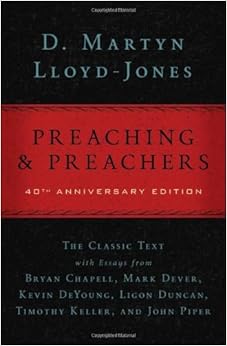
Reading Through Preaching and Preachers Chapter Nine

In the ninth chapter Lloyd-Jones advances his argument to discuss the preparation of the sermon. He rightly notes that the first thing which must be prepared is the preacher himself. Before working on preparing a message the pastor needs to have his own soul aflame with God’s Word.

The Doctor gives a list of ways in which we ought to prepare ourselves for preaching. This extends far beyond just praying before the sermon or while you are writing out the sermon. This is the preacher preparing his entire self in all aspects of life. First and foremost the preacher must be a man of self-discipline. He must live a holy life.

Secondly, Lloyd-Jones notes that “prayer is vital to the life of the preacher.” (181) This includes “warming oneself up” to preach, but it also being  man who responds to every impulse to pray. We must pray for our people as we are preaching to them.

The preacher must also be a voracious reader. He must be a student of the Bible and not just for sermon preparation. Not only should he read his Bible systematically but also he should be reading to nourish his soul. But it is not just the soul which needs nourished it is also the mind. All in all the preacher should have a balanced diet of reading—moving from apologetics to devotional. Again this is not just for sermon preparation this is to nourish the pastor and make him a well-rounded man.

Lloyd-Jones closes out the chapter with a brief comment on the benefit of music. But what is needed more than anything in all of this is that the preacher know himself and be diligent in preparing himself before preparing sermons.

Tweet Note:

Before the preacher prepares his sermon he must first prepare himself.

Quotables:

You have to learn how to kindle a flame in your spirit, to warm yourself up, to give yourself a start. (182)

Above all—and this I regard as most important of all—always respond to every impulse to pray…So never resist, never postpone it, never push it aside because you are busy. (182-83)

One of the most fatal habits a preacher can ever fall into is to read his Bible simply in order to find texts for sermons. (184)

Much harm is often done by advising people to read the wrong type of book. (188)

Preachers who have to go to books to get sermons are generally caught out! (191)

It is tragic when men become mere gramophone records, or tape-recording machines with the same thing being churned out repeated endlessly. Such a man will soon become barren; he will soon be in difficulties; and his people will have recognized it long before he does. (192)

You will find that there will be periods, perhaps even days, even weeks, when for some amazing reason your mind is working at its very best, and you are in a fecund condition finding ideas for sermons everywhere…when that happens, hold out both hands, take it all in; write down on paper as much as you can, so that when the dry and barren and arid periods come you will have something to fall back upon. (194)

Questions:

  • Lloyd-Jones encourages preachers to “safeguard your mornings!”. How do you do this? Do you agree that the morning is the time which needs to be safeguarded?
  • What does MLJ mean that nothing is more important than that a man get to know himself? Do you agree?
  • Side note: I find it interesting that MLJ said, “I abominate ‘devotional’ commentaries” and yet his “commentaries” on Romans and Ephesians are just that.
  • What does he mean when he says, “the preacher should never be moody; but he will have varying moods”?
  • Do you have a balanced reading diet? What can you do to improve this?
  • Can a man be called to preaching if he doesn’t like to read? What if he is a poor or a very slow reader? (Question from page 195)

Today in Blogworld 05.13.16

Success is Dangerous

Have I linked to this before? If I haven’t it’s worth your read. If I did, read it again.

9 Marks of a Christian Family

Just claiming the name of Christ doesn’t mean your family is modeled after Christ.

Five Awkward Conversations Every Teen Needs to Have with Their Parents

Thankfully I’m not dreading all five of these.

Don’t Just Pray Alone

This is important.

Why You Need the Church (And Not Just a Campus Ministry)

For their good, tell your graduating seniors this!

I’m a master of the awkward high five:

Balm for the Weary Soul

I’m struggling to find the right words to say what I’m hoping to say here. 2 Timothy 4:14-18 has been such a balm for my soul lately. But in order to explain why it has been such a tremendous blessing to me I have to talk about the yucks and the fears accompanying pastoral ministry. Yet, I don’t want to be one of those dues who groans and complains about pastoral ministry. Pastoral whining isn’t one of the spiritual gifts.

So please bear with me for a moment as I walk through the mire and muck so that I can get to the beauty of 2 Timothy 4:14-18.

I’ve been battling feelings of loneliness. At this stage it is just feelings. But there is something about uprooting your family and moving hours away from everyone you know that is rather unsettling. You meet new friends. You build new relationships that will be deep and meaningful, and thankfully you are able to hang onto old friends that you treasure. But there at these beginning stages in a new place it’s tough.

There is an old story, that is probably reality in a thousand different churches, of an angry old deacon who says to the young preacher, “Young man, I’ve outlasted the ten preachers before you and I’m going to outlast you as well.” In other words, “I won’t be the one experiencing change…you will. You’ll be the one who has to uproot your family again. I’m staying right here.”

And he’s right. We pastors who aren’t homegrown but transported in, really are outsiders. By the grace of God we become family. We build those deep relationships that will last into eternity—but at the end of the day we don’t share the same history of place as most of our congregation. So, at least in this young pastor’s heart, there is an under current of fear that there is always present a real possibility that my family and I will end up alone again.

I share all of that to say this is why 2 Timothy 4:14-18 has been ministering so deeply to my soul. Because Paul found himself absolutely alone. “Alexander the coppersmith did me great harm”, Paul says. We don’t know the details but every pastor will likely have his own ‘Alexander’. And for some we might experience verse 16, “no one came to stand by me, but all deserted me”. I pray that I never experience that first hand. But it’s a possibility, and if a pastor let’s the devil focus his eyes on that possibility you’ll have many sleepless nights.

I’m convinced this little snippet from the life of Paul is in our Bible to help pastors like me go to sleep at night. Because Paul experienced the very thing I’m afraid of and he was “rescued from the lion’s mouth”. Here are four lessons I’m learning from this passage.

  1. Bitterness is not an option. We see in verse 16 that everybody left Paul. If I had written 2 Timothy I think I’d have made a list of the deserters and prayed that funny prayer about God turning the ankles of our enemies so we can see them by their limp. But Paul doesn’t do that. Paul, just like Jesus and the godly Stephen he martyred before him, prayed that God would forgive his deserters. This is the heart of a pastor.
  2. The Lord will stand by me. Isn’t this enough? My goal is to be faithful to the Lord and to humbly and boldly preach His Word. If he says, “Well done” and everyone else leaves then His commendation will sustain me. My fear creeps in when I’m wanting more than His applause.
  3. His strengthening me has a purpose. Paul says that the Lord stood by him and strengthened him, “so that through me the message might fully be proclaimed…” If I make my life and my ministry about me then I’m going to have sleepless nights and every bad thing that happens is going to be traumatic. But if my singular aim is to see God glorified and His gospel be preached, this is an unstoppable mission. He isn’t strengthening me to make stronger and  happier—he’s likely doing it to pour me out again.
  4. He will bring me safely home. There will be no evil deed against me which will ultimately stick. Nothing that happens can shatter my foundation. Even if totally deserted and kicked to the curb. Even if I become a ministry statistic. The Lord “will rescue me from every evil deed and bring me safely into his heavenly kingdom”. This allows me to minister with boldness and reckless abandon. It’s not ministry results that will bring me safely home—it’s Him. And because my security is wrapped up in His unchanging character I have an unshakeable hope.

I think what Paul says here can provide comfort to anyone. Not just us pastors. But as a pastor I’m really finding nourishment from this. I pray that this little reflection will nourish another weary soul as it has mine.

—

Photo source: here