
Review of Live No Lies by @JohnMarkComer

9780525653134When I was a college student I was involved with a group of other students engaging our community with the gospel. Our vision was simple. Adopt a block. Go back every week and ask if we can pray for them. Share the love of Jesus as we are able.

On one occasion, I met a man who was of a different faith. As chance would have it, I had just studied on that particular religion in my world religion class. I was primed to engage. But the Spirit, I believe, stopped me dead in my tracks and just gave me one question to ask the man. “Do you have peace?”

I ended up praying that he wouldn’t sleep until he had peace. God answered my prayer. He didn’t sleep for a few days and eventually we were able to share with him the peace that Jesus gives. I share that story because I think the question I asked that man on that day would be a good one for any of us (even professed followers of Jesus). Do you have peace? Is the life you are living one that is marked by peace or something else?

John Mark Comer has written Live No Lies, because he too has noticed that we are not a people marked by peace. Comer believes he knows the problem. As he writes, “the world, the flesh, and the devil are alive and well; and aided by our skepticism, they are wreaking havoc in our souls and society.” (xxii)

For centuries Christians have identified the world, the flesh, and the devil as the great enemies to our soul. Live No Lies is a reinterpretation of these ancient categories for our contemporary society. Comer’s translation of those categories looks like this:
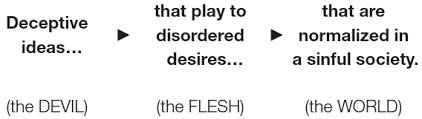
3-enemies

The book is then divided into these three categories. How has the devil given us deceptive ideas? How does our flesh with it’s disordered desires interact with these ideas? And how does our society normalize these wrong ideas about reality?

The Devil

Each section also has a helpful “step sheet” which can be used to summarize the main thoughts of each part. Comer summarizes part 1 (the devil) this way:

The devil’s goal is to first isolate us, then implant in our minds deceitful ideas that play to our disordered desires, which we feel comfortable with because they are normalized by the status quo of our society. Specifically, he lies about who God is, who we are, and what the good life is, with an aim to undermine our trust in God’s love and wisdom. His intent is to get us to seize autonomy from God and redefine good and evil for ourselves, thereby leading to the ruin of our souls and society. (99)

The way to combat this goal, says Comer, is to engage in quiet prayer and Scripture reading.This sounds overly simplistic, but he is correct. It is simple, not simplistic. This was the way of Jesus and it has been the way of the church for many centuries.

Comer is certainly correct that the preferred tactic of our real enemy is to implant deceitful ideas into our minds. We see this from Genesis 3 onward. It is important to see how these ideas move from our minds to our hearts, as well. Ideas are always intending to land in the heart.

I appreciate that Comer puts a great deal of focus on ideas. I think he is correct that as we’ve dismissed the idea of the devil we’ve sort of adopted the notion that ideas are neutral and innocent. Telling someone to watch what goes into their minds, feels like Pharisaical advice from days gone by. But what if it isn’t? What if we would be far healthier and happier if we had a steady stream of truth going into our minds instead of devilish ideas?

The Flesh

When the devil gives a devilish thought it finds a ready home in the unredeemed heart fueled by disordered desires. Sadly, there is often a ready home in the remaining corruption within believers as well. Comer summarizes this section thusly:

The devil’s deceitful ideas are not random; they appeal to our disordered desires, or what the New Testament writers call the flesh. The flesh is our animal side, the primal, instinctual drives of self-gratification and self-preservation. The solution is not to white-knuckle our way through but to live by the Spirit via practices that enable us to draw on the power of God to live in freedom. (189)

One of the best things that Comer brings out in this section is the older idea, lost in our time, that “our strongest desires are not actually our deepest desires” (121). These deeper desires are “often sabotaged by the stronger surface-level desires of our flesh” (122).

Comer does a great job of showing how if we allow these stronger desires to win we end up shackled by our own impulse for freedom. His chapter on the law of returns may be worth the price of the book. It’s a helpful reminder that actions have consequences. I think our society gets this when it comes to things like finances, health, etc. but we seem to not connect this with what it means to follow our desires. I appreciate Comer’s work in this area. Choice eventually forms character. And as Comer says, “Character is destiny” (166).

The solution is to live by the Spirit. Here, the author encourages spiritual disciplines such as fasting and confession. These are things which reshape our disordered desires and help us keep in step with the Spirit. The section on fasting may be one of the best explanations and encouragement to fast that I have read.

The World

We not only have devilish thoughts which connected to our disordered desires but we have an entire society ready to celebrate us on our foolish plunge into ruin. Comer summarizes our final enemy this way:

The devil’s deceptive ideas get as far as they do because they appeal to our flesh’s animal cravings. But these in turn find a home in our bodies through the echo chamber of the world, which allows us to assuage any guilt or shame and live as we please. As a result, evil is often labeled good, and good, evil; and the soul and society devolve into a reign of anarchy via the loss of a moral and spiritual true north. In such an exilic moment, the church as a counter-anti-culture has the potential to not only survive but also to flourish as a creative minority, loving the host culture from the margins. (243)

Comer does a great job of showing why believers cannot be at home in the world. But he also does a great job of showing how this should fuel our mission instead of leading to discouragement. I think he is spot on when he says this:

Right and Left are no longer two opposing sides that keep each other in balance; they are two rival religions locked in holy war with zealots fighting it out online and, increasingly, on the streets of cities like Portland or the halls of DC. (214-15)

The world is a polarized echo-chamber. Christians cannot afford to be swept up into this way of thinking. We are called to be a remnant—to gather with our church and be different from the world (both on the right and the left).

Conclusion

Comer’s book is certainly thought-provoking. Knowing his majority audience, Comer is bold in some places. The context in which he ministers is not going to appreciate some of what Comer says about what he believes to be a biblical sexual ethic. There are also places where some of his readers (perhaps in a more Bible Belt environment) may not think Comer went far enough.

Personally, I think he strikes a good balance and his overall thesis is worthy of consideration. It is helpful to consider what devilish thoughts may have crept in? Where am I being exposed to lies? And how are these attaching to my disordered desires? I also found myself thinking about my surroundings a bit more. Which devilish ideas would have a ready home in the “world” around me? Both on my social media “world” and the real world in which I live.

His chapter on “law of returns” was particularly helpful and challenging for me. I’m 40 and thinking through many things in life. It helped me to think about how I’m investing in my children and family and church and society. It encouraged me to put rhythms in my life to nurture some things and mortify others. This alone will mean that this book was beneficial to me personally.

This is a book I would recommend. You can purchase here.
How is Repentance Connected to Good News

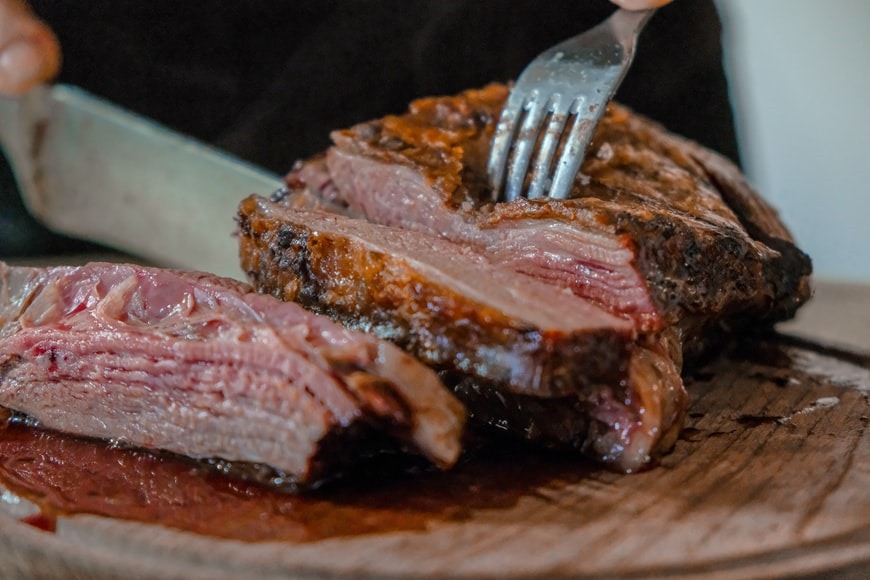
photo-1529692236671-f1f6cf9683baYou are given a plate as you enter the buffet line. Your friend had been raving about how wonderful this buffet was, and he finally talked you into coming. To be honest, you’re not very pleased with the selection. The selection is horrible, the meat looks only a step above a Carl Buddig ham sandwich, and the mashed potatoes are clearly from a cheap box of instant taters. But you dutifully fill up your plate—hoping that the drinks will help you was down this poor excuse for a buffet.

Just as you begin to sit down you notice a little room off to the side with a long line protruding from it. You have a little space left on you plate, so you step in that line in the hopes that you’ll be able to scooch over your soggy mac and get a little slice of edible pie or something. As you get closer to this buffet you realize that the meat is prime, the sides are delightful, and the vegetables look shockingly edible.

But you’ve only got a little spot left on your tray. What do you do? Do you double down and decide to just eat your “chicken that tastes like wood”, do you try to just pile the good stuff over top of the nasty, or do you ditch the whole tray and start fresh?

If you decide to dump the tray entirely you’ve engaged in what the Bible calls repentance. In the above scenario the decision seems obvious. And it seems obvious because there is something missing, emotionally, in the story. You aren’t dedicated to your pig slop in the above scenario. You realize that the mashed potatoes are boxed taters, you aren’t duped into thinking they are luxurious. The world, our flesh, and the devil are far more tricksy. But I share that above scenario to help Mark 1:14-15 make sense.

14 Now after John was arrested, Jesus came into Galilee, proclaiming the gospel of God, 15 and saying, “The time is fulfilled, and the kingdom of God is at hand; repent and believe in the gospel.”

We don’t tend to think of repentance as good news. But here Jesus is “proclaiming the gospel of God” and it seems that the context of this proclamation is that “the kingdom of God is at hand” and the only fitting response to this good news is to repent and believe that good news. We tend to think of repentance as the stuff of bitter battles and sorrowful and shame-filled stand-offs. But good news is actually what causes us to drop our slop bucket and stand in the line for the good stuff.

I’ve said before that I think the Puritan, Thomas Watson, might have gotten it backwards when he said, “until sin be bitter Christ will not be sweet.” I wonder if the beauty of the gospel is that the sweetness of Christ is what exposes the emptiness of sin.

When Jesus says that “the kingdom of God is at hand” you really only have three options.

1. Pit your kingdom against his

2. Try to add his kingdom to our own

3. Allow his kingdom to replace ours.

This is why Jesus says what he does about repentance and believing the gospel. By gospel he doesn’t mean the quite the same thing that Paul meant in 1 Corinthians 15. It would be a bit odd for Jesus to tell people to trust in his death and resurrection when those events have not yet happened. Instead what Jesus is calling people to do is to trust in the goodness of God’s kingdom, and entrust themselves to Jesus as the King of that kingdom. He is calling people to turn away from their own kingdom and replace it with His kingdom.

Drop your stank food entirely, grab a new plate, and feast upon the delicacies of Christ. That is the call of Mark 1:14-15. And we see this illustrated in the next passage. The calling of the first disciples is an apt illustration of what it means to “repent and believe the gospel.” It looks like “and immediately they left their nets and followed him”. They could have told him to buzz off. They could have attempted to add Jesus to their fishing business. But the beauty, as well as the demand, of Christ does not allow for these options.

Photo source: here

When the Spirit Casts Jesus Out

photo-1517513161821-807b5cb427fb

I will tell of the decree:The Lord said to me, “You are my Son; today I have begotten you. 8 Ask of me, and I will make the nations your heritage, and the ends of the earth your possession. 9 You shall break them with a rod of iron and dash them in pieces like a potter’s vessel.” –Psalm 2:7-9

At Jesus’ baptism the Spirit descends upon Him and the Father proclaims, “You are my beloved Son, with you I am well pleased.” It’s obvious that in this declaration there is a call back to Psalm 2.

So what happens immediately following this inauguration? Psalm 2 would seem to indicate that the Son of God will take up sword and begin his quest of kicking tail. But it’s not. The shift in Mark is jarring, sadly broken up by our section divisions.

“The Spirit immediately drove him out into the wilderness.” –Mark 1:12

The word for “drove him out” is ekballo. It’s a word that is most typically used by Mark of Jesus driving out a demon. When you’re a bouncer and you need to remove some cat who doesn’t belong, you’d use ekballo to say you bounced him out on his head. Matthew and Luke use a different word (anago). It’s less jarring. It has the Spirit leading—or guiding by the hand—into the wilderness. Mark uses a word that would bring to mind a whip instead of wooing word. 

At this point commentaries and sermons tend to get caught up on the dynamic between the Spirit and the Son. Did the Son not want to go and so had to be driven? Of course not, but that’s getting sidetracked from what Mark is actually telling us.

Jesus’ baptism is a moment of glory. Then the Spirit enters in, like a bouncer, and throws Jesus out into the wilderness. It’s almost as if the Spirit is saying, “The Son doesn’t belong in this locale (pointing to glorious things) but in that (pointing to the place of the jackals and all things barren).

That is what Mark is doing here. But why? Why is he doing something a little different than both Matthew and Luke. I would propose that part of the reason is because Mark’s audience is largely Roman and they have a certain glory-bent that would grab ahold of this beloved Son and make him a warrior king instead of a Suffering Servant.

Mark’s whole gospel is driving to one beautiful declaration, “truly this man was the Son of God!” But what kind of Son of God is he? Mark labors for sixteen chapters to show us that he is the kind of Son of God who will choose a cross over a crown, spittle over splendor, pain over pomp.

Don’t mistake Mark’s message, though. Jesus does belong in glory. But the Spirit drives him out into the wilderness (fully in accordance with His own pleasure) because this is where humanity has placed themselves. We are “where the wild things are”. Therefore he must conquer our enemy in the wilderness.

I remember being taught that the safest place to be was smack dab in the center of God’s will. I understand the sentiment, but I don’t think the wilderness is every the safest place. But it’s a necessary place. Just as Mrs. Beaver said of Aslan, “he isn’t safe but he is good.” Yeah, obedience to the Spirit probably isn’t the safest but it’s the goodest (sic).

It’s also worth noting that the Spirit never abandoned Jesus while in the desert. “Angles were ministering to him” is what Mark says. He wants us to know that Jesus—though thrust into the darkness by the Spirit—was not abandoned by the Spirit. In the same way the Spirit will always go with us into these darkest places where we are following the footsteps of Jesus.

The Spirit drove Jesus into the wilderness so that Christ could drive the wild out of the wilderness. He is redeeming all the broken things. That means us. He makes all things new—not by coercion but through suffering. He crushes the head of the serpent (dashes him to pieces) through a bloody cross and not a bloody sword. It is the Suffering Servant who rules the nations.

Photo source: here

Tell It Vivid

photo-1475483768296-6163e08872a1I think Andy Griffith is one of the better storytellers. If you’ve got about five minutes listen to how he draws these kids in to the story of Paul Revere. And notice in particular how he draws the listener in with the way he plays with verb tenses.

“Paul Revere asked a man ‘what was new’, and the gentleman told him that the British were coming. This startled Paul and he thought of a way to warn others.”

That’s an okay way to tell the story. But it’s not how Andy would tell it. He places you into the story and changes the tenses as if they are happening then and there. Watch from around the 2:20 mark if you’re in a hurry and listen to a master storyteller.

Andy Griffith Paul Revere Ride from dsiano on Vimeo.

Why am I telling you this?

Because Mark is also a master storyteller, he does something similar in Mark 1:9-11 at the baptism of Jesus. While he was speaking of John the Baptist he uses the aorist tense. That’s his way of just telling you facts that had happened in the past. But then at the baptism of Jesus he switches to the imperfect tense. And this draws us in and places us right there at the baptism.

You can picture a guy walking around with a belt and eating bugs and honey. But you picture it a bit like you might a sidebar pic in an encyclopedia. It’s not nearly as vivid. But we’re invited in Mark 1:9-11 to see, hear, smell, taste, everything that is going on.

Can you hear the creek bubbling? Do you see the beautiful dove descending upon Jesus? Does the voice from heaven startle you? That’s what Mark is doing here because what happens in verse 9 is a dramatic shift.

Why is this so important? It’s important because this is a climactic moment in history. It is the point when the baton is being passed. It is here that we move into the new stage of redemptive history. And Mark wants us to see it and feel it.

When Jesus comes out of the water three things happen that signify this new era: the heavens open, the Spirit descends, and God speaks. Something new is happening. The reader would immediately pick up on the fact that this one who is being baptized is the very same mighty one of whom John said would “baptize you with the Holy Spirit”.

You can also see this great shift in the way Mark uses the passive voice in verse 9. Notice how for the first eight verses he is talking about John the Baptist. If this was the first time you had read this story, and I told you there was a baptism scene right after learning about John the Baptizer, who would you assume was the main subject? You would not be faulted for assuming it was John. You’d expect it to say Person A was baptized by John. But notice what Mark does:

“Jesus…was baptized by John in the Jordan.”

He’s shifting to the passive voice. John is no longer the main subject. He is just the instrument who does the action to the main character—Jesus.

A new era has dawned and it is all because of Jesus. And Mark, the great storyteller, doesn’t use drab language to tell the story. He draws his readers in and tells us the good news as vividly as possible.

This is why I would say we have biblical precedent for not being boring preachers or bad storytellers. Yes, God’s Word is powerful and it does the work. God’s Word does all the heavy lifting and it doesn’t need fancy storytelling. But it’s beauty kind of demands it. Can you rightly be said to be sharing the beautiful gospel if you aren’t doing it with beauty?

Photo source: here