If You Want Ministry to Last, Give It Away

photo-1528693404014-b13ebe6e723eI was a youth pastor at the time. And we were growing. Teens were coming to know Jesus almost every week it seemed. Another church in the area asked me to come to help them vision what youth ministry could look like in their context. I was honored to do this and centered my talk around one big principle:

The success of our youth ministry will not be determined by the number of students we have today. It will be determined 10-15 years from now. Are these kids still serving the Lord? Are they reproducing the gospel in their new families, friends, and context? Are they still in church?

I still believe that. But it causes me a bit of consternation when I try to assess John Newton’s ministry at Olney. Was his ministry a success by the metric I used? This is what the pastor who followed Newton said about the church shortly after Newton had left (or even as he was leaving):

When Mr. Newton left…[Olney] swarmed with antinomians; and, when I about a year after became curate of the parish, most of the professors of the gospel joined the dissenters; and I had to attempt raising a new congregation, in opposition to the antinomianism and antichurchism…which prevailed.

The church at Olney went from 2500 down to a paltry number (some estimations have it at 100). What happened?

It should be noted that leaving the Anglican Church does not equate to apostasy. Many of these “dissenters” likely found other evangelical churches within the area. And we do not know for certain what Scott means by antinomianism. But there was a significant shift that happened among Newton’s people. As he was leaving he referred to difficult circumstances that had come upon his ministry.

Thankfully, I’m not called upon to judge the ministry of another. And in the case of Newton it would be difficult because his “ministry” might have included the way in which he was strengthening the gospel foundations of the other congregations within his area. It’s possible that some of those “dissenters” were actually continuing to faithfully apply what Newton taught them. Perhaps, they were being even more consistent than Newton himself to evangelical principles. But clearly something happened where the disciples of Newton were taking a different path.

There was a discussion between William Bull, Thomas Scott (the man who followed Newton), and William Cowper on these matters. Bull believed that familiarity had bred contempt among the people. Newton was too much among them, said Bull:

How often do you speak to [your people] in a week?—“Thrice”—Ay, there it is! Your sermons are an old ballad; your prayers are an old ballad; and you are an old ballad too.—“I would wish to tread in the steps of Mr. N.—You do well to follow his steps in other instances; but in this instance you are wrong, and so was he. Mr. N trod a path which no man but himself could have used so long as he did, and he wore it out long before he went from Olney. Too much familiarity and condescension cost him the estimation of his people. (cited from Demaray, 149)

I don’t necessarily agree with Bull’s assessment that Newton spent too much time with his people. But I do think there is something to be said for Newton’s having trod a path which only he could have walked. It was his personality which often kept the attention of his people. It was his own love for them which bound them to the man. And what seems to have happened, at least with some, is that they were more bound to the man than to the message. This is always a great danger with someone of such a dynamic personality as Newton.

What do we learn from this?

I think this story is connected to another story from the latter part of Newton’s life. Towards the end of his life he was mostly blind, his mind wasn’t nearly as sharp, but he kept wanting to preach. He said, “I cannot stop.  What! Shall the old African blasphemer stop while he can speak?”

But he should have stopped. And the fact that he couldn’t is probably why the fruit of his Olney ministry was not as healthy or far-reaching as it could have been. Don’t hear me wrong, I am still benefiting from one element of his ministry while at Olney a few hundred years later. But I think there was a significant pastoral misstep for Newton here and it likely impacted the flesh and blood and soil of Olney.

I think Zack Eswine is correct when he notes that,

“If we want to use our gifts, we are required to take a step. But in whatever direction we place our foot, we necessarily leave every other direction empty for the footsteps of another.”

And I think Andy Crouch is correct when he considers the purpose of the “sabbath ladder” that God had given the people of Israel:

…the discipline the Lord required of Israel was not to do everything within their power, not to push their own productivity to the limit—to intentionally leave margins that made room for others to participate in the economy of the community…the more territory expands, the more we must embrace the disciplines that make room on the margins for others to also exercise their calling to image bearing. (Crouch, 248)

Newton wasn’t the best at doing this. He held the view, and perhaps rightly so, that the African blasphemer needed to be completely spent for the glory of God. But what he did not factor in was that the African blasphemer should have been making room for others who had been transformed by Jesus. He wasn’t vital to the cause of Christ. None of us are. I think Newton understood this. Everything in his writing indicates that he was a man who longed for humility and to put to death Mr. Self. But it’s clear that this was a struggle for him within ministry. And it cost him a bit.

If we want our ministries to last then we need to be sure that we leave margins for others to exercise their gifts and calling. We shouldn’t allow our light to shine so brightly. One of my goals is that when people think of Calvary of Neosho they don’t think of me first—or even that much at all. I want them to think of many of our people. “That is Mr. Newton’s church” was not a healthy thing. And whenever the church in which we labor becomes “our” church—then we’re harming the soil instead of cultivating it.

Photo source: here

You Need Doctrine and Life to Sail Properly

photo-1452065656801-6c60b6e7cbc5“My son, when you go to school today, watch out for wild elephants.”

That’s not a sentence I’ve uttered to either of my children. Wild elephants aren’t really a threat in Southwest MO. The things we warn our children—or followers about are the things which we perceive to be potential threats. Wild elephants don’t rank very high on that list.

Fear can be a very good motivator. I think collegiate athletes would have better 40 yard dash times if they let a snake loose at the starting line. Ideological fears can be just as motivating, though they might not improve 40 time. Knowing fear to be a motivator there is a decent market for “single greatest threat to the gospel” literature.

Warnings aren’t necessarily bad things. In fact, the Bible has many warnings. Rather ironically, sometimes the real danger, though, is when we engage in fear-mongering. Or we distract from a real danger by over-emphasizing a potential or perceived danger. This was the case in Isaiah 8. False teachers often use fear to gain a hearing. (Consider the situation in Philippians).

A few weeks ago I found myself reading Evangelicalism Divided. In that book Iain Murray focuses on some of the changes which took place within Anglicanism (as well as the wider evangelical world) from the 1950s to the early 2000s. He makes a thorough argument about the dangers of allowing false-teaching to creep into the church. I appreciated this paragraph:

The idea that Christianity stands chiefly in danger from the forces of materialism, or from secular philosophy, or from pagan religions, is not the teaching of the New Testament. The greatest danger comes rather from temptations within and from those who, using the name of Christ, are instruments of Satan to lead men to believe a lie and to worship what in reality belongs to the demonic (2 Thess. 2:3-9; Revelation 13:11)…No one can rightly believe this without seeing the seriousness of error. Wrong belief is as dangerous as unbelief. (Murray, 259)

I don’t disagree with Murray’s warning. But it got me to thinking and scouring the Scriptures to look for the warnings. False teaching is something which we are warned about. Doctrine does matter. But what I found is that a majority of warnings aren’t about right belief but about right living.

Certainly obedience and doctrine are connected. But it’s false to assume that good doctrine will lead to right living. Jesus predominately warned against covetousness, greed, hypocrisy and the like. Paul did warn against the danger of false teachers but he also warned against biting and devouring. Likewise, the prophets and the Torah warn against failing to obey more frequently than failing to believe correctly.

1 Timothy 4:16 is telling. “Watch your life and doctrine closely. Persevere in them, because if you do, you will save both yourself and your hearers.” Life AND doctrine. If we focus our eyes upon our doctrine and yet neglect to live in a manner worthy of the gospel, we bring great harm to our souls and endanger those of whom we are leading. The same is true if we focus upon right living but we neglect right teaching.

As I reflected upon this oversight in Murray’s book I couldn’t help but think about my tribe (or maybe it is former tribe at this point). Those of us who were part of the Young, Restless, and Reformed movement but a heavy focus upon doctrine and preaching. But we shared in Murray’s oversight. It was almost assumed in our circles that right living would follow on the tails of right believing. But it didn’t, and it doesn’t. We’ve experience a good deal of shipwreck because of this oversight.

As many are picking up the pieces from the shipwreck this oversight wrought, and we are engaging in this thing called deconstruction, it would do us well not to neglect sound doctrine. We are right in this moment to emphasize the important of living in a way that is consistent with the gospel of Jesus. We are right to pursue issues of justice and mercy. But as we gather on this boat and sail into the sunset we’ll find ourselves soon dashed upon the rocks again with new holes in the boat. You need both doctrine and life to sail properly.

Sail away.

Photo source: here

Does 1 Corinthians 11:14 Teach That I can’t Have A Man Bun?

photo-1572965733194-784e4b4efa45“Cut your hair, young man. The Bible says it’s a disgrace for a man to have long hair. Long hair is for ladies.”

Is that true? Does the Bible really say that?

Yes. And no.

Yes, there is a verse that sounds a bit like “cut your hair, hippies.” In 1 Corinthians 11:14, Paul says, “Does not nature itself teach you that if a man wears long hair it is a disgrace for him…” Can we then conclude with former MBTS professor Owen Strachan that the man bun needs to go?

Wait, Didn’t Jesus have long hair?

If you’ve seen any pictures of “Jesus” in your church you’ve likely marveled at his long flowing locks of hair. For many of us, to picture Jesus is to picture someone who looks like Kenny Loggins or Johnny Damon. But in reality Jesus probably had shorter hair. The Jewish men who had longer hair were Nazirites, not Nazarenes.

“‘During the entire period of their Nazirite vow, no razor may be used on their head. They must be holy until the period of their dedication to the Lord is over; they must let their hair grow long.” –Numbers 6:5

Think Samson. And think of John the Baptist. Jesus’ cousin was a Nazarite, so he would have had longer hair. Which, I believe, does pertain to how we would read a verse like 1 Corinthians 11:14. Was a Nazarite shameful because of his long hair? How would John the Baptist have interacted with Paul’s statement here?

The Context of 1 Corinthians 11:14


I also believe it must be admitted there is at least some element of gender distinctions in this passage. Whatever the specifics, how a woman (or wife) is to relate to man (or her husband) in the public gathering is the topic of the passage. I think most would agree with these general parameters, it is when we get specific that the debate begins.

As for me, I believe the major point in this section is that gender distinctions should be preserved during public worship. Decent evidence has been given that there was much disorder within the worship services at Corinth. This was only one of those areas. I would not be dogmatic on specifics, but I do believe it has a good deal to do with representation (headship) within an honor/shame culture.

The prophecy of Joel was being beautifully fulfilled within the early church. Both men and women were prophesying and praying together. It was a beautiful thing. So did this mean, then, that there we no longer any distinctions between the genders? That is Paul’s concern and the way they answered that question was reflected in how they presented themselves as men and women.

What Is An Argument From Nature?

The word used in 1 Corinthians 11:4 for “nature” is a word with broad meaning. It can be connected to an argument from creation, it can refer to that which is from birth, it can point to a disposition, or to the regular and established order of things.

Is Paul here making an argument from creation (as in “God created this way”) or from culture (as in “this is what is considered normal in our society)? I tend to agree with Schreiner:

It seems that the creation and culture coalesce here. The hair of men and women, generally speaking, is quite different; hence for a man to wear his hair long disgraces him. What long hair means is not defined, but Paul probably had in mind a man wearing his hair so that he looks like a woman. (Schreiner, 237)

In other words, yes, it is typical (natural) for women to have longer hair and for men to be on a march toward baldness. But there is also a way in which a man can wear his hair that would make him look feminine (and vice versa) within a certain culture. And the words that Paul used for “long hair” may also be a clue. The word komao only appears here in the Scriptures. If Paul had simply meant hair that gets long and isn’t cut he could have used a different term. Instead, this term is more likely referring specifically to ornamental hair. It would be similar to what Pseudo-Phocylides writes:

“If a child is a boy, do not let locks grow on his head. Do not braid his crown nor cross knots at the top of his head. Long hair is not fit for boys, but for voluptuous women.”

In other words, in that culture the “natural thing” was for a boy to have non-decorated hair (probably shorter) and for women to wear their hair decorated and more lengthy. How, then, in Corinthian worship do men present themselves as men and women present themselves as women?

Back to John the Baptist

So how would John the Baptist, a long-haired fella, worship among the people of Corinth? Or to put that negatively: how, if he desired to rebel, would he go about sticking it to Paul’s words and tradition here?

First of all, Paul’s words are not about typical attire. The context here is worship. So, John could wear his hair wild, dress how ever he wanted, etc. and not fall under Paul’s instruction in this passage. This passage is for a specific setting; namely, the gathered church.

But if John the Baptist wanted to mess up the Corinthian worship service and stick it to Paul, he could probably keep his hair long—but he’d need to decorate it in such a way that his contemporaries would know that he is attempting to show himself to be a lady. (So he might want to shave that beard and do something about the locusts in his teeth).

So do I agree with that tweet from Owen Strachan?

Not at all.

First, Strachan is extending a direction to a Corinthians worship gathering to an American Tuesday afternoon. Oddly enough, consistency here might demand that a long-haired man draw his hair up during a worship service. So, if anything, this passage may be calling a long-haired man to wear a man bun. (Though, I don’t believe that to be the case—I just appreciate the irony).

Secondly, Owen is taking his skewed definition of masculinity (and masculine appearance) and imposing it upon the Bible. Having a man bun does not in our culture indicate that someone is a female, nor does having long hair down your back. And Paul is not grounding his long hair/short hair argument in creation. As if God created Adam with short hair and every long-haired male is an aberration of his good design. (If that were the case he wouldn’t have instructed men to take a Nazirite vow).

This text isn’t saying “look manly”. It is saying, I believe, when you gather within worship the beauty of receiving the blessing of Joel does not negate gender distinctions. Keep God’s good order. The fact that some would say, “doesn’t that mean look manly” only indicates how captive to a certain period of culture some are.

Don’t bring cultural shame upon your family by the way you dress in gathered worship. Dress in such a way that you accurately reflect God’s good creation. That’s the universal commandment here. And it may be harder and harder to break as well as model, specifically within our culture. But to impose something other than this onto the text is, frankly, to not accurately read, believe, or apply the Bible.

Photo source: here

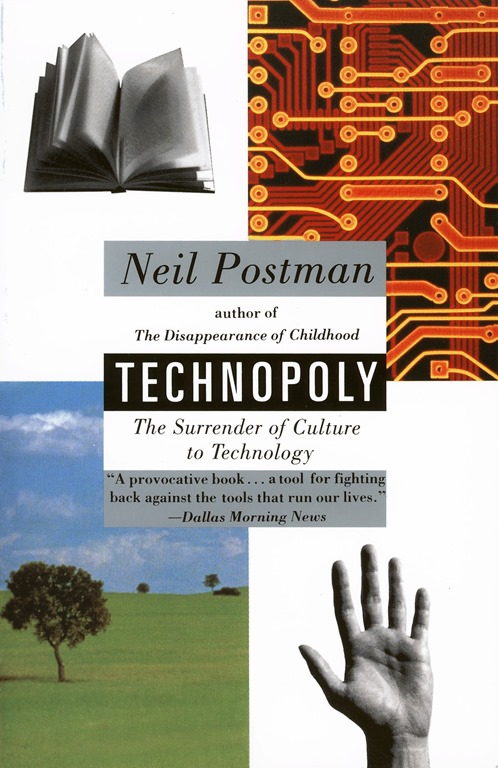
Do You Use Technology Or Does Technology Use You? A Brief Review of Neil Postman’s Technopoly

91Z8WzYA3hLAre we using electronics or are they using us? That is the fundamental question that Neil Postman asks in Technopoly. Postman wrote this book in 1992. Long before the smartphone and even a few years before widespread use of the internet. This makes his assessment of the direction of our culture all the more prescient.

Postman decried our move from a society that used tools into one that is now shaped by tools. He called this a technopoly—“a self-justifying, self-perpetuating system wherein technology of every kind is cheerfully granted sovereignty over social institutions and national life.”

What Postman saw was a collapse of significant cultural symbols, bowing to the idol of this technopoly. Technopoly is not simply about technology it is about the way in which we rely upon these tools. It is the unblushing allegiance that we give to “scientific facts”.

Long before Google, Postman saw our dependence upon the machine to define reality for us. Something is true now because Google says it is true. (Consider here and here).

This ideology is not neutral. It aims to take no prisoners and bring about the surrender of our culture. Postman devotes an entire chapter to showing the path which leads to losing important cultural symbols. He notes that they are often trivialized instead of directly blasphemed.

So what is the answer? Postman gives a list of characteristics of those who “resist the American Technopoloy”. They are people who:

  • pay no attention to a poll unless they know what questions were asked, and why
  • refuse to accept efficiency as the pre-eminent goal of human relations
  • have freed themselves from the belief in the magical powers of numbers, do not regard calculation as an adequate substitute for judgment, or precision as a synonym for truth
  • refuse to allow psychology or any ‘social science’ to preempt the language and thought of common sense
  • are, at least, suspicious of the idea of progress, and who do not confuse information with understanding
  • do not regard the aged as irrelevant
  • take seriously the meaning of family loyalty and honor, and who, when they ‘reach out and touch someone’, expect that person to be in the room
  • take take great narratives of religion seriously and who do not believe that science is the only system of thought capable of producing truth
  • know the difference between the sacred and the profane, and who do not wink at tradition for modernity’s sake
  • admire technological ingenuity but do not think it represents the highest possible form of human achievement.

Postman says that we must understand

“that technology must never be accepted as part of the natural order of things, that every technology…carries with it a program, an agenda, and a philosophy that may or may not be life-enhancing and that therefore requires scrutiny, criticism, and control.” (Postman, 185)

I am intrigued by Postman’s ideas here. I think in many places he is spot on and he clearly saw the dangers that were awaiting us. Is it to late to fight the Technopoly? I would say it is already well upon us and the governing ideology of our day.