 I’m yet to decide if I think Google is killing us or making us stronger. I guess it’s a bit like having a gorilla for a body guard. It’s a great asset if you know how to use it properly but it’ll just as easily rip you to shreds if you aren’t careful. What is having so much information at our fingertips doing to our minds? Is it stimulating curiosity or killing it? I tend to agree with Barnabas Piper that “this access can fool us into thinking we are smarter than we are”. And it “allows us to think less and search more”. (108) But I also agree with Piper that it ought to actually be making us more curious:
Except that Google should be a super power for the curious person! Rather than deadening our minds, it should open up a world of opportunities. We have answers to questions readily at hand, which means we can ask new and better questions and learn even more…Having information and being curious should feed one another, grow one another. Information is the fuel of curiosity…” (108)
Those of us who grew up on the internet ought to be the most curious generation ever. I’m not sure if we are, but what I do see is a great passion for learning and exploring and doing things that have never been done before. Part of me wants to kick against this and cry out that we should be anchored to truth and such curiosity will only lead to our demise. But the other part of me celebrates the wonder of it all.
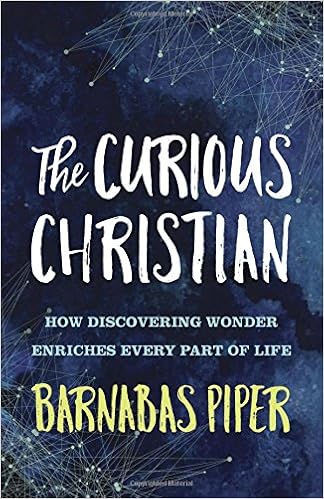
This is why I’m thankful for Barnabas Piper’s book The Curious Christian. Piper makes a compelling case for the necessity of curiosity. He paints a pretty ugly picture of what happens to us if we squelch our curiosity. But he also develops a compelling vision of a world of the curious. And I’m pleased that such a world—in Piper’s vision at least—isn’t one that is untethered from biblical truth. In fact biblical truth gives wings to true curiosity. It helps us ask the right questions and swim in the most joyous of streams.
I came into this book convinced that curiosity is a good thing. But after reading Piper’s book I’m encouraged to explore even more. He said that his goal was to make us “feel claustrophobic in your current state of life and to see the expanses of truth you could experience instead”. (6) I think he succeeds. This book helps cultivate curiosity in me and makes me uncomfortable with the status quo. It gives permission to the curious, and I appreciate that.
Just as a side note, as the dad of a homeschool family (wishing I was even more involved) I think this would be a great book to inspire homeschool families. That’s one of the things I love about homeschooling. I think it can open up the world even more than public school—just because of the freedom and flexibility it offers to tailor the lesson to the interests of your particular student.
As a curious person, though, I did wrestle a bit with this book. Part of being curious is asking questions of everything. I do this in Bible study all the time. Curiosity enriches Bible study—and I believe helps with preaching as well.
I also have questions when reading a book like this one. But that can lead to a difficulty in reviewing a book. It’s not a good practice to chide a writer for not answering questions he didn’t set out to answer. It’s best to judge a book on its own aims and not the ones I wish it had. In this, Piper succeeds. He accomplished his goals. And so nothing I say below is saying the book didn’t accomplish what it set out to do.
If I were to continue the conversation I’d ask a couple of questions. First, I wonder about a good working definition of curiosity. I don’t think curiosity was ever really defined. I get a good grasp of what it isn’t but I’m not sure there is a good working definition of curiosity. That’s okay because I think it’s a bit like love—you know it when you experience it. Maybe that’d have just been too boring—but I’m left wondering how in the world I’d define curiosity if I had to do it.
Secondly, I was left wondering whether or not we could say Jesus was a curious person. And I suppose that’s another reason a good working definition would have been valuable. But I think the question is important because Jesus is the perfect representation of what humanity is supposed to be. If Jesus wasn’t curious, then Piper’s argument that “discovering wonder enriches every part of life” is a bit problematic. I would have liked a defense of curiosity to come from this spot—but then again, I don’t think his purpose was to give a theological argument as much as simply stir up wonder.
But I think Jesus was curious. I’m not quite sure how all of that relates—I suppose it’s the same difficulty we have with seeing Jesus (who is fully God) asleep on a boat. And when we encounter the Son of God in a temple at twelve years old he is asking questions and learning. The parables of Jesus show a man that clearly was familiar with awe and wonder.
This means that curiosity isn’t just a coping mechanism for this side of Eden. It isn’t merely a part of our finitude. It’s part of what it means to be human. Piper brings this out wonderfully. He argues that this isn’t just something for now but curiosity/wonder will be present with us for all of eternity. I appreciate this point.
My final question of the book concerns its audience. That’s only a question I’d have as a reviewer. Who is this book for? As a naturally curious person I think the book inspired me and gave me a bit more permission to pursue curiosity and wonder. It’s a great encouragement to not become stale and stop asking questions. But if I weren’t naturally curious would this book have convinced me? I’m not sure. And I don’t even know if that is Barnabas’ audience. I certainly think anyone who reads the book will find it enjoyable, informative, and inspiring.
I promised myself I’d avoid an obvious joke at the end about being curious enough to pick up the book….but here we are. You can purchase the book here.
Like this:
Like Loading...
 I’ve shared in the past