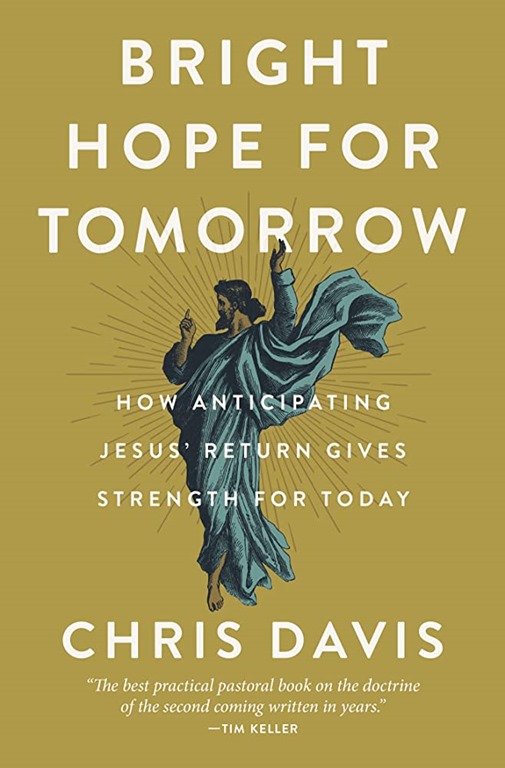
Review of Bright Hope For Tomorrow By @RevChrisDavis

71T3C1BrShL._AC_UF1000,1000_QL80_I’ll confess that when the topic of Jesus’ return comes up, I get slightly triggered. Sadly, this is a topic which brings more argument than hope.

When I heard that my friend, Chris Davis, was going to be writing a book on the topic I had two thoughts. First, I was worried for his safety (I’m only partially kidding—you can get some pretty nasty letters if you don’t toe the line on eschatology in some quarters). Secondly, I was excited because I knew that Chris would handle this topic with great care and that he would point us to Jesus.

I was not disappointed at all. Through each chapter Davis wades through the quagmire of questions and timelines and charts and gets to the central tenet of the Second Coming: hope.

When you analyze the letters of the New Testament in regards to the second coming what you find is that the topic was not centered upon debate or speculation but given to us for practical living. The Second Coming was a fuel for Christian living.

There was a meme circulating a few years ago with a picture of “Jesus” and the phrase “Jesus is coming look busy”. That’s not what is meant by the return of Christ fueling Christian living. But Christ coming as a judge is also an important aspect of His return. Chapter Six of Bright Hope for Tomorrow focuses upon this aspect. 

This, in my opinion, was one of the strongest chapters in the book. The author doesn’t mince words or beat around the bush. He boldly declares:

…if you are hiding something now, it will not be hidden when Jesus returns in his brilliance. So expose it now through confession to God and to others whose presence in those hidden places can prepare you for the light of Jesus on the final day. (Davis, 86)

But it’s not only hard-hitting, it is also hope-filled. He notes that this judgment means that we will be revealed for who we actually are. For Paul, and for any of those who are in union with Christ, this will be a day of blessing. It will reveal our overall character.

There are also a few chapters on how the Second Coming influences our spiritual disciplines as well. This is where the book really shines. That is not the type of thing you typically find in a book on the Second Coming, but it’s certainly what was in the mind of the biblical authors.

For these reasons, this book is a needed addition in your library and an important resource for any discussion of the Second Coming. If this doctrines doesn’t impact our day to day life then we aren’t “using” it the way the biblical authors did. Chris has done good work here in restoring that biblical aim.

Buy it here.

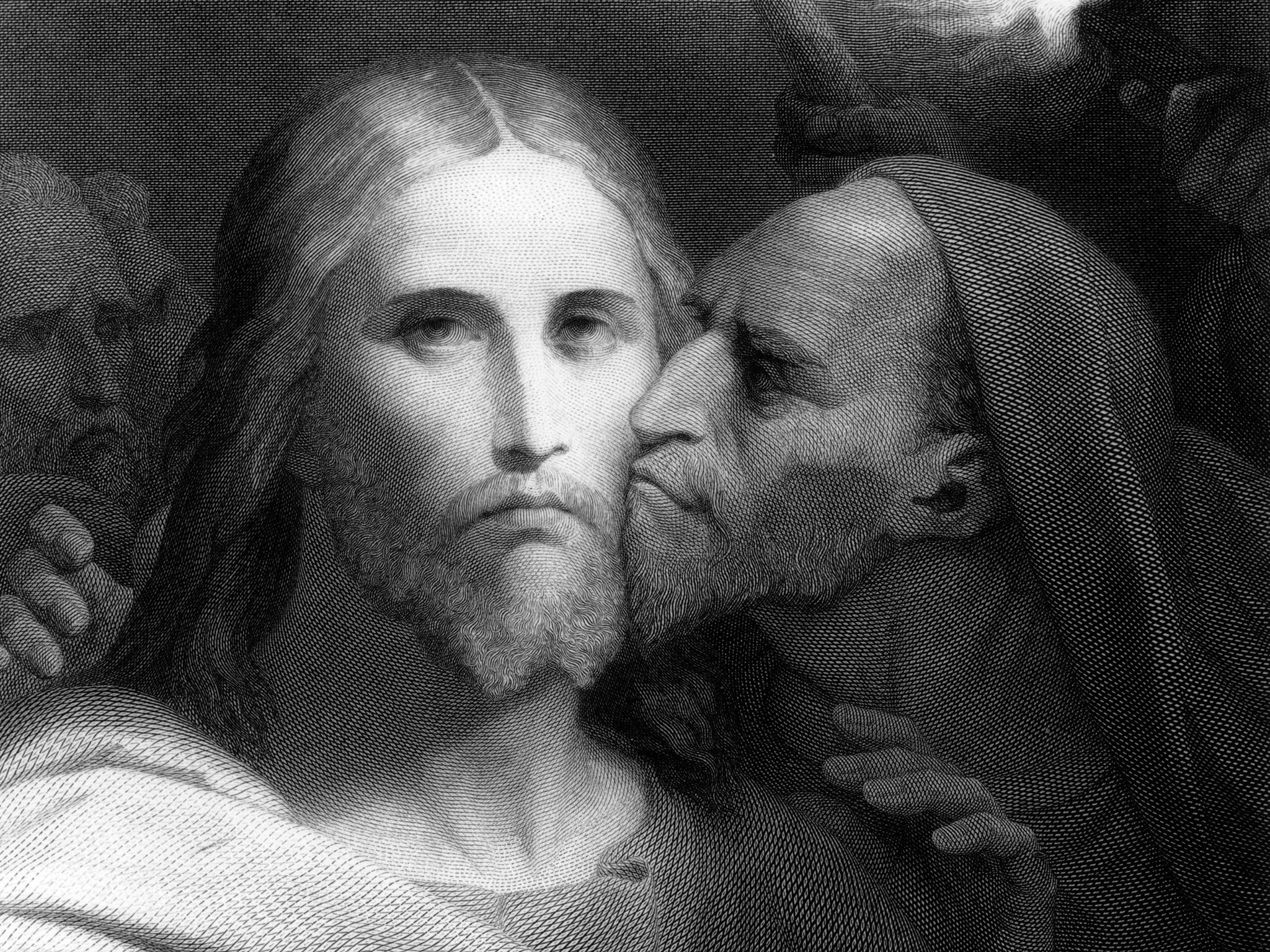
Could You Spot Judas?

“He appointed the twelve that they might be with him and that he might send them out to preach and to have authority to drive out demons.”

Be with Jesus.

Preach.

Drive out demons.

Picture that ministry in your mind. What was the preaching like? What would you conclude about the powerful ministry where the works of darkness are being overturned? And what must we say about the preacher who has “been with Jesus”?

Now check out who appears in the list of those appointed by Jesus.

“…and Judas Iscariot, who betrayed him.”

Sit with that for a moment.

There is absolutely no indication that anything was “off” in Judas’ preaching ministry. No indication that he was the guy in the group who just couldn’t seem to drive out demons. And there’s no indication that he was always lurking in the shadows and being the weird guy in the group.

There is no indication that when Jesus said, “one of you will betray me” all eyes suddenly lit upon Judas. This means that his preaching was at least adequate. There was nothing that caused the other disciples to shake their head at his weird take upon the good news. Every sign pointed to Judas being one of the gang.

What Does This Mean?

A few weeks ago my wife and I stumbled upon this show on Peacock called Traitors. It’s a ridiculous show, honestly. But it hooked us and so we kept watching to the end. The concept of the show is that there are 20 people in a house, three of them are traitors. If you spent any time in youth group it’s like a glorified game of Mafia.

In order to win the money, you have to spot the traitors, banish them from the group, and then split the money with your other survivors. Or if you are one of the three traitors, your goal is to “kill” everybody without being spotted as a traitor.

What is amazing to me about this show is that the ones who are traitors are typically the last person that others would expect. It’s comical as some of the contestants say things like, “I would stake my life on it not being Person X”. But it absolutely is person X.

This show is an illustration of a painful reality of humanity–we aren’t skilled at spotting monsters in our midst. That isn’t necessarily dangerous, but what makes it dangerous is that we think we are amazing at spotting the traitor.

This is how Judas, or any other fraudulent leader, is able to last so long within an organization. They make themselves the least suspecting. Those who work with organizations battling sexual abuse tell us that it’s not only a child that is groomed, it is everyone around them as well. Judas fits in.

I would love to give you 8 steps to spotting a Judas in your mix. But my point here is simple. You and I probably can’t spot Judas. That doesn’t mean that we should always view others with suspicion or to develop an unhelpfully cynical view of humanity. Eleven disciples weren’t Judas.

But it does mean that we ought to be aware of this reality. Don’t ever say, “It could never be Person X” and bend the rules for such a person. If there is a way to spot a Judas it’s not found in results of ministry, it’s not found in eloquent speech, it’s not even found in what he/she appears to be treasuring.

We are probably healthiest when we do not treat people with unwarranted suspicion but also when we aren’t surprised by depravity. True discernment will be grounded in hope instead of suspicion. It also doesn’t insulate anyone from the reality of human depravity. Trying to root out Judas isn’t the answer. But denying the obvious when he rears his ugly head isn’t the answer either.

When You Should Be Silent About Jesus

nick-fewings-eMwZP7NL6a4-unsplash

I suppose there are some recommendations that you don’t want.

“He trained me in fielding ground balls.” –Bill Buckner

“Taught us everything we know about singing.” –Milli Vanilli

“He’s financially creative. I’ve learned much from him.” –Charles Ponzi

“His views on group dynamics and leadership are top shelf. I’m a disciple.” –Charles Manson

“I’ve used him for my taxes for over a decade now.” –Al Capone

11 And whenever the unclean spirits saw him, they fell down before him and cried out, “You are the Son of God.” 12 And he strictly ordered them not to make him known.

It’s pretty obvious why Jesus didn’t want demons to be leading the charge on his public relations. It wouldn’t be long after that the religious leaders were charging Jesus with driving out demons by the power of demons. As non-sensical as that sounds, it’d have been an easier sell if the demons were the ones telling people that Jesus was the Son of God.

But there is something else happening here in Mark. It’s not only demons who are silenced, but in Mark 8, we’ll see the apostle Peter charged with not telling anyone that Jesus is the Son of God. It won’t be until his crucifixion that this declaration is made. Why?

Because a premature expression of Jesus’ identity would have led to much confusion. If people were going to wildly misunderstand what it meant for him to be Messiah, or Son of God, then it would be detrimental.

It’s dangerous when precious words aren’t combined with precious character. And it’s dangerous when precious words are used for an unholy end. The demonic declaration of truth, that Jesus is the Son of God, would have been used by them to perpetuate harm instead of worship.

Because of this Jesus essentially tells the demons to “shut up”. He muzzles them. True words can be used for treacherous things. And good words can be used for nefarious ends. When that’s the case Jesus tells demons, or us, to shut it.

I appreciate what Diane Langberg says here,

We are easily seduced by good words that touch our longings and desires; we frequently make the mistake of assuming those words are true because we want them to be true, not because we have seen character that demonstrates their truth. When we get glimpses, hints that raise questions, we deny the warnings because we so desperately want what we have heard to be true. Do patients trust therapists, people trust pastors, students trust teachers, men and women trust each other, girls and boys trust pedophiles, and entire nations trust politicians because their words sound good. But good words can hide bad material and bad goals. Good words can whitewash evil. (Langberg, Redeeming Power, 50)

But we see in this little passage that Jesus is different. Jesus is concerned with actual truth. Rather than having a PR campaign where people call Him the Son of God, but do so without an actual understanding, He’d rather wait until they knowingly profess. He silences the demonic because though they are speaking the truth, they do so with wicked intent and with character bent toward harm.

If you’re using good words for bad ends or with wicked intentions. Jesus is saying the same thing to you that he was saying to the demons so many years ago…

Silence.

Photo source: here

A brief History of “Ackchyually…”

DpQ9YJl

Americans now believe that having equal rights in a political system also means that each person’s opinion about anything must be accepted as equal to anyone else’s. –Thomas Nichols, The Death of Expertise

Have you seen the meme of the nerdy looking dude saying “Akshually…”? It’s because we are all a little annoyed by a supposed expert entering into a conversation and saying, “well, akshually….” and then spitting some alternate facts. (There is a whole episode of The Office dedicated to this).

Here in Southwest MO, we have one of the best meteorologist in the nation. Doug Heady knows his stuff. He’s truly an expert. And yet it’s amusing to me that he’ll get slammed on social media by people who have only a very limited knowledge of the field. “Well akshually….”

This happens even more in church settings, because we have something called the priesthood of the believer. We believe that the Holy Spirit dwells within every believer and we have equal access to God, through Jesus Christ. Because of this, what Nichols mentions here runs rampant within the church.

A couple hundred years ago, John Newton mentioned this to a young John Ryland, Jr.

That sovereign power, which the Independents assume over their ministers, appears to me too great to be trusted in such hands.  If a man ranks as member of a Church of Christ, however ignorant, illiterate and illiberal he may be, though he has seen and known nothing beyond the bounds of his parish, though his temper be sour, and his spirit obstinate as a mule, still he thinks himself both qualified and authorized to teach his pastor.  Half a dozen persons of this description are sufficient to make a minister and a whole congregation uneasy through life.  Whatever burden we are supposed to have in the Establishment, we are free from this.  And I would be thankful for it.  (Wise Counsel, 223)

Going back even further, Gregory of Nazianzus (329-390) cautioned against everybody “doing theology”. He was debating the Gnostics. These were the OG conspiracy theorist. They’d “well akshually…” those like Gregory who’d given themselves to years of theological study.

Not to every one, my friends, does it belong to philosophise about God–not to every one. The subject is not so cheaply acquired, nor is it for earth-bound minds. And I will add, not before every audience, nor at all times, nor on all points; but on certain occasions, and before certain persons, and within certain limits. (From Theological Orations, Book 1)

I’ll admit, I kind of bristle at what Gregory and Newton say here. And there is a bit of history that came after Gregory’s words which ought to give us some caution.

After Gregory

I’m not entirely blaming this on Gregory. His view was somewhat widespread, and at the time I believe it was entirely necessary. How do you reign in the “special knowledge” which the Gnostics claimed to have? These Early Church Fathers did what John the Apostle did in 1 John; they go back to the source. Who is connected to Jesus? Who is teaching that which is consistent with Christ? To sum, they appeal to expertise.

But there is a consequence to this as well. A few hundred years after Gregory we read this in the Decree of the Council of Toulouse (1229):

“We prohibit also that the laity should be permitted to have the books of the Old or New Testament; but we most strictly forbid their having any translation of these books.”

It could be argued that the Dark Ages comes from taking things like Gregory’s words to their logical extreme. Much corruption came from the people being ignorant and solely dependent upon “gate-keepers” to provide truth. This is why the religious establishment hated John Wycliffe and William Tyndale so much.

Even in 1536, after the Protestant Reformation, the Church of England forbade a common person owning or reading the Bible. This was to control learning. It was to legislate what Gregory spoke of 1,000 years prior.

Tyndale’s dying words were that he would “cause a boy who drives a plow to know more of the Scriptures than the pope.”

The Fruit of Tyndale

The vision which Tyndale had has won the day. Any “boy who drives the plow” is able to have all of the Scriptures and mounds of information at his fingertips. The pope has no more access to the Scriptures—or other knowledge—than you or I have.

There are many good things which have come from this. For one, I think of the #MeToo movement. Until social media, survivors had to go through gate-keepers to tell their story. Often, they were silenced at that step. There are good things that have comes from having access to both information and platform.

And it’s not lost on me that I’ll be able to hit “publish” and this piece will enter into the public space without a single gate-keeper telling me I can’t say this. The only regulation is whether or not my platform has enough reach to be heard. Or if I pay enough money to assist this in going “viral”.

But those benefits also become problematic. We end up with no guardrails. The “well akshually” nerd has just as much of a platform as someone who has given years to his/her craft. In fact, if he knows how to game the system well enough—his platform will be bigger.

There are two ways to become an expert today:

  1. 10,000 hours of hard work.
  2. A YouTube channel and a platform on which to share your “expertise”.

Most are opting for the second. We aren’t healthy. We are able to consume all of the knowledge we want. But consumption doesn’t make an expert. What is needed is deep attention and wisdom. We’re lacking in these areas.

Are we moving into a new Dark Ages, where we have all the information we need but no system by which to process it? We have access to any information we want but no ability to discern what is truly good or even what we need to advance as a society.

Conclusion

I don’t believe the path of Tyndale or Gregory is entirely the right one. Gregory dreamed of self-regulation. His words are a call for humility in learning. It’s also a call for leaders to disciple.

But humility and discipleship are hard practices. It’s far easier for leaders to control rather than disciple. And it’s a broad way to take short cuts and seat yourself in the position of honor. Why put in 10,000 hours when I can watch an hour of YouTube and become an “expert”?

While we are still broken people, living in a broken world we will take the easy path. But the way of Christ is one marked with humility and discipleship. It’s one where we learn to humbly limit ourselves. And it’s one where leaders open up access as they are in the process of discipleship. It’s where leaders are open to hear and listen and eventually share the platform.

I don’t know the answer, really. Nor, do I know the proper balance. But I do know that Gregory and Tyndale need one another.

And now, I’ll hit publish because we’re living in Tyndale’s world, for good or ill….