Lawful but Hurtful in Abuse

John Newton writes a sketch of the believer’s temper.  The entire letter is worthy of your consideration but I though this particularly helpful:

Satan will not often tempt a believer to gross crimes—our greatest snares and sorest conflicts are usually found in things lawful in themselves—but hurtful to us by their abuse, engrossing too much of our time, or of our hearts, or somehow indisposing us for communion with the Lord. The Christian will be jealous of anything which might entangle his affections, dampen his zeal, or straiten him in his opportunities of serving his Savior.

What are areas in your life that are “lawful in themselves” but “hurtful by their abuse”? 

For me I think certain entertainments like television and video games are the obvious ones.  The less obvious ones are spending an inordinate amount of time reading Christian books to the neglect of Scripture and prayer.  Surfing the internet and blogging—even if with an intention of doing it for the glory of God—can “engross too much of my time”. 

This letter is very helpful, you can read the entire thing here. 

Deadly to Faith

After contemplating on a recent visit from a missionary John Bloom posts these sobering and true reflections:

The New Testament teaches us that whether or not our treasure is really in heaven is most clearly seen when it costs us our earthly treasures in order to obtain it. But American Christians live in the most prosperous nation in world history and the one in which it costs the least to be a Christian.

This environment can be deadly to faith. It allows false faith to masquerade as real very easily. And its power to dissipate zeal and energy and mission-focus and willingness to risk is extraordinary because it doesn’t come to us with a whip and a threat. It comes to us with a pillow and a promise of comfort for us and our children. The former makes us desperate for God. The latter robs our sense of desperation.

And it’s the lack of a sense of desperation for God that is so deadly. If we don’t feel desperate for God, we don’t tend to cry out to him. Love for this present world sets in subtly, like a spiritual leprosy, damaging spiritual nerve endings so that we don’t feel the erosion and decay happening until it’s too late.

Read the rest…

Moral Superiority?

Found this today from Preaching Today and found it interesting enough to share:

“It ought to be possible to live a Christian life without being a Christian,” laments Roy Hattersley, a columnist for the U.K. Guardian. An outspoken atheist, Hattersley came to this conclusion after watching the Salvation Army lead several other faith-based organizations in the relief effort after Hurricane Katrina.

“Notable by their absence,” he says, were “teams from rationalist societies, free thinkers’ clubs, and atheists’ associations—the sort of people who scoff at religion’s intellectual absurdity.” According to Hattersley, it is an unavoidable conclusion that Christians “are the people most likely to take the risks and make the sacrifices involved in helping others.”

Hattersley also notes that this pattern of behavior goes beyond disaster relief:

Civilized people do not believe that drug addiction and male prostitution offend against divine ordinance. But those who do are the men and women most willing to change the fetid bandages, replace the sodden sleeping bags, and—probably most difficult of all—argue, without a trace of impatience, that the time has come for some serious medical treatment.

“The only possible conclusion,” says Hattersley, “is that faith comes with a packet of moral imperatives that, while they do not condition the attitude of all believers, influence enough of them to make [Christians] morally superior to atheists like me.”

———————–

What do you think?  Are Christians “morally superior” to atheists?  Is this even a helpful quote?  How would you use this in a sermon?

Review of The Trellis and the Vine by Marshall and Payne

Author: Colin Marshall and Tony Payne

Pages: 206pgs

Publisher: Matthias Media

Price:  11.99

Genre: Ministry/Church Resources

Quick Summary:

“According to this book, Christians are to be disciple-making disciples and pastors are to be trainers. Superb! This book sets out a crucial shift that is needed in the mindset of many pastors. The authors have carefully listened to the Bible. And they’ve worked on this book. The result is a book that is well-written and well- illustrated, but even more, a book that is full of biblical wisdom and practical advice. This is the best book I’ve read on the nature of church ministry.”

That is how Mark Dever described this book. The authors of this book want to see a ministry mindset shift. Instead of simply engaging in trellis work Payne and Marshall encourage church leaders to spend their time on vine work. Trellis work is working on the structures, programs, that supports the vine and its growth. Vine work is the actual doing of ministry. In this book church leaders are encouraged to turn the way they think of doing ministry upside-down (or perhaps right side up).

What I Liked?

Mark Dever is right, this really is one of the best books on the nature of church ministry that I have read. Some of these things I have known and believed for some time—but was unsure how to articulate them. Marshall and Payne articulate these principles in ways that I would have only dreamed of. But this is not just some pie-in-the-sky approach to ministry, this stuff is practical. The problem is this type of ministry (though very biblical) calls for a patient plodding approach, so it probably will not be flying of the shelves. Many will probably “try it” and then when immediate results do not happen will pick up the “next great thing”. If you like 9Marks type stuff you will like this book.

What I Disliked?

I am completely sold on what is being proposed in this book. I cannot think of any specific thing that I would disagree with or greatly dislike. I was greatly challenged by some chapters, encouraged by others, and helped by all of them.

The only “problem” that I have is wondering how to implement some of these things. I would love to see a sequel; sort of like Dever did with The Deliberate Church. There is just one question that I have how do you do Vine work when your people are expecting Trellis work? I know it’s through patient teaching of the Word—but do you do both until the Word really sinks in and the congregation catches the vision?

Chapter 12 and a couple of the questions in the end really do attempt to answer this question. I may just desire being spoon fed. In the end this is probably not a “hole” in the book as much as it is a “hole” in my intellect and experience.

Should You Buy It?

Absolutely. If you are involved in leadership at church you should read this. It would be helpful I think for any believer to pick this up. You can get it from Monergism now for a little over 10 bucks and it is well worth every penny.

Rating: 5 out of 5 stars

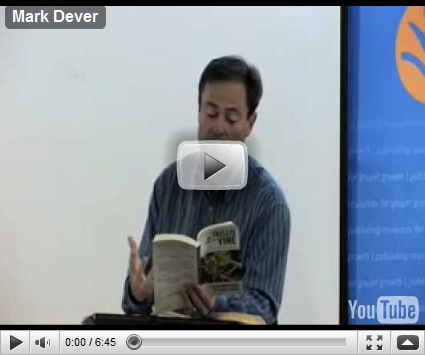
Watch Mark Dever plug this book:

<\/param><\/embed><\/object><\/div>“;” alt=””>
© 2026 . All rights reserved.
Fashionista by aThemes
  • -
  • +