Basic Instructions Before Leaving Earth?

Why do people who pile into movie theaters on a Friday evening complain that the Bible is boring on a Sunday morning?  One reason, and I stress ONE reason, is that we have not rightly been convinced that the Bible is a compelling story. 

If our view of Scripture is akin to Basic Instructions Before Leaving Earth then I doubt very seriously that we will be compelled to open its pages.  At least not until something goes wrong. 

I’m one of those guys that tries to put something together without reading the instruction manual.  I only read it when I end up with an extra part or the piece of furniture I was putting together topples onto itself.  I only read instruction manuals when I’m in trouble. 

If that is your view of the Bible then you probably only read it when you have significant trouble in your life.  And even then you probably do not read it the right way.  Rather than reading it to find Christ you are reading it to find “an answer”.  Any answer will do.  Sometimes you are just looking for God’s stamp of approval on what you know you already want to do.  Then you go back to building your piece of furniture and don’t look at your “instruction manual” again until one of the wheels falls off. 

Do you realize how hard it is to convince people to find Life in the Scriptures when this is our view?  It’s like trying to convince people that if they want to really enjoy food they should become acquainted with their refrigerator’s manual of operation.  That’s just silly. 

What if instead we started viewing it as a compelling story told by the Creator of the universe or as a drama that is acted out and then explained by God about God?  (I’m indebted to Michael Lawrence for that thought). 

I’m convinced that a good number of people piling into movie theaters on a Friday night are doing so because they are looking for story.  Not everyone mind you.  But story is powerful.  And we have the most compelling story ever told—the story that all stories comes from—but we’ve decided to sell it as an instruction booklet. 

So, please…Stop It!

—

P.S. I have no beef with Burlap to Cashmere. 
Is New Calvinism Really New Fundamentalism? Partial Response.

That is the question that David Fitch asks over at Out of Ur.  He is interacting with this video:

DeYoung, Duncan, Mohler: What’s New About the New Calvinism from The Gospel Coalition on Vimeo.

From this he argues that this “new Calvinism” is really nothing more than a resurrection of the “insularity”, “us v. them mentality”, and “distrust towards culture” that marked fundamentalism. 
Now, I really do not care to answer his titled question—but only that which he is actually asking.  In other words I do not want this to be a discussion on what is and is not “fundamentalism” and whether that is a good or bad thing.  It seems to me that what Fitch is most concerned with is that this New Calvinism is insular, narrow, arrogant, and culture-rejecting. 

Argument #1: New Calvinists Oppose the compelling Story

“These words reveal that Mohler sees ‘the structure of thought’ as the means of being able to defend the coherence of one’s own beliefs. As opposed to engaging the world with a compelling Story, and inviting the world in, this ‘structure of thought’ helps me defend why I am a Christian.”  –David Fitch

A little research—and not just a 12 minute video—would show that Mohler is not opposed to engaging the world with a compelling Story.  Consider chapter 6 of his book on preaching—He is Not Silent.  Does this sound like he is opposed to engaging the world with a compelling Story?

Many of our people are dying of spiritual starvation because they do not know the Bible’s whole story, and thus they do not find themselves in the story.  True, they know many little stories.  They have a bag of facts.  But a little bit of knowledge is not a big picture.  As we preach, we need to bring every text into accountability with the big story of Scripture.  Mohler, He is Not Silent, p102

Argument #2: They have an Us vs. Them Mentality
This one is tricky.  Do the New Calvinists believe “we are the true evangelicals”.  Or really, more importantly, do they believe “we are the ones that have Scripture right”? 

In one sense I would say you had better hope that they (or you) believe that you have Scripture right.  No serious Arminian believes that he is wrong and is just being stubborn.  No, he/she believes that he is interpreting Scripture correctly.  So, does the Calvinist.  Same way with the paedo-baptist and those that hold to believer’s baptism. 

The real question is whether they hold their position arrogantly.  And honestly, I would not be surprised if people from every theological background struggle with this.  But is Mohler’s comment (at about the 6 minute mark)  “where are they going to go” a display of his “arrogant” position that New Calvinists are the only way? 

I’ll grant Fitch that this does almost sound like Mohler is saying if you take your Bible serious then you have no option but to be a Calvinists.  And he may be saying that. 
But it’s also possible that he is responding within the grid of what DeYoung said prior—these are those “rediscovering biblical truths”.  So, I think Mohler is talking about those people that are beginning to see and wrestle with the doctrines of grace—where else are they going to go?

But is it really bad if Mohler believes this?  I would hope that any Anabaptist, Arminian, Methodist, Presbyterian, etc. would hold this same position.  Otherwise you should change your position.  It’s not arrogant, it’s just being convicted about what you believe in. 

This is getting lengthy.  I’ll just end it here, and maybe spend some more time on this later…

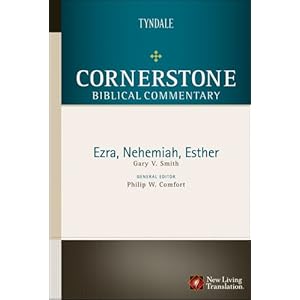
Review of CBC Ezra-Nehemiah, Esther

Commentaries come in all different styles.  There is the more technical variety, like the NIGTC.  Then there is also the more pastoral commentaries, like the Pillar Commentary series.  Finally, there are those that tend to be more devotional. 

Gary V. Smith’s commentary on Ezra-Nehemiah and Esther, which I received from Tyndale to review, falls into the latter.  It is based off of the New Living Translation and it’s goal is to: “…provide students, pastors, and laypeople with up-to-date, evangelical scholarship on the Old and New Testaments.”

It would have been much easier to have review this commentary if I were preaching through Ezra-Nehemiah and Esther.  That is typically when I get the most use out of a commentary.  However, I did spend some time perusing and interacting with the commentary. 

The format of this commentary is very easy to follow.  Each section provides the biblical text (NLT), a short section of notes, and then an overall commentary on the textual unit.  The notes are similar to what you would find at the bottom of a study Bible.  The commentary is typically short and succinct and provides a helpful summary and a few points of application. 

Is it helpful?

That is probably the most important question to ask of a commentary.  To answer this question of the Cornerstone Biblical Commentary series it depends on who is reading it and for what purpose. 

If a pastor is really trying to wrestle with a text and discover all the nuances, and discussion surrounding a passage this probably is not the best commentary.  However, if a pastor is looking to get a “feel” for the text then this commentary would be very helpful. 

I think this commentary would be MOST helpful to a Sunday school teacher.  It goes into just enough depth to get a good grasp on the meaning but not so much that you have to be bogged down by technical arguments.  The notes will support the teacher in writing a lesson, or adding meat to the pre-packaged variety.  The commentary will provide a few application points to really place the text into our every day lives. 

If you are looking for something technical this is not it.  But for a basic, yet deeper, understanding of the Scriptures this series (and this particular volume) will assist you in your studies.  You can buy it for only 22.79

Piper on the Danger of Disconnect

<\/param><\/embed><\/object><\/div>“;” alt=””>

(HT: JT)

What do you think?

Personally I agree.  I’ve seen it in my own life.  And it’s telling that this is even worthy of 4 minutes of Piper’s time (as well as ours).  The fact that this will generate discussion proves Piper’s point. 

Lord, connect my wires!  Give me a vision of the beauty of Jesus and the only fitting response of worship that proves itself in personal holiness. 

© 2026 . All rights reserved.
Fashionista by aThemes
  • -
  • +