When Keswick Meets Calvin

One of the charges often leveled against Calvinism is that it hinders growth in holiness.  It is often asked, “If God is going to bring his elect to maturity then why bother engaging in spiritual disciplines”?  It is thought that if Calvinism is taken to its logical conclusion then why bother with holiness.  Reformed folk like John Samson rightly disagree with and don’t understand this charge: 

I have heard this mentioned a few times recently and just scratch my head in wonder about it. One great example are the Puritans, who were strong Calvinists and yet were driven by a desire for holiness. But some see this as a contradiction in terms. Where they get this, I do not know.

Allow me to try to answer that from my own journey.  I grew up (spiritually speaking) in a Baptist church that was strongly revivalistic.  I also had a good does of Pentecostal teaching along with a steady diet of Keswick theology.  Early on in my walk with Christ one of my favorite books was Andrew Murray’s Absolute Surrender.  Some of these quotes were underlined in my copy:

The condition of God’s blessing is absolute surrender of all into His hands.

When God has begun the work of absolute surrender in you, and when God has accepted your surrender, then God holds Himself bound to care for it and to keep it. Will you believe that? In this matter of surrender there are two: God and I– I a worm, God the everlasting and omnipotent Jehovah. Worm, will you be afraid to trust yourself to this mighty God now? God is willing. Do you not believe that He can keep you continually, day by day, and moment by moment?

Say: “Lord God, not a word upon my tongue but for Thy glory, not a movement of my temper but for Thy glory, not an affection of love or hate in my heart but for Thy glory, and according to Thy blessed will.”

I firmly believed that if I wanted my life to “count for God” then I had to have absolute surrender.  I wanted (probably somewhat selfishly) for God to use me to do great things.  I desired revival.  I desired a deep experience with God.  I wanted what my heroes (at that time) experienced.  Men like Finney, Moody, and other revivalists.  I wanted the intimate “talking together” type of relationship with God that I heard my favorite preachers on television speak about.  And I knew this would come from absolute surrender.

The only problem is that I could never seem to absolutely surrender.  There was always something I was hanging on to.  There was always some residual sin.  I never could have absolute surrender or perfect faith.  So like a donkey pursuing a carrot I sought experience after experience, hoping that something would click.  I wanted to find the key to this whole Christian life. 

Somehow my disenchantment actually led me towards Reformed theology.  Hearing of a great God that would bring about my holiness was welcome news.  Inevitable faith was what my heart had been longing for.  So, the pendulum swung.  I stopped focusing so much on the “let go” aspect of my faith and started focusing on the “let God”. 

The result? 

I became spiritually dry.  I stopped worrying about spiritual disciplines so much.  Yeah, my “Calvinism” had stunted my growth in holiness.  I know now that it was not my “Calvinism” it was my wrong headed understanding of sanctification matched with my new found doctrines of grace.  In other words, when Keswick meets Calvin the result is deadly. 

Calvinism, rightly understood, should not lead to stunted growth.  But Calvinism (or any other system) that is not firmly rooted in the gospel will inevitably lead to frustration and a lack of true growth. 

This all came to a head in my bath tub in Hannibal, MO.  I was in a deep and dark time of the soul.  I felt as if I was on the precipice of rejecting the faith.  Not just Keswick.  Not just Calvinism.  But the whole darn thing.  Then it clicked.  The beauty of the gospel was awakened in my mind, heart, and soul.  And just like John Bunyan I felt chains come off my legs.  Indeed I came to find that my righteousness is found totally in Christ and him alone. 

Keswick theology may call this having a crisis, surrendering absolutely, and trusting in Christ alone.  Perhaps.  A Calvinist would say that all of this was the sovereign working of God bringing about inevitable growth in holiness.  I am inclined to agree.  But all I know is that my desire for holiness was a sham until Jesus rescued me in that bath tub.  The gospel awakened my heart. 

And now I’ll put my trust in absolute Jesus not my absolute surrender. 
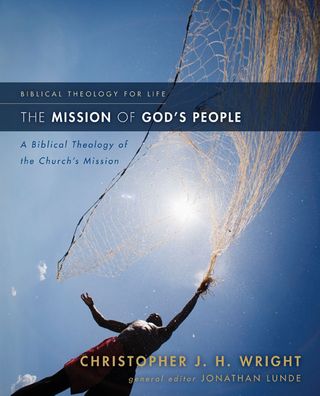
Review of The Mission of God’s People

A couple years ago I was introduced to the writings of Christopher J.H. Wright.  My first exposure was to a massive book called The Mission of God: Unlocking the Bible’s Grand Narrative.  It quickly became one of my favorite books (you can read my review of it here).  In that review I noted that, “I would absolutely love to see a condensed version of this book for those that are more casual readers”. 

I was delighted to see what I thought to be a shorter version: The Mission of God’s People .  I was further delighted to receive this book free from Zondervan in exchange for a review.  Much to my surprise I discovered that this is not actually a condensed version of The Mission of God.  It is very similar, and draws from Wrights’ earlier works, but this book is more a follow-up.  As Wright notes:

In this book, I am asking the “so what?” question on behalf of those of us whom this God of the Bible has called into saving and covenant relationship with himself-the church, the people of God from Abraham to the population of the city of God in Revelation.  Who are we and what are we here for?  If the Bible renders to us the grand mission of God through all generations of history, what does it tell us about the mission of God’s people in each generation, including our own?  What is our mission?  (Wright, 17, The Mission of God’s People)

Wright’s goal in this book is to spell out specifically the mission of God’s people.  He begins by explaining that this mission (which is really God’s mission) “requires the whole church to take the whole Gospel to the whole world” (Wright, 26).  What follows is an explanation of what this “whole gospel” entails. 

He begins with the big story and encourages believers to take the whole story to the whole world.  Where he goes next may seem surprising to some.  His third chapter is dedicated to creation care.  Many may read this and think that Wright has a liberal agenda.  He does not.  He has a gospel agenda.  What I appreciate about Wright is that “his gospel” is always centered on the finished work of Jesus Christ.  But “his gospel” is also full-orbed, touching every sphere of life. 

There are still 9 more chapters and about 200 more pages after chapter 3, but they can be summed up easily.  These chapters are a call to proclaim the living God with our life and with our lips.  Wright gives a passionate plea (rooted in the OT) for personal holiness.  He also encourages the verbal proclamation of the good news.  He closes the book by showing the relationship between worship and missions as well as showing the relevance of mission for today. 

Wright is a great author and is always a compelling read.  He is dedicated to Christ and the Scriptures.  What you read flows from a full-orbed, and well thought out biblical theology.  You may not agree with everything Wright says but you will certainly have a good understanding of where he is coming from. 

This is, however, another example of a Wright book that could be very beneficial but is a little redundant in places.  Even though a good read it still would benefit from being shortened by about 80 pages.  I’m still looking for a condensed version of The Mission of God.  Perhaps a condensed version of the two combined would be helpful.  Nonetheless, you will greatly benefit from reading this book. 

There are also a few relevant questions at the end of each chapter.  I am not certain that this would be conducive to a small group, but using this book when getting together with a few fellow believers to discuss missions may be beneficial. 

Rating: 4 out of 5 stars

For only 16.49 this book is well worth a pick up.  You can preview a good bit of it at Google Books as well.  It is also worth checking out the 9-Marks review of this book. 

Review of MacCulloch’s A History of Christianity DVD

I received episode 1 of this BBC series free in the mail to review.  It took me awhile to sit down and watch it, so my review is a little tardy.

I had heard of MacCulloch before.  I know him as the agnostic-homosexual-Anglican church historian that has tried to recapture the story of Eastern Christianity.  Often church histories are decidedly Western and neglect the massive influence and history of Eastern Christianity.  MacCulloch has made it his life’s work to change that. 

My only exposure to this video series is the one that I received in the mail: Episode One.  It was pretty interesting and I think foundational to the rest of the series.  I would probably like to view the rest of the series, though I disagree with some of the positions. 

The scenery is typical of films on church history, but what makes this interesting is that MacCulloch travels to Eastern places that many do not see in typical church history films.  The cinematography is nothing to write home about, but it is sufficient for a documentary. 

What I dislike about this film is that his bias obviously shapes the way he views the history of the church.  For instance, at one point he said “this is not the story of Jesus”.  I understand what he is saying.  But on the other hand, the history of the church is the story of Jesus (at least part of it).  I would hope that you could not write a biography of my wife without it being also deeply related to me.  But his agnostic, “the Bible is just another book”, view of Christianity shapes his church history. 

In the end, though, it is interesting.  I hope it sparks more discussion and scholarship on Christianity in the East.  It’s not as black and white or anti-West as MacCulloch would love it to be, nonetheless, it’s a pretty compelling video.

Rating 3 out of 5 stars

You can buy it for 71.99 or get the book for 30 bucks.

Review of The Gift of Psalms

If you have ever dreamed of doing your quiet time with George Costanza or Mac Taylor then the Gift of Psalms is the devotional for you.  Otherwise it’s just plain weird.  I received this book a really long time ago from Thomas Nelson in exchange for a review.  After sitting on my shelf for months I finally pulled it down to finish and review. 

Honestly the devotionals, written by Lori Jones, are pretty solid for devotionals.  Not every Psalm is represented (only 50 of them).  Each devotional is a page long, and typically filled with some background information.  Also the Psalm is presented in NKJV. Some of the devotionals also do a good job of making the Psalm Christ-centered, although some seem to miss it’s Gospel-Centered interpretation.  Each devotional then closes in prayer. 

Here is a sample (one that’s more of a “be like David”, than a “look at Jesus”):

Like David, we must have determination in order to live lives that are devoted to honoring God.  We are constantly bombarded every day with things that dishonor God—prideful attitudes, disrespectful language, selfishness, deceit, and more.  We have to be careful about what we allow our hearts and minds to be exposed to…

The packaging of this book is wonderful.  It’s very appealing and would at least look like a great gift for someone.  But honestly, I’m not sure who I would give this to or recommend it for.  It may be a decent introductory devotional, maybe.  But I just could not get around the reading of the Psalms by celebrities that don’t believe the words they are reading. 

Rating 2 out of 5 Stars

You can buy it for under 15 bucks at Amazon.