Stinkin’ Thinkin’

I received a really neat little book in the mail yesterday:  Christians Get Depressed Too.  It’s short so I’ll probably have it read and reviewed by the end of this week.  However, I found this little section so beneficial I wanted to share. 

In his section on unhelpful thought patterns (p36-44) Murray outlines 10 false thought patterns:

  1. False extremes—“the tendency to evaluate personal qualities in extreme, black and white categories”
  2. False generalization—“after experiencing one unpleasant event, we conclude that the same thing will happen to us again and again.
  3. False filter—“filtering out anything positive and decide everything is negative”
  4. False transformation—“ignoring positives, disqualifying them and turning them into their opposite”
  5. False mind reading—assuming you know what another person is thinking about you
  6. False fortune telling—expecting catastrophe
  7. False lens—“viewing our fears, errors, or mistakes through a magnifying glass and deduce catastrophic consequences.”
  8. False feelings-based reasoning—taking your emotions as truth
  9. False “shoulds”—pressuring yourself or feeling guilty when you do not “reach certain unattainable standards”.
  10. False responsibility—”assuming responsibility and blame for a negative outcome, even when there is no basis for this”

This book is a good, easy, and helpful read.  I highly recommend either buying the e-book for 5 bucks or getting the hardcopy from Amazon for only $7.50.

Review of The Goodness of God by Randy Alcorn

The Goodness of God: Assurance of Purpose in the Midst of Sufferingis a shorter version of Randy Alcorn’s work If God Is Good: Faith in the Midst of Suffering and Evil.  I typically am turned off by theodicy’s (defenses of God) as they often attempt to answer questions that Scripture never attempts to answer.  If God does not feel the need to offer much of a theodicy I wonder why we do? 
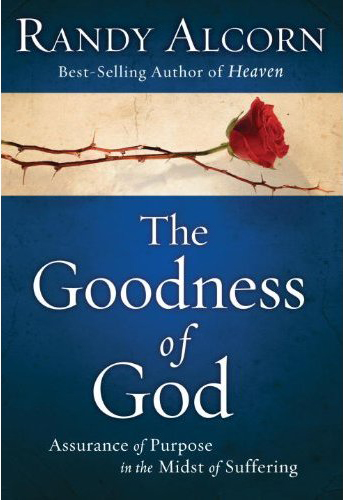
However, Alcorn’s book on The Goodness of God is much more than just an answer to the problem of evil.  It’s gritty and honest, which is often missing in many such books.  Yes, there are some times when I think he may be a little overly simplistic.  I also do not think that this book is the absolute best to give to someone in the midst of intense suffering.  This is a book to strengthen your faith in the midst of dark trials and in this regard it is very helpful.

There are two things that really struck me in this book.  The first section that really hit me is one entitled “When Losing Faith is Good”.  Here Alcorn says that there are times when “losing faith” can actually be a good thing.  It’s a good thing to lose a weak faith.  As our states, “any faith that leaves us unprepared for suffering is a false faith that deserves to be abandoned.” Great words.  God is okay with us abandoning a weak or false faith so that he can replace it with one that is stronger. 

The second thing that really impacted me was this statement, “Knowing that I’ll sit before God’s judgment seat—not he before mine—I choose to trust him.  And the more I do, the more sense the story makes to me” (48).  Yes, many will call this just blind faith.  But it’s really not.  It’s not blind because it’s informed by a tested guide (Scripture).  Scripture proclaims this truth.  And I need to believe that.  To really grasp that I’ll stand before God and not vice versa makes me more like Job and less like his unhelpful counselors. 

If only for these two things I would highly recommend this book.  But there are numerous other stories and helpful anecdotes to help in our battle with suffering and evil.  It is not as exhaustive as some books on suffering.  Nor is it as personal as others.  But it is a helpful little book that you can quickly read that will strengthen your faith in the living God. 

I do wish that there would have been a little more interaction with the attributes of God and actually the book would have been well served to have spent another 10 pages or so on really fleshing out the title, “The Goodness of God”.  That is the reason why it gets 4 stars instead of 5.

Rating 4 out of 5 stars

Disclaimer: I received this book free from Multnomah in exchange for a review.  But it’d be worth your 10 bucks.

Today in Blogworld 1.4.11 (With a Little comment on Alcohol & the SBC)

Piper re-enters the blogworld with this: Don’t Make Jesus More of a Mediator Than He Is.

The Secret to Newton’s Boldness in Prayer

—–

Baptist debate social drinking.  (HT: Colin Hansen) Yeah, this really isn’t news.  But because either the blogworld is slow to day or I am being picky, I’ll link to this and provide a little interaction.  The author of this article quotes Peter Lumpkins who says this:

“Make no mistake: the popular, trendy appeal for Bible studies in bars; pastors leading men’s groups at cigar shops to puff, preach and partake; conference speakers who openly drink alcohol nevertheless are invited to college campuses as they carve out yet more influence into the youngest generation of Southern Baptists — all this makes an impending moral crisis among Southern Baptists predictably certain.”

The author of the article also stated this: “Lumpkins is among Southern Baptists who view relaxed attitudes about social drinking as the biggest controversy facing the Southern Baptist Convention since the “conservative resurgence” debate over Scripture in the 1980s.”

Yeah, I disagree.  Mainly because this isn’t 1980 and most in the younger generation are less concerned with being SBC than they are about following Jesus (whatever that means).  I’m not agreeing or disagreeing with Lumpkins here.  I’m simply doubting his assessment.  I doubt it will be as much of a moral crisis within the SBC as it will be a “what the heck happened to the younger generation”?  If pushed I would say that many will continue doing “missional” things like Bible studies in bars and drop their affiliation with the SBC.  Or maybe I’m just a simpleton.

—

Back to regular linkage…

I love these.  Brant Hansen writes another edition of If Jesus Had a Blog.

I love Ed Welch:

<\/param><\/embed><\/object><\/div>“;” alt=””>

(HT: Dane)

That’s it for today…

Agree or Disagree? The Author of the Story

God isn’t the author of evil, but he is the author of a story that includes evil.  He intended from the beginning to permit evil, then to turn it on its head—to take what fallen angels and fallen people intended for evil and use it for good.  In the face of the worst wrongs, God intended to show his highest good.  (Randy Alcorn, The Goodness of God: Assurance of Purpose in the Midst of Suffering , p.15)

This may not really fall under the category of Agree or Disagree.  However, I am interested to hear your reaction to this statement.  Is it biblical to say that God is not the author of evil BUT he is the author of a story that includes evil? 

If you agree I would like to hear how you would respond to someone saying that this does not “let God off the hook” if he wrote the story that includes evil then he in a roundabout way created evil.

If you disagree I would like to hear why.  Where did evil come from, biblically speaking. 

If you are an atheist and want to use this as your soapbox to proclaim that God does not exist, go ahead.  However, one rule.  We are interested in answering this question biblically.  Does Scripture agree or disagree with Alcorn’s statement? 

© 2026 . All rights reserved.
Fashionista by aThemes
  • -
  • +