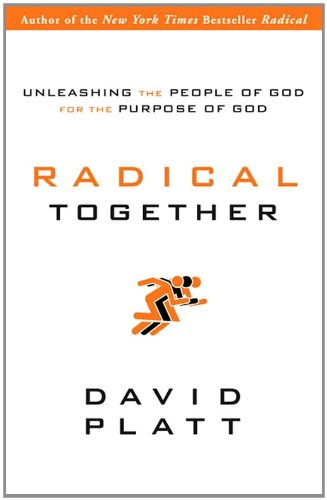
 David Platt’s first book Radical has already changed the lives of many people, and this change has impacted several churches. Many churches have used Radical as small group material, and many will be observing Platt’s six hour Secret Church simulcast. (Our local church is one of them).
On April 19 Platt will release his second book, Radical Together: Unleashing the People of God for the Purpose of God . Radical was an urgent plea for individual Christians to take back their faith from the American Dream. This offering is an urgent plea for churches to reshape their vision and priorities to take back their churches from the American Dream.
What you will find in this book is not a full-orbed ecclesiology but a passionate plea for churches to abandon the “good” for the great of following a “self-centered God” that is passionate about extending His glory to all the nations. Platt offers six correctives to the typical American church. I will discuss each of these chapters individually.
The Tyranny of the Good
If you have spent any time behind closed doors in a church you know how scheduling typical happens. “What did we do last year?” “How did that go?” “Ok, we’ll schedule these things again this year, with a few minor tweaks”. Many of these things are good things but are they the best?
In typical Platt fashion he encourages churches to consider the lostness of the world, the dire needs of those around us, and the heart of God. As we consider the purpose of God in the world we have to ask of every program and activity, “Is this the best way to spend our time, money, and energy for the spread of the gospel in our neighborhood and in all nations?” (8)
Platt also shows how this is not merely a theory. Brook Hills (Platt’s church) is putting their money where God’s heart is. Through asking these hard questions this thriving church made radical cuts to several areas to better spread the gospel to the nations. One such “radical” result of these questions was spending all of their excess cash ($525,000) to serve impoverished churches across India.
Platt says that as we ask these questions:
“We begin to discover our dangerous tendency to value our traditions over God’s truth, just as Jesus warned. We find ourselves defending a program because that’s what’s worked before, not because that’s what God has said to do now. We realize just how prone we are to exalt our works over God’s will, our dreams over God’s desires, and our plans over God’s priorities”. (9)
The Misunderstood Gospel
There are two types of wrong responses to what Platt asserts in Radical. One such response is to balk at its claims while maintaining a faith that is dead. Such a person believes a “gospel” that is nothing more than fire insurance. It is a “gospel” that is diametrically opposed to the one that you find in the Scriptures.
The other wrong response to Radical is the person that passionately attempts to be radical in the hopes that somehow he/she will be accepted by God. This person is motivated by guilt and a wrong-seated obligation. Being Radical this way will simply wear you out. This is no gospel either.
This chapter seems to be a needed corrective to the claims in Radical. Here Platt firmly roots the call to be radical in the gospel. As he at one point states, “The gospel is the key—and the only sustainable motivation—to sacrificial living”. Of course the gospel does indeed motivate and free us to work.
Here Platt is grounding all of the claims (not only in Radical Together but also Radical) in the gospel. He is urging churches to not live and proclaim the first “gospel” of inaction as well as the second “gospel” of “law-action”. Instead let us “show in the church a gospel that saves us from work and saves us to work” (37).
God Is Saying Something
If we want people to become enthralled with the mission of God how do we bring that about? How does a church inspire people to forsake their very own lives for the sake of spreading God’s glory throughout the world?
One way to answer those questions is to be innovative and creative. If you want to inspire people for mission then you certainly need to have an inspirational pastor that has an engaging persona. This why so many of the ads placed by churches that are looking for a pastor have something about being a dynamic leader in the job description. Sad thing is you won’t find many of these qualifications in Scripture. (41)
How then does David Platt suggest we motivate people? Simple:
“Scripture is clear that any leader who wants to unleash the people of God in the church for the glory of God in the world must simply be competent to communicate and faithful to follow the Word of God. (41)”
This chapter is a simple plea for believing that the Word of God “is sufficient to hold the attention of God’s people and satisfying enough to capture their affection” (57). It is a simple chapter but perhaps the most important. I say that because throughout this book Platt asks several open ended questions. The Word of God is what we use to answer the questions about “what is the best way to…”
I pray that those of us that claim to believe in the sufficiency of Scripture read this chapter and really test our hearts. Do we really believe in the sufficiency of Scripture or do we only give our doctrine of Scripture lip service? If we really believed in the sufficiency of Scripture I’m convinced that many of our churches would look different. (Including my own ministry).
The Genius of Wrong
If we are going to really be serious about reaching the world with the gospel then we must gather together the best people possible. Our task as ministry leaders is to put all of the right people in the right places. This is why we have spiritual gifts tests, personality tests, etc.
Wrong!
According to Platt the key to “building the right church depends on using all the wrong people”. The assertions that Platt makes in this chapter have huge implications for how we “do” church. And I have to be honest I love it. The vision of community that Platt is presenting here is inspiring:
“We want to focus on ways we can cultivate the best people: a people who love to pray together, fast together, confess sin together, sing together, and study together; a people who depend on the Word that is spoken more than the one who speaks it; a people who are gripped in music more by the content of the song than the appeal of the singer; and a people who define worship less by the quality of a slick performance and more by the commitment of a humble people who gather together week after week simply to behold the glory of God as they surrender their lives to him. (64-65)”
There is one question that really drives this chapter. Think on this question for awhile and then when you buy this book in April you can see how Platt answers it. Here you go: “Imagine that your church had no building or facilities whatsoever. Could you still make disciples?” (68)
Our Unmistakable Task
This chapter is vintage Platt. (Can you say vintage for a guy that’s only 31?) Here Platt makes a very interesting observation. When did Jesus say that he would come back? When the gospel reaches every people group, right? When will Satan’s influence be ended? When Jesus comes back. So, where do you think Satan is going to be putting all of his energy? You guessed it. When you engage in this mission to share the gospel with every people group then you can expect all the powers of hell to come against you.
Here Platt encourages the both/and of local and global missions. We cannot neglect either. But Platt says we do local missions to equip people for global missions, because we want to see the return of Jesus.
The God Who Exalts God
This chapter is written by John Piper. Well, not really, but Platt is echoing much of what Piper has proclaimed for decades. And this really is the foundation of the entire book. Because God is passionate about His glory above all things and because God is engaged in this mission, we have power to engage the world with the beauty of God.
If you’ve read much of Piper then not much will be new here. But I am really glad that Platt has this chapter in his book. I am glad because Platt is reaching people with this message that Piper was not. Platt communicates this essential gospel truth in a way that is far more communicable to many pastors than Piper’s deeper theological books. In other words I am excited that more people will hear the message of the God-centeredness of God.
Summary Thoughts
This book is only 140 pages worth of material (though the copy you will buy will have a helpful discussion guide). Though small it packs a huge punch. I am convinced that many churches will be changed through these six principles that Platt introduces us to. Not because David Platt is a great communicator or because he is innovative. But I believe God is using Platt in a mighty way to be faithful to the gospel and inspire and encourage a great number of people to really believe that God is powerful, sufficient, and passionate about spreading His glory to the nations.
I look forward to seeing how the Lord uses this book in the same way that he used Platt’s prior offering of Radical.
You can pre-order your copy of Radical Together and get it for under $10. (Honestly, I would encourage you to pre-order it if you want it in April because I’m expecting a massive amount of people to buy this up front).
Like this:
Like Loading...
 For the past 3 years I have been honored to be part of the SBC Blog Madness. In 2008 I entered the tourney field with an 11 seed and was quickly ousted. The selection committee must have token note as I entered the field as a 16 seed in the next two years. This year, thanks to your help, I enter the tournament as a #5 seed.
 Last year I made five insane NCAA Predictions and they proved to be truly insane…not to mention completely wrong. So I thought I would make five more silly picks:
 Have you ever tried to compliment a pastor after a sermon but are not quite sure how to do it? It’s difficult isn’t it? You want to be certain to give glory to God but you also thought the message was really good (whatever that means). Because of this conundrum many people simply refuse to give good affirmation because they do not want to risk causing the other person to struggle with pride, nor do they want to risk robbing God of His glory. Others want to give a compliment but aren’t quite sure how to do it, so they just offer a “good sermon Pastor”. Then there are some people that know how to strike that helpful balance of “giving God-centered praise to those that aren’t God”.
 . Of course it is about far more than how to compliment your pastor. The subtitle sums up the book nicely: “God-centered Praise of Those Who Are Not God”. Crabtree believes that affirmation is a key that could unlock many relationship problems. But it is more than a help to our relationships—affirmation is commanded by God. If we aren’t affirming people in a God-centered way we are disobedient.