 I have been doing youth ministry in some form or another for around 10 years. Through this time I have vacillated between several different philosophies of ministry. I began as a lone-ranger save the kids from their stupid parents type of mentality. That view did not last long. Frankly, either that view had to go or I did. I’m glad it was the former. (Well, actually it was both because I did leave my first position as youth pastor during this time).
After my foray into ministry as the self-proclaimed messiah of students I quickly learned the importance of parents. I discovered on my own that parents have a more lasting influence on their children than I ever would. And this was the case whether the parents were the reincarnation of Hitler or the Apostle Paul. Parents are typically the primary influencers of their children whether for good or ill.
Once I made this discovery through experience I soon found that it is not only experience that teaches this but Scripture too. I found myself studying many books on how to minister to the family and the teenagers. I began trying to implement some of these programs but oddly enough found much resistance. I knew that things needed to change. I knew that parents needed to have a vital role but I was not sure what that was supposed to look like.
Riding in on his white horse was Voddie Baucham and his book Family-Driven Faith. This was what I was looking for. This reinforced my growing belief that parents are the primary disciple makers of their children. But it called for some pretty radical changes. One of which would eventually be my resignation because apparently I was serving in an unbiblical position as a youth pastor.
After a little time and reflection on Baucham’s ideas I soon discovered that what Scripture and ministry in our context called for was a hybrid. I was not sold on a Family-Driven model, but I wasn’t so sure that it should be thrown out either. We needed something in between.
I never found it.
Light at the End of the Tunnel?
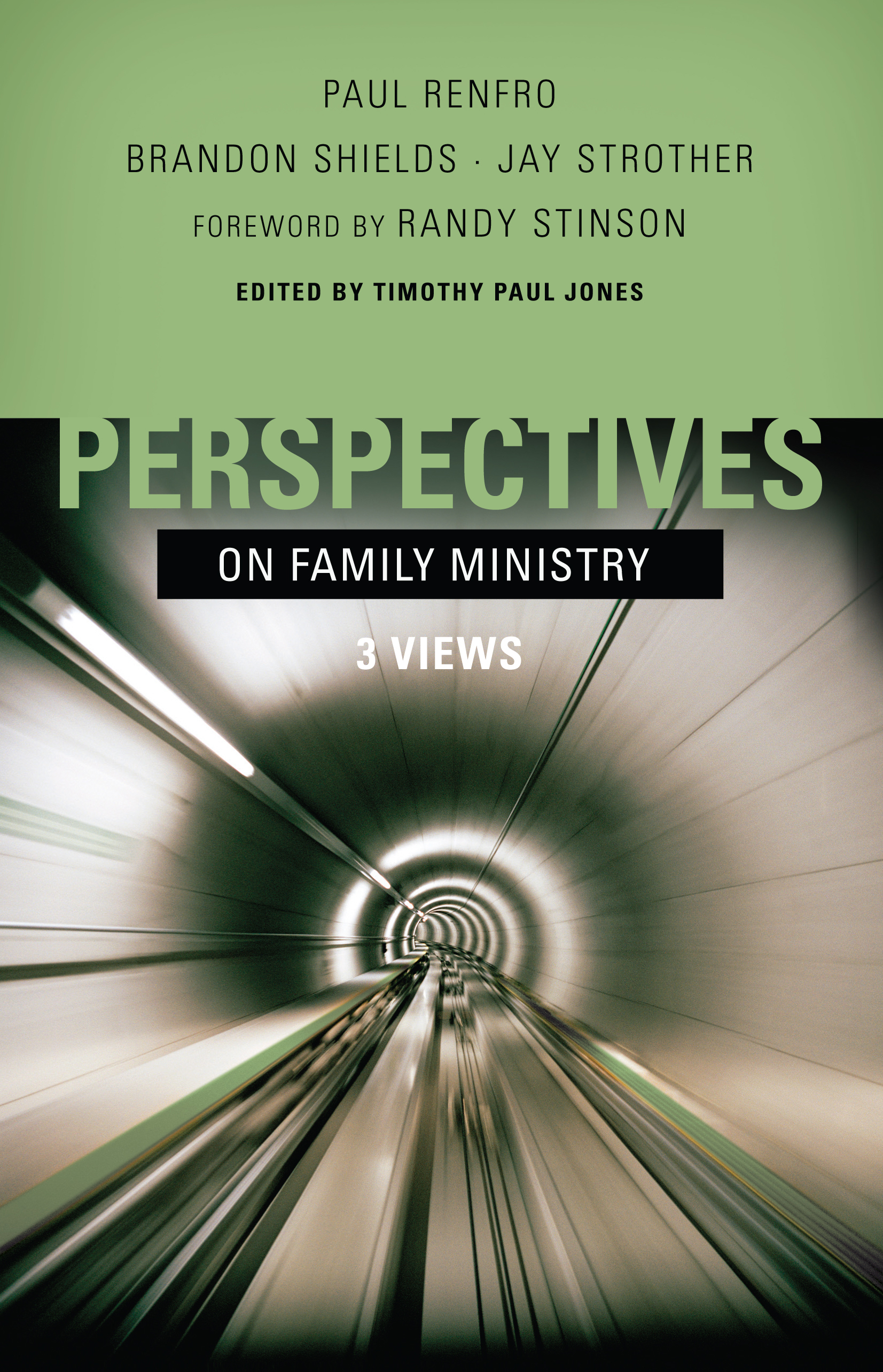
That is until last semester at SBTS when I was exposed to the “in-between” of family-equipping ministry. They are in the beginning stages of working out the very thing that I was trying for the last few years to wrap my mind around. Some of this discussion is found in Perspectives on Family Ministry, a book I had received free from B & H in exchange for a review. It was actually required reading for my course on Family Ministry so I waited for the semester was over to review it.
The first part of this book is written by Timothy Paul Jones and it argues for the necessity of family ministry. Family ministry is defined as:
“The process of intentionally and persistently realigning a congregation’s proclamation and practices so that parents are acknowledge, trained, and held accountable as the persons primarily responsible for the discipleship of their children.”[1]
After exploring the necessity of family ministry Jones briefly summarizes the three most prevalent options for family ministry. He then shows how all three of these have very key things in common; such as the sufficiency of Scripture, a firm belief that God has called parents as the primary disciple-makers, and that the generations need one another and we must reconnect these groups.[2]
The second part of this book is an interaction between Paul Renfro (representing the Family-Integrated Model), Brandon Shields (representing the Family-Based Model), and Jay Strother (representing the Family-Equipping Model). Each model is given about 25 pages to make their case. Then the other two proponents provide brief responses. And finally each section is concluded with a concluding response from the original proponent.
The Family-Integrated Model is explained and defended by Paul Renfro. This model is very similar to the one that I was exposed to through the writings of Voddie Baucham. It argues for a “clean break” from age-segregated ministry (55-56). Every family worships together and there is no “youth group”, “children’s ministry”, or “preschool ministry” but the entire church is aimed towards promoting active parenting and involving everyone throughout the church calendar.
The Family-Based Model is explained and defended by Brandon Shields. This model was probably the first “family ministry” model. It maintains age-segregation for missional reasons. Realistically, according to this view, there are many families that are not able to fit into the Family-Integrated Model. They still passionately pursue assisting families in raising their children but they do not find the other models compelling or necessary.
The Family-Equipping Model is, as stated earlier, the hybrid that I was looking for. It is the “in-between” of family-based and family-integrated. They keep age-segregated ministries but find ways to use them to train, involve, and equip parents. Rather than being an additional ministry or an added event on the calendar—the family-equipping model is a philosophy of ministry that shapes the way every ministry within the church relates to families.
Analysis
It is amazing how much Timothy Paul Jones can accomplish within 50 pages defending the need for family ministry. In this four chapter section he aptly argues for the necessity of family ministry while also explaining how we got to where we are today. He then very cordially defines the three groups and sets up the main discussion of the book. It is also very helpful that he admit his leaning towards the family-equipping model.
Each proponent does an adequate job defending their case. And the interaction between these groups is very helpful. I found myself frequently asking questions only to find them addressed later by proponents of the other views. Overall I found Jay Strother’s case the most compelling. In my opinion both Shields and Renfro seem to be interacting mostly with one another and never really giving a compelling reason why Strother’s view is not the most balanaced. Indeed the family-equipping model maintains the benefits of the family-integrated model but is realistic like the family-based model.
The family-integrated model has several positive features to it. They rightly see that “it isn’t necessary to ‘dumb down’ the message nearly as much as our culture claims we must”.[3] To this end they passionately pursue age-integrated ministries. They also rightly see that, “Scripture clearly states that parents should be primary disciple-makers in their children’s lives.”[4] Their emphasis upon the family is certainly commendable.
However, there are a few problems with this model. One is that it really does not seem to be realistic. It may be possible to plant a church like this but I could envision a great difficulty in implementing such a cataclysmic change into a church that has been age-segregated for a good amount of time. Furthermore, Strother is wise in stating that adolescence is a “societal actuality that is probably not going to fade away anytime soon”.[5] God has called us to minister to the culture in 2011 and not 1811. We cannot pretend that this societal phenomenon is not real, regardless of its faulty foundation.
The family-based model also has positive features. They rightly see that age segregation is not necessarily the problem regardless of what those promoting alarmist statistics would like us to believe. The truth is there is some benefit to occasional age-segregation. I also commend their passion for evangelism and attempting to reach the culture. The church must minister to people where they are instead of where we want them to be; the family-based model seems to get this.
But the family-based model also has its problems. I believe that Strother asks a valid question when he asks, “Does family-based ministry go far enough, in actual practice, in addressing the disconnect between the church and the family?” It does seem that the family-based approach really only adds another program or another arm to an already existing youth ministry. This may be somewhat helpful, but does it go far enough? I tend to agree with Strother that it does not.
The family-equipping model is the one that I prefer. It carries the positives of the others views without the negatives. Rather than being a program addition or a cataclysmic programmatic and structural change, the family-equipping model is a philosophical/theological change that gradually is realized in the structure and programming. They retain some age-segregated ministries but keep the family as a priority with every program.
Honestly it seems that both Renfro and Shields are grasping for critique of this model. Shields’ charge of a lack of sufficient rationale is a weak argument[6]. He must believe in a need for change otherwise there would be no need to adopt a family-based model but simply embrace a programmatic model. Renfro too seems to be grasping for something to disagree with in this model. Again, the greatest benefit of this model is that it takes the both from the family-integrated and family-based models and makes them reproducible and transferable.[7]
This book is not the last one you will want to purchase to consider Family-Equipping Ministry. In fact it will probably just whet your appetite and convince you to pursue rethinking the way you relate to families within your ministry. I would consider ordering a copy of Dr. Jones’ upcoming Family Ministry Field Guide. If you become convinced that Family-Equipping is the way to go then this will help you to implement it into your church.
[1] Renfro, 40
[2] Ibid, 46-49
[3] Ibid, 58
[4] Ibid, 63
[5] Ibid, 87
[6] Ibid, 175
[7] Ibid, 183
Like this:
Like Loading...
 My heart still skips a beat. I can still see her face, her smile, our joy. Then my vision gets a little blurry because of the tears in my eyes. I wipe away the tears and she’s still there only closer—closer to my hand holding hers, and closer to beginning our lives together.
 You write up your wish list and send it in to the President. To your dismay two weeks later everything you “ordered” is delivered on the lawn of your least favorite neighbor. (You know the smelly guy that gets his morning paper in his not-so-flattering boxer shorts while his dog poops in your yard.)