Counsel to a Friend with Cancer

The following is a modernized and de-Britainized version of John Newton’s letter to Mr. B in 1774.  I have tried to keep my changing of the words minimal but I have reformatted some to make it more readable for a blog entry as well.

—————–

My Dearest Sir,

I see the necessity of having, if possible, my beliefs upon my fingertips, so that I may apply them as I need them every hour.  Certainly, if my ability matched my desire, I would remove your tumor with a word or a touch; I would instantly take away every pain and inconvenience forever. 

But you are in the hands of One who could do all this and more, and who loves you infinitely better than I can do, and yet He is pleased to permit you to suffer. 

What can we conclude from this? 

Certainly, that at this time, He, to whom all of the history is present in one view, sees better for you to have this tumor than to be without it; for I have no more idea of tumor rising (or any other incidental trial coming upon you), without a cause, without a need-be, without a designed advantage to result from it, than I have a mountain or pyramid rising up of its own accord in the middle of Salisbury Plain. 

The promise is clear, and literally true, that all things, universally and without exception, shall work together for good to them that love God.  But they work together: the smallest as well as the greatest events have their place and use, like several stones in the arch of a bridge, where no one would by itself be useful, but every one in its place is necessary to the structure and support of the arch. 

Or, rather, it is like the movement of a watch, where, though there obviously are some pieces more important than others, yet the smallest pieces have their place and use, and are so far equally important, that the watch could not work if they were not present. 

Some acts and turns of Divine Providence may be compared to the main spring or big wheels, which have a more visible, sensible, and determining influence upon the whole direction of our lives: but the more ordinary occurrences of every day are at least pins and pivots, adjusted, timed, and suited with equal accuracy, by the hand of the same great Artist who planned and executes the whole.

We are sometimes surprised to see how much more depends and turns upon these “lesser things” than we are aware of.  Then we admire his skill, and say “he has done all things well.”  Indeed, with respect to his works of providence, as well as of creation, he well deserves the title of “The Very Greatest in the Least”.

Such thoughts as these, when I am enabled to realize them, in some measure reconcile me to what he allots for myself or my friends, and convinces me of truthfulness of that statement, which speaks the language of love as well as authority, “Be still, and know that I am God.” 

I sympathize with you in your trial, and pray and trust that your Shepherd will be your Physician; will oversee and bless the use of means; will give you in his good time health and cure, and at all times reveal unto you abundance of peace.  His promises and power are necessary for our preservation in the better times, and they are likewise sufficient for the roughest. 

We are always equally in danger in ourselves, and always equally safe under the shadow of his wings.  No storms, assaults, sieges, or pestilences, can hurt us, till we have filled up his appointed measure of service; and when our work is done, and he has ripened us for glory, it is no great matter by what means he is pleased to call us home to himself. 

I have only room to present our join and sincerest respects.  The Lord bless you all. 
Calvin, Calvinists, and Seeking God

It’s funny that Calvinists are often accused (and many times rightly so) of looking outside of Scripture and what God has revealed to find our theology.  A pretty common objection is that it is nothing more than a man-made system.  That’s probably true with every “ism”.  Nonetheless I found this from Calvin himself quite enlightening:

Consequently, we know the most perfect way of seeking God, and the most suitable order, is not for us to attempt with bold curiosity to penetrate to the investigation of his essence, which we ought more to adore than meticulously to search out, but for us to contemplate him in his works whereby he renders himself near and familiar to us, and in some manner communicates himself.  (Calvin, Institutes, 1.5.10)

In other words the way to seeking God is not by dissecting Him like you would a frog but adoring Him like you would a sunset. 

7 Questions with William Boekestein

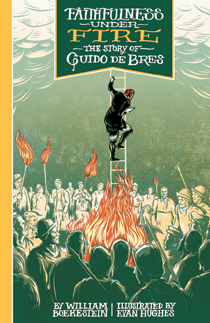
A couple of months ago I had the pleasure to read and review an interesting children’s book written by William Boekestein: Faithfulness Under Fire.  I was intrigued by the concept and thought it would be fun and beneficial to interview William.  He graciously agreed to answer 7 Questions. 

1. I recently had the opportunity to review your children’s book on the life of Guido de Bres. I am a history nerd, but honestly until I picked up this children’s book I had never heard of him. So, I’m curious of all the historical figures that you could have picked why Guido de Bres?

The short answer to this is, I have young children, I love church history and our denomination (the URCNA) uses Guido de Bres’ Belgic Confession as a secondary standard of doctrine. From my vantage point the choice made a lot of sense. On the other hand, De Bres’ lived such a fascinating life that even without those three criterion he’d be worth writing about. In addition to this, it can be rewarding to “unearth,” so to speak, the history of an obscure personality from the past.

2. Some may consider the subject matter a little too intense for the books target audience. The cover is not one that you would typically see in a preschool section of the book store. Most parents shy away from books that have flames under a guy climbing up a ladder. Explain a little about your philosophy of not sheltering children from the realities of life and persecution.

De Bres’ story is a bit graphic. We did try to gear the language toward young children and modify some of the images so they wouldn’t be too scary. That said, some of the themes of the book might seem to be too mature for young children. I address that concern in a note to parents on the last page:

The life of Guido De Bres is not exactly a pleasant read. The story is sad, and, in our age of tolerance, at times it is uncomfortable. Yet we believe his story is important because it really happened. In fact, it happened a lot! In other words, De Bres was not all that extraordinary. He was one of countless Christians who spent their lives in devotion to the Lord and in commitment to His Word.

We should say a few things about the graphic details and references to historical religious conflict in this book. First, the reader should know that every reasonable attempt has been made to avoid gratuitous, unsavory detail. It would be impossible, however, to tell the story of De Bres apart from the theme of suffering. We have also tried carefully to avoid unnecessarily inflammatory religious rhetoric. However, the fact remains that right up to the present, strongly held convictions will produce conflict. Even young children experience this.

Second, we don’t believe it is necessary to shield even young children from the ugliness of life as long as we also provide a context in which this life can be lived victoriously. Guido de Bres thrived in tragedy because he was hoping in the gospel of Jesus Christ. The gospel (or good news) of Jesus is this: because of His perfect life and sacrificial death, those who repent of their sins and trust in Him have God’s promise of forgiveness and eternal life (John 3:16). As this promise is realized in our lives, we too will approach life with the same hope that De Bres had. We will be equipped and motivated to spend our lives for God’s glory as we look to an eternal reward of grace.

This is the value we see in teaching our children about Guido de Bres—not to glorify him, but to be drawn by his example to live to the glory of God.

In addition to this, Christianity is rooted in one of most graphic stories ever told. I wonder how many Christian parents would disallow their children from hearing the passion narratives read? When we hold up the story of Guido de Bres with other stories in Scripture it doesn’t look that extreme.

3. You have written a bible study on the life of Jonah and you have also written a couple of children’s books now. Which do you prefer? What is a unique joy that you have in writing children’s books as opposed to books geared towards adults?

I do enjoy both. But children’s books are really fun. I think it has actually been helpful to do both. I used to think that books for adults don’t have to be interesting; especially theological books. I know that’s not true but it still isn’t easy to remember the rule of “show don’t tell.”

4. How many more of these children’s books from RHB can we expect?

That’s hard to say. “The Quest for Comfort: The Story of the Heidelberg Catechism” (see the FB page for this book) is due to be released in early Fall. I would love to see RHB publish the final book in this “series” on the story of the Canons of Dort. Who says that the story of a 400 year old theological deliberative assembly meeting can’t be engaging for young children?

5. I noticed that you recently had your third annual Life Reformation conference. Can you explain a little about the vision behind these conferences? Where are they located?

Our area (northeast Pennsylvania) has a very small evangelical population (it has been estimated at under ten percent. Our intention behind these conferences is to encourage those who do belong to evangelical churches and to offer robust, winsome theology in the Reformed/Presbyterian tradition. We would love to see more people attend these conferences but we are also aware that in the theological culture with which we are surrounded we need to be building for the future.

6. I can tell from much that you have written that you are passionate about families. How does your church minister to families?

We are still working on this one. One of the main ways we minister to families is through the preaching. One of the benefits of preaching in a small church is that you don’t lose sight of the “trees in the forest.” Each Sunday I’m preaching to 10-15 families. I need to communicate Scripture to them as fathers, mothers, children and siblings.

Our elders also have a commitment to visit every family in the congregation on an annual basis. This gives an opportunity to connect with, encourage, teach and if need be correct our families on a more personal level than is afforded during public worship.

7. Lets talk beards. I noticed that many of the books that clip_image002you have written have older Reformed guys with long and studly man-beards. Have you ever considered growing a beard like that of John Knox?

Is mine that much different than Knox’s? I guess I’ll keep working on it. I have a lot of respect for men with beards. If I lived in Scotland and my wife would go for it I would probably try to give Knox a run for his money.

——

Thanks for taking the time on these questions and may the Lord cause great growth in your life…both spiritually and in regards to your aspirations to have a Knox beard. 

You can follow William’s blog here: Life Reformation and you can find more information on his church here: Covenant Reformed Church.

happy and miserable

“What a wonder am I to myself!  Compared with what I deserve to be, how happy!  Compared with what I desire to be, how miserable!  -Andrew Fuller

One of the things that God often uses in my life to teach and strengthen me is to read the diaries of dear departed saints.  I have gotten much fruit from reading the diary of Robert M. McCheyne, Andrew Fuller, John Newton, and David Brainerd, to name a few. 

Often as you read through the diaries of these great men of God one is struck with how miserable they sometimes are.  It seems that many of these—those that seemed in public to have it all together—are wrestling with God from the depths of their souls.  I don’t think they are being dishonest or faking it in public.  I simply think that they have a tendency (like myself) toward introspection and as such they are prone to this pain. 

If you read through enough of these diaries you will see a pattern.  Usually after these bouts of misery God will heal with the balm of grace.  And hence we have the first part of Fuller’s quote—“compared with what I deserve to be, how happy”.  The gospel penetrates through the misery and the light and beauty of Christ is seen more clearly against the backdrop of personal sin and failure. 

I think Fuller is onto something here.  Believers are in a constant state of exceeding joy at who they are in Christ—but are not yet what we desire to be…and therein lies a deep seated misery. 

May this cause us to long for eternity—when our faith will become sight and our desire to see and savor Christ without the heart-numbing stain of sin will be finally realized.