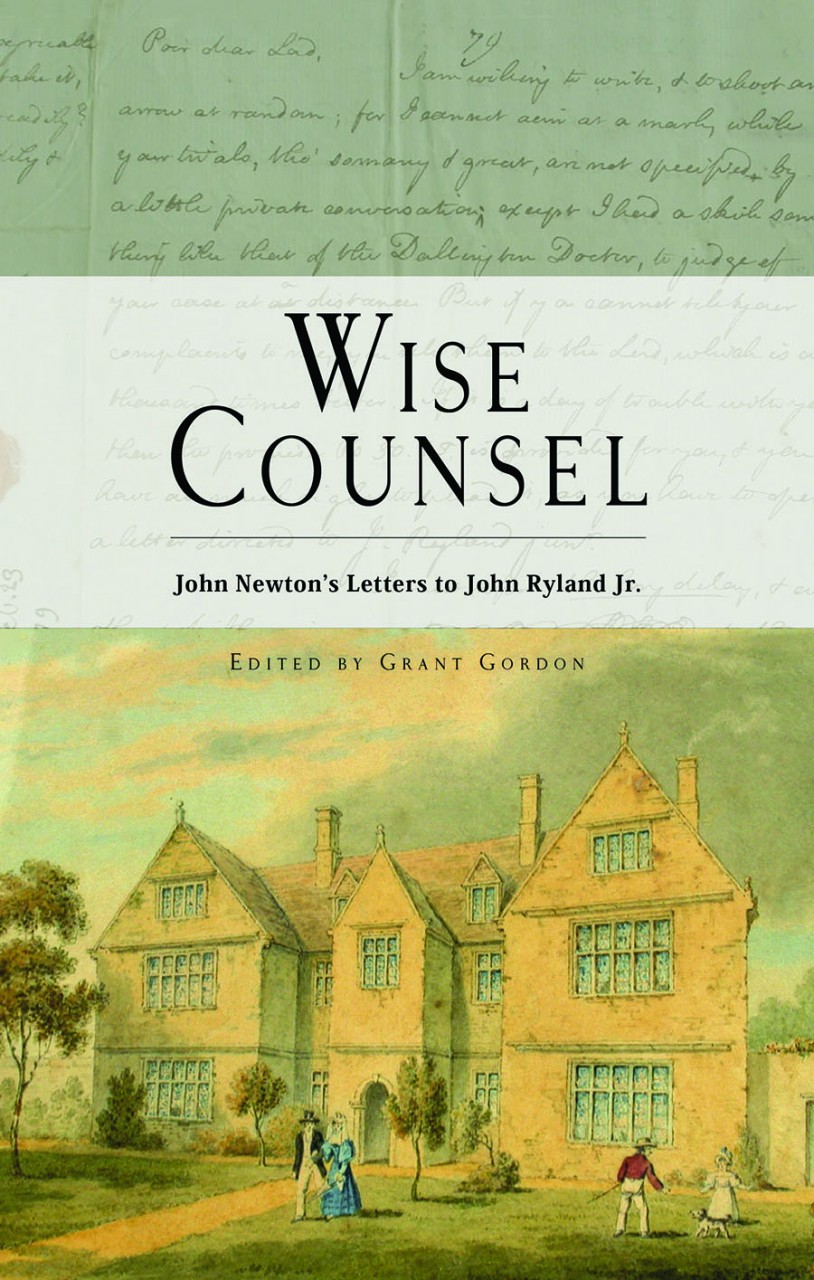
Quick Review of Wise Counsel: John Newton’s Letters to John Ryland Jr. Edited by Grant Gordon

“I wish my letters may be a bridle to you and yours a spur to me”.

T he above words are ones that John Newton wrote to John Ryland, Jr.  Newton was almost 50 when he wrote those words and Ryland was only around 20 years old. 
Every young pastor needs a bridle.  I know I did.  I had a dear pastor friend that would often “reign in” my youthful vigor with seasoned words of encouragement.  He had already been through the fire on many issues that were just beginning to warm me up.  He had already experienced some of the dangers attending ministry.  He was a bridle to my youthful zeal that was often marked by more ignorance and selfishness than actual grace. 

John Newton served as that “bridle” to John Ryland.  What Grant Gordon gives us in Wise Counsel is four decades of one-sided correspondence between John Newton and John Ryland Jr.  Within the pages of Wise Counsel are 83 letters that Newton wrote to Ryland.  Of these a good portion are previously unpublished. 

Gordon also has helpfully added footnotes explaining certain historical events to help the reader better grasp the context of the letter.  Also, after every letter Gordon adds a helpful historical survey to help the reader get a picture of the unfolding story in the life of both Newton and Ryland. 

If you are a fan of Newton then this book is a gold mine of information.  If you are a pastor (young or old) you will learn a great deal from this book.  Newton’s Wise Counsel extends well beyond his era and his cultural setting.  Because his advice is so often grounded in the unchangeable gospel it will cross borders, cultures, and centuries.  Those wanting to study Baptist history will find a wealth of information as well.  As will those wanting to study Christianity in the 18th century.  There is even helpful information for those wanting to learn about the abolishment of the slave trade.  There is something here for everyone.

I cannot too highly recommend this book.  There is a reason that it is #3 on my list of Top 11 books of 2011.  It quite possibly could be in the top 10 of books that I have read in my lifetime.  It is that rich with information and helpful advice.  You will benefit from buying and reading this book. 

Buy it here for 20 bucks.  (It’s worth every penny). 

From the Pen of Newton: The Danger of a Prosperity “Gospel”

Watch this:

Now read this:

…I believe there may be a real exercise of faith and growth in grace, when our sensible feelings are faint and low.  A soul may be in as thriving a state when thirsting, seeking, and mourning after the Lord, as when actually rejoicing in him; as much in earnest when fighting in the valley, as when singing upon the mount: nay, dark seasons afford the surest and strongest manifestations of the power of faith.

To hold fast the word of promise, to maintain a hatred of sin, to go on steadfastly in the path of duty, in defiance both of the frowns and the smiles of the world, when we have but little comfort, is a more certain evidence of grace, than a thousand things which we may do or forbear when our spirits are warm and lively. 

I have seen many who have been, upon the whole, but uneven walkers, though at times they have seemed to enjoy, at least have talked of, great comforts.  I have seen others, for the most part, complain of much darkness and coldness, who have been remarkably humble, tender, and exemplary in their spirit and conduct.  Surely, were I to choose my lot, it should be with the latter.   -John Newton

My Point:

Everything Joel Osteen says above may actually be medically true.  It is true that we probably would be healthier if we would lighten up a little.  Laughter really is good medicine.  So, medically speaking he is probably not wrong.  There is even one sense in which what Osteen says is actually quite helpful.  Sometimes what really needs to happen with a depressed, anxious, insomniatic person is that they do need to chill out and smile. 

But at the end of the day Osteen’s preaching is meant to give you your best life now.  God’s aim is much deeper.  Those that buy into Osteen’s “gospel” inevitably undercut one of the greatest graces that the Lord gives us to bring about holiness; namely, suffering. 

The apostle Paul says in Romans 5:3-5, “More than that, we rejoice in our sufferings, knowing that suffering produces endurance, and endurance produces character, and character produces hope, and hope does not put us to shame…” 

Who sounds more like the Scriptures?  Newton or Osteen?  Osteen is essentially saying above “hate your sufferings, run from your sufferings, laugh off your sufferings, whatever it takes keep yourself from pain.  Pain is the great enemy of God.”  Whereas Newton, is saying, “look to Christ in the midst of your sufferings, cling to grace when comfort seems to be nowhere to be found, whatever it takes throw yourself on the mercy of Christ.  Sin is the great enemy of God.”  Newton, rightly sees God working in the midst of suffering to root out of our hearts sin and unbelief. 

Most of Osteen’s stuff can fall under this rebuke.  I’ve heard many people swallow this stuff, confess that it may not be fully the gospel, and then ask, “what harm does it do”.  It seems like good advice.  If feels really good.  It matches well with our distorted view of God—that he’s around primarily for us and to make us happy. 

The problem is Osteen and all such prosperity theology actually undercuts the hope that it means to give.  It offers those suffering a best life now in a world of rape, starvation, greed, murder, slander, and all manner of God-belittling sin.  The gospel—as Newton faithfully preached—tells us that this is not our best life now and that God is in the midst of rooting out of our world all sin and unbelief (including our own).  There will be a blessed day when laughter reigns instead of depression.  But that’s accomplished through the triumphant Christ and not through making yourself laugh at the television.  In the midst of a broken world we ache—we don’t smile our way through life pretending like this is what redemption looks like. 

And that’s why the prosperity gospel is garbage.  Saying Osteen is harmless is like letting your children have a prostitute for a babysitter because she’s pretty, has a nice smile, and smells real nice. 

I’d also recommend this from John Piper:

The Cost of Not Loving

Love anything, and your heart will certainly be wrung and possibly broken.  If you want to make sure of keeping it intact, you must give your heart to no one, not even to an animal.  Wrap it carefully round with hobbies and little luxuries, avoid all entanglements; lock it up safe in the casket or coffin of your selfishness.  But in that casket—safe, dark, motionless, airless—it will change.  It will not be broken; it will become unbreakable, impenetrable, irredeemable.  The alternative to tragedy, or at least to the risk of tragedy, is damnation.  –C.S. Lewis

In other words, coffins might keep the dirt out but eventually you’re going to lose sunshine, beauty, hugs, and even life itself. 

Monday’s Ministry Musing: The Danger of Not Letting the Text Speak

Sometimes we are told that we cannot come to Christ unless the Father draws us, that without Christ we can do nothing, and that if we live, it is not we, but Christ who lives in us.  Now these views tend to hide pride from man, to create a diffidence of ourselves, and to center our hopes and dependence on Christ; but lest the slothful and wicked servant should make his impotence his excuse, we are called upon to turn and make ourselves new hearts; we are exhorted to ask and we shall receive; and we are assured that God will give the Spirit to them who ask Him…(John Jennings, Christian Pastor’s Manual, 53)

I have seen men of various stripes (myself included) totally blow this one.  I have seen those of a more Calvinistic understanding of the text come to a place that sounds really “Arminian” not let the text speak for itself but simply explain it away.  I have also heard those of a non-Calvinistic understanding of the text come to those places in Scripture that sure sound Calvinistic spend their time explaining why this cannot mean what it sounds like and do not let the text speak for itself. 

What inevitably happens is that when we are guilty of not letting the text speak for itself we have very unbalanced Christians.  I am amazed that whenever my heart and mind wants to attach myself to a narrow view the Scriptures pull me back.  There are so many times that I have ridden a verse for too long only to run smack into another verse that cries out to me, “yeah but”. 

Perhaps one thing that it means to “rightly divide the Word of truth” is to let the Scriptures speak for themselves.  When we come to a text like John 6:44 we should realize that many of these Calvinistic passages are given to us for the purpose of killing our pride, inspiring us to rest solely on Christ, motivating us to have unity, and encouraging us with the power and sovereignty of a faithful God.  Preach the text for those results, don’t go about explaining it away but use the text for what it’s intended to accomplish. 

The same thing goes for passages like Luke 13:24 or Ezekiel 18:23.  Rather than trying to explain them away or make them fit a Calvinistic grid just preach them as they are.  As John Piper rightly says,

“Don’t ride hobbyhorses that aren’t in the text. Preach exegetically, explaining and applying what is in the text. If it sounds Arminian, let it sound Arminian. Trust the text and the people will trust you to be faithful to the text.”

These text are here to help us have a full understanding of the heart of God.  It motivates us to missions and causes us to love our “enemies”.  When we are tempted to ride a text like John 6:44 into the errors of Hyper-Calvinism these verses a reigns that pull us in to a more balanced and biblical understanding of salvation.  Yes, we must strive to enter this rest.  There is no room for complacency. 

So, if you want to be the pastor of balanced Christians then one way to bring that about is to be faithful in preaching the text as it is.  Let the text speak for itself.  Yes, that’s hard…but that is part of the reason that you are “set apart” for the teaching and preaching of the Word.  You and I are given a charge by God to rightly divide the Word—let us do it, by His grace and for His glory.