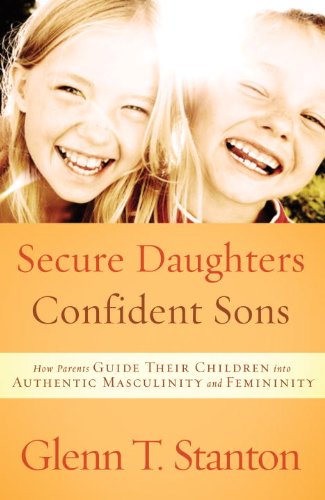
 Men and women are different.
You know that already. Some believe men and women are different because of social constructs that are left over residue from mindless and primitive culture. Others, like Glenn T. Stanton, believe that these differences are genetic. As such, a proper understanding of manhood and womanhood is essential to raising children. It is with this belief that Secure Daughters and Confident Sons was written. As Stanton says our goal in parenting is to, “raise daughters secure in their femininity and sons confident in their masculinity”.
Throughout the book Stanton considers the differences between men and women (both mom and dad and boy and girl). The first part of the book Stanton seeks to give a clear vision of biblical manhood and womanhood. In the second half he practically explores the implications of these gender differences on various aspects of parenting and life, including discipline, sex, empathy, and play.
Each chapter ends with a few questions and answers. And the book also has a helpful appendix consulting the sciences on differences between men and women. Stanton, taking over for James Dobson, is ever bit the social psychologist that Dobson was. He grounds much of his points in social research while reflecting on Scripture.
The Intention
In a moment I will share a few things that I believe are missing that could have made this book far more beneficial. In doing that, though, I want to be fair and thus carefully read and review the book on its own terms. I must consider Stanton’s claims for the books. What did he hope to accomplish? It appears to me that his chief aim in this book is to defend the reality of gender differences, show how they actually benefit, as well as show how it takes manhood and womanhood to raise secure daughters and confident sons. He wants to defend his major thesis that “raising secure daughters and confident sons is, by definition, gender-distinct work.
What I Appreciate
There is much that I appreciate about this book. First, one cannot read this book without coming away with the idea that both mom and dad are vital to parenting a child. Of course this may be discouraging for single parent families. But it may also dispel the silly myth that women need men like a fish needs a bicycle (or vice versa).
Secondly, I learned a good deal. I think a good amount that can be learned and gleaned from the social sciences that Stanton uses can be very beneficial in parenting. It is really wonderful to hear stories of other parents and children and be able to say, “ohhhhh, that’s why he’s/she’s doing that”. It can also be beneficial to know that part of spousal differences in parenting really goes back to gender differences.
Lastly, I am thankful for Stanton’s work and his courage in standing against a growing cultural tide against what Scripture teaches about men and women. I am thankful that Stanton is standing against the tide and saying—“hey men and women are different, they are different for a reason, and that is a good thing. Men and Women are both necessary in raising a child”. I echo the sentiment of Dr. Mohler who says, “I am thankful for his conviction and his courage”.
The Missing
In the first two chapters Stanton lists various masculine traits and feminine traits. Those these qualities will manifest themselves in different ways and though they may be stronger in some than in others, yet they still help us to distinctly understand what it means to be male/female.
In my mind this begs a question: are these “masculine” or “feminine” traits part of the Created order or from the Fall?
I think it can be faithfully argued from Scripture that God did indeed make male and female different. Anatomy teaches us this much. But are all (or any) of these characteristics part of the Created order or is it possible that they are from the Fall? I believe that Stanton is rightly observing men and women as they are. But because he is not able to (or at least doesn’t) ground these characteristics in creation we are not certain that this is the way that men/women should be. Just because this is how a vast majority of men and women are it does not mean this is how they ought to be.
And this is where I feel books such as this are fundamentally lacking. The heart is very deceitful and if moms and dads are not gospel-informed they can easily mask sin behind claims of “this is who I am”. We can also easily miss opportunities leading our children to the gospel because we wrongly assume that little Billy’s aggression is more a result of his maleness rather than his fallenness. While it is a worthwhile and noble goal to raise secure daughters and confident sons—at the end of the day we want our daughters to be secure in Christ and our sons to be confident in the Lord.
I do not think that Stanton would disagree with the above sentiment. I believe that Stanton loves the Lord and wants to see the gospel promoted. Certainly biblical manhood and womanhood is key in reflecting the glory of a Triune God. God made male and female different for a reason. Part of living out the gospel is reflecting the unity in Christ through our diversity of gender. I believe Stanton would agree with this and would say that his book helps in this regard. Yet, at the end of the day in reading through Secure Daughters and Confident Sons I do not see the gospel proclamation and pointing to Christ that could have buttressed what is –or could be–a very helpful book.
Conclusion
I am at a loss as it concerns recommending this book. Part of me wants to give a stamp of approval. The other part of me wants to tell you to spend your money elsewhere. There is a good amount in this book that can assist a mom or dad in seeing how differences in gender impact their children as well as their parenting. There are also many helpful tips that will potentially create more unity between moms and dads. As I stated earlier I also want to recommend the book because I agree with its fundamental thesis and its emphasis on the necessity of both mom and dad. If this book inspired more intentional parenting between men and women then I am all for it. However, I also think that the gospel may be merely or assumed in this book—or worse yet is eclipsed by a misdirected focus.
At the end of the day I am left with saying if you are looking for a book that will give you eyes to see how things are then this book will be helpful. But if you are looking for a book inspiring you, motivating you, and assisting you in living out the gospel and how things should be then I think there may be other parenting books that help a little more.
I got this book free from Multnomah in exchange for a review. You can buy the book for around 10 bucks.


 From (
 God is not satisfied with us merely having a “good” marriage. God wants to use our marriage to conform us more and more into the image of Christ. God has a rescue plan for your marriage. His goal is not simply to rescue your marriage. His goal is to use your marriage to rescue you.