Review of Counterfeit Gospels by @TrevinWax

I had just taken a group of teenagers to this conference to hear one of those really amazing youth speakers.  Thought it was a good speech, when compared to a Christ-centered sermon it was pretty bad.  I’m not even sure that the dude even mentioned Jesus.  He certainly gave Ignatius the Rock Star Youth Pastor a run for his money. 

Afterwards I asked a couple of the guys that I had been discipling what they thought of it.  One of the guys responded, “You know I couldn’t really put my finger on it, but I knew that something wasn’t right about this.  I knew something was missing”.  In other words, he knew that something was counterfeit he just wasn’t sure exactly what about it was askew. 

Trevin Wax has written a really good book on the counterfeit gospels in our day that would have helped that student to put his finger on just what was askew in the Ignatius wannabe’s sermon. 

Summary

In Counterfeit Gospels, Wax outlines the biblical gospel under three headings.  Which act as a “three-legged stool.  Cut off one of these legs, and the whole thing tips over.”  These three legs are the gospel story, gospel announcement, and the gospel community.  Each of these legs are in danger of being hi-jacked by a counterfeit gospel. 

Wax’s book is structured around these three legs.  First he considers the gospel story.  And then it’s two counterfeits: the therapeutic gospel and the judgmentless gospel.  Then he looks at the gospel announcement and its two counterfeits; namely, the moralistic and the quietist gospel.  Lastly, he consider the gospel community and it’s counterfeits of the activist gospel and the churchless gospel.  He closes up the book with a helpful epilogue about being witnesses of the unchanging gospel. 

I appreciate the way that each explanation of the counterfeit gospels is structured.  Wax begins with examples of how this counterfeit displays itself in our culture.  He then considers a few reasons why such a false gospel could be attractive.  Though attractive these false versions of the gospel are deadly and Wax demonstrates why.  He closes out each chapter with a few tips on countering the counterfeit.

My Take

The book is immensely practical and well-written.  I know that a book is well-penned if it inspires several ideas for my own writing.  It seemed that about every 10 pages or so I was putting the book down and jotting down an idea for an article.  Wax does a great job of making what could have been a 600 page book a succinct yet thorough 220 page book. 

None of these counterfeits are off the wall or just simply filler.  I have personally witnessed and dealt with every single one of these.  Some of them are more prevalent than others but they all exist in our culture.  I think that I may occasionally go back to Wax’s book as I think through outlining a few preaching series for the coming year.  One could use his “countering the counterfeits” to think through a plan for not only proclaiming the full biblical gospel but doing so in light of some of the ways that people might mishear the gospel message. 

It is also worth noting that I’m a little late to the review Counterfeit Gospels party.  One particular discussion that took place concerning this book is Wax’s analogy of the gospel as a three-legged stool.  John Starke had some helpful criticism and it’s worthy of reading.   I appreciate Starke’s revision, yet I think Wax’s analogy is strong enough to stand on its own. 

Should You Buy It?

As I read through this book I found myself constantly wondering who it would be best suited for.  Is it a book that I should hand a newer believer?  It’s certainly written in a way that would be helpful for one.  Is it a book that a pastor ought to read?  I’m a pastor and I found it helpful.  Is it a book for those that seem to be drinking the poison of a counterfeit gospel?  I think if they were doing so ignorantly then perhaps it would help. 

At the end of the day I’m not sure that I can really pinpoint an audience.  This book would be helpful for every believer that desires to believe and live out the biblical gospel and not succumb to some of its most subtle counterfeits.  I think it would be a helpful read for anyone. 

You can buy a copy today for only 9.90 or 8 bucks on your e-reader. 
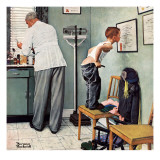
Why We Must Dig a Little Deeper Than Norman Rockwell and Benjamin Franklin to Discover Idols

I’ve said it in sermons and probably even wrote it on this blog a few times: 

“Show me your wallet and your calendar and I’ll show you what you treasure”. 

I still believe that statement is true.  But I also believe that in practice it needs to go a little deeper than seeing what I’ve scribbled onto my Norman Rockwell calendar or where I’ve shelled out my Benjamin Franklin’s (or more precisely my Abe Lincoln’s). 

I say that it needs to go a little deeper because I know the things that are on my calendar and the things that are I spend my money on.  And I also know the idols that I battle in my life.  And the two don’t seem to match up and first glance.

As an example one item that I spend time and money on is the MLB.TV baseball package.  I love watching Kansas City Royals baseball (or whatever you call that thing they do while the opponent plays baseball).  This is one place where both money and time goes to.  Yet, for the most part it is not an idol in my life.  At least most of the time.  Sometimes I use it as an escape.  Occasionally when things around me seem to be spinning out of control I crave locking myself in the basement and just watching the Royals “play”. 

If I were to take the time and money test then I could put KC Royals baseball on the list of idols.  And if I were feeling uber-spiritual or something I would unplug the television, unsubscribe, stop watching Royals games, and pretend like I had conquered an idol.  But in reality its not baseball that is an idol.  In actuality, it is trying to find comfort and security outside of Jesus.  And those dirty siblings would just pop their little unconquered rebellious heads up in something else.   

That’s why I say that though we can begin identifying idols by analyzing where we spend our time and money, it would do us well to ask a few more probing questions once we get beyond the initial look at our time and money. 

Today in Blogworld 7.30.12

7 Ways to Put On Humility

Scripture call us to clothe ourselves with humility.  Mark Altrogge gives 7 ways that we can do just that. 

Are We All Just Broken People?

Maybe I should have called this edition of Today in Blogworld the “Blazing Center Edition”.  This one also comes from there written by Stephen Altrogge.  The question seems to be coming up quite a bit lately concerning the use of the term “broken”.  Stephen likes the word but isn’t a big fan of using it in reference to Christians.  I’m still not sure. 

Sometimes God Doesn’t Open Doors

TGC is running a series of posts on “The Page that Changed Your Life”.  Here Gloria Furman discusses how page 31 of Milton Vincent’s The Gospel Primer for Christians changed her life.   

4 Debilitating Fears

I am beginning to wonder if Paul Tripp is in the process of writing a book on fear.  He has been posting a ton about fear lately.  Here he discusses four types of fear that can cripple us. 

For some reason this makes me laugh:

(HT: 22 Words)

The Effect of the Prosperity “Gospel” On Pain*

If you are not familiar with the prosperity “gospel” turn on your television and watch TBN for about 15 minutes.  There you will be exposed to the damnable teaching that what the gospel is really about is securing our health, wealth, and happiness and our best life now.  Consider these words of Kenneth Copeland concerning Paul’s thorn in the flesh:

Paul’s thorn in the flesh is a tradition that Satan has used to deceive and rob many people. Using it as an excuse, tradition says that God gets glory from sickness because the world sees how marvelously the Christian bears pain and agony. Tradition never adds up to the right answer – anyone knows that the world has all the pain and agony it can stand. The world wants a way out of sickness, not another way into it.

The typical mantra of these shiny watch-wearing, jet-flying, shysters is that God is in the business of blessing people.  If you want to see someone who is living in the favor of God you will not find it in a poor widow, a sickly orphan, or in a downcast soul.  You will find it in a first-class flyin’ preacher that spends his time helpin’ poor folk get their blessings by sowing their seed into his tailor-made suit pocket. 

Because of this belief Paul’s teaching on the thorn in the flesh is completely reversed.  Rather than Paul saying that he is glorying in an unremoved thorn and that the Lord’s grace is sufficient in the midst of hardship these prosperity teachers do a ton of gymnastics to get around what the text clearly says. 

Paul’s thorn

According to Copeland the thorn is an “evil angel”.  This isn’t any of God’s doing it’s all of the devil.  Pain, suffering, sickness, all of those things must not have anything to do with the work of God.  And according to Copeland “this evil angel was assigned to Paul for one reason—to stop the Word from being preached”.  Forget that Paul said it was “given me in the flesh” for the purpose of “keeping me from being too elated”. 

You see within the framework of the prosperity gospel God is not glorified in  our weakness.  God is glorified in our strength.  Or to put that another way the way that God receives glory is when my past is conquered and I live in victory.  If I am not living my best life now then I’m not giving God the glory that He deserves. 

Copeland even has the gall to say that Paul erred in pleading with God to take away the thorn.  As he says, “If you want results, do not ask God to deal with the devil for you…He instructs you to drive out the demons or evil spirits.”  Had Paul not pleaded with the Lord to remove it then he would have gotten the results that he desired. 

While you have a thorn in your flesh you aren’t able to glorify God as you ought because you are living in the devils defeat and not the Lord’s victory.  Therefore, you believe on what you want.  You unleash your faith on removing this thorn and you believe God for it.  You let go of it and you start believing God for victory. 

But what happens when “victory” doesn’t come?…

The Effect on Pain

The problem with this false teaching is that it tries to wipe away ever tear from our eye before we are living in the Redeemed Eden.  That sounds nice and some of these false teachers may very well have good intentions and believe every word of the garbage spewing out of their mouth.  Problem is, they sound more like Job’s miserable counselors than the counsel of the Lord.

What they are subtly communicating—and sadly I think many within the church have bought into this—is that God cannot use me until I have this thorn conquered.  I am a little less than acceptable until I get a grip on this depression.  Certainly people will rally around me and help me remove this thorn—that’s what Job’s friends did.  But what if this thorn is never going to be removed?  Am I supposed to hide this part of me?  Should I shoe my thorn?  Dare I walk with a limp? 

You see I’m becoming increasingly convinced that faith doesn’t look like a man living in success and victory in the Christian life, where everyday is better than the next.  I’m convinced that a better picture of faith is when a man is almost totally overcome by doubt, fear, anxiety but he still keeps a white-knuckled grip on the promise of future redemption.  I’m convinced that a better disciple is one who fixates his eyes on “things that are above” instead of trying to live his best life now. 

Of course we all want mountain moving faith but the faith as tiny as a mustard seed is just as miraculous.  So, why don’t we rejoice in feeble faith? Why don’t we celebrate those souls that are shamed and yet trusting, like Jesus does?  Can we celebrate a wound that isn’t yet healed?  Why do we have to wait for victory?  Why can we not dance with a limp? 

Maybe because we’ve bought into the lie that people with thorns are a little less than what it means to be a disciple.  And maybe we’ve made thorn removal the goal instead of dancing in grace. 

—

*This is actually part three in my series on thorn removal but I changed the title to make it more accessible.