Review of The Hole in Our Holiness

“The hole in our holiness is that we don’t seem to care much about holiness.  Or, at the very least we don’t understand it”. 

That “hole” is what has motivated Kevin DeYoung to set his pen to writing.  The result is a little book entitled The Hole in Our Holiness: Filling the Gap between Gospel Passion and the Pursuit of Godliness.  Many have been waiting this “ruthlessly biblical” treatment of holiness.  And those that attended T4G and heard DeYoung’s message there (which seems to have found its home in chapter six of this book) knew that this book was going to send shock waves throughout the gospel-centered movement. 
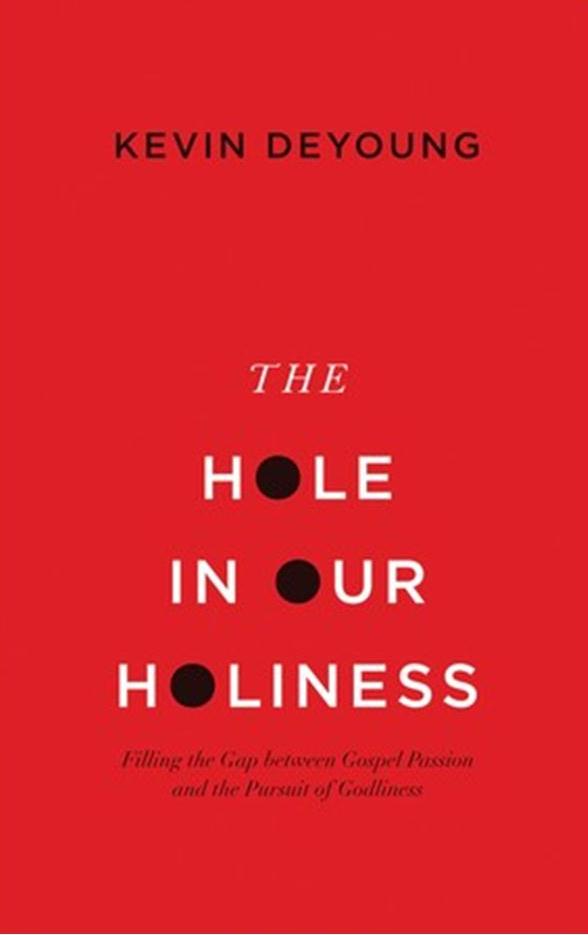
The book begins with DeYoung’s defense of his book and explaining his desire to fill the gap that seems to be in the gospel-centered movement.  For the first six chapters DeYoung, with his typical wit and faithful treatment, lobs a few correctives to the gospel-centered movement and slowly begins establishing a case for having a passion for holiness alongside our passion for gospel centrality.  In the last four chapters he begins to make his case practical and explain the biblical categories of union and communion. 

Union with Christ, says DeYoung is the “irrevocable work of the Spirit”.  He notes that, “nothing can make us a little more or a little less united.”  Compartively, “Communion with Christ…can be affected by sin and unresponsiveness to God’s grace”.  For all of our emphasis on union with Christ, DeYoung wants to see the church also have a passion for pursuing deeper communion with Christ.  And that is the central theme and purpose the book.

My Take:

I’m a little lost at how to review this.  If these chapters were separate blog posts from Kevin’s blog, DeYoung, Restless, and Reformed, then I would have probably linked to almost everyone of them in my Today in Blogworld feature.  By themselves each one is tremendous.  Kevin is a tremendous writer and it shows throughout this book.  He has a way of making you laugh, punching you in the gut, applying the gospel, and then making you laugh again as you close the book up and go about living your life all the while having been profoundly changed throughout. 

There is nothing in this book that leaves me shaking my head and saying, “whoa, this dude has gone off the deep end”.  The correctives that he mentions are needed and helpful.  Personally, I appreciate him saying, “It’s not wrong for a sermon to conclude with something we have to do.” (54)  And I further agree with him that those of us within the gospel-centered movement can without an equal emphasis on holiness end up “confused, wondering why sanctification isn’t automatically flowing from a heartfelt commitment to gospel-drenched justification”.  (91)

So why am I confused in how to review this?  Mainly because this is a book review and not a review of several separate blog posts put together.  In my opinion the book is confused as to its audience and overall purpose. 

I think had DeYoung decided he wanted to only write a book about the hole in the gospel-centered movement and our lack of emphasis and promotion of holiness then it’d have been better.  Or even if he wanted to write a book simply on holiness and how it comes about.  But I think he tried both and it didn’t seem to fit together. Honestly, it reads kind of like an associate pastor that finally gets to preach and decides to try preaching 4 sermons in the time frame of 1. 

That is why I am conflicted.  If you were to ask me, “What is the main thesis of the book” I think I would say that DeYoung believes that there is a hole in our gospel and that we need to start emphasizing personal holiness as well as gospel passion.  And as he points out that hole in the gospel he wants to fill it with a robust theology of holiness.  The book is an attempt to point out the hole and then fill it. 

But does he do it? 

Time will tell.  Part of me wants to say that the book is awesome and one of the better books written in the last couple of years.  But the other part of me wonders if it is just a bunch of really awesome truths and statements that wind up simply jarbled around in my skull but not as life transforming as they could have been had I been given a few pegs to hang them on. 

Part of me does not even want to mention that criticism.  The book is superb for the most part and I would feel comfortable putting it in the hands of anyone in our congregation.  It is, as Piper says on the back cover, “ruthlessly biblical”.  And I would never discourage anyone from buying a book that is ruthlessly biblical.  There are whole paragraphs in the book that inspired me, encouraged me, convicted me, and drove me to re-examine ways that I say things.  The book has proven helpful for me.  I’m simply left wondering if the lack of cohesiveness and confused audience will get in the way of leaving a lasting impact. 

At the end of the day, though, I would highly recommend this book.  It’s possible that the lack of cohesiveness is a problem with my brain and not Kevin’s typewriter.  He’s a tremendous author, speaker, and seems to be a humble man of God.  So, I’d be happy to chalk the fault up entirely to myself.  And I would greatly encourage you to shuck out 10 bucks and get a copy for yourself. 

You can buy it here.

Today in Blogworld 9.12.12

Democrats and Abortion: Why the DNC “Cheering” Disturbs Me So Much

Wise words here from Ed Stetzer.  “In 1992, President Clinton talked about making abortion “safe, legal, and rare.” Now the DNC cheers its mention– dozens of times– and never mentions the “rare.” Perhaps the cheering points shows us that the “rare” part was just a talking point from another era.” 

When Should Children Be Baptized?

I wish Tim Challies would have posted this piece a couple of months ago when we were discussing this while revising our Constitution.  I think most Baptists tend to take the “baptize them when they make a decision”.  I tend to be the minority and believe it’s probably wise to wait.  (I’m more in line with David Michael’s view than any). 

A Possible Marriage Saver in Nine Steps

One of the keys to marriage is seeing how “bearing with” and “forgiving” mingle together. 

A Couple Books for your E-Reader

Orphanology by Tony Merida & Rick Morton is only $2.99
The Unwavering Resolve of Jonathan Edwards by Steven Lawson is under a buck. 
Basic Christianity by John Stott is only $3.60 

I found this to be really powerful:

Hope in the Midst of A Really Long Bath of Tears

    I hear, and my body trembles;
        my lips quiver at the sound;
    rottenness enters into my bones;
        my legs tremble beneath me.
    Yet I will quietly wait for the day of trouble
        to come upon people who invade us.
(Habakkuk 3:16 ESV)

I’ve noted in the past my continuing frustration with the northside McDonald’s in Jasper.  It doesn’t seem to matter if I order something as easily accessible as sliced apples they always make me pull forward and wait an eternal three minutes.  It is a great injustice to my American sensibilities and Mc-expectations that I must wait over 5 minutes to get food. 

Then I read Habakkuk 3:16 and gloss over it without feeling the weight of that last sentence, “Yet I will wait for the day of trouble…”  Allow me to put that into perspective.  More than likely the absolute latest that Habakkuk penned these words was 609 B.C.  A few years later in 605 the beginning of the Jewish turmoil from the hands of the Babylonians took place.  It wasn’t until 586 that they were finally taken into an exile that would last until 538.  The Babylonians themselves were not given their day of trouble until 539 by the hands of the Persians.

That means that from the time of Habakkuk 3:16 until the Babylonians had their day of trouble in 539 a whopping 66 years had passed.  Sixty-six years is a long time.  

Sixty-six years ago it was 1945. 

  • This was the final year of World War II.  At the beginning of 1945 Adolf Hitler was still alive.  FDR was still President.
  • The kiss pictured to the right was on VJ Day sixty-six years ago.  Though the identity of the couple is debated we know the subjects are either in their 90’s or their grave. 
  • Bob Marley, Pete Townshend (of Who fame), Walt Frazier, Peter Gammons, Neil Young, and Bette Midler were all born.
  • Though few were buying them because of the war, a new car was 800 bucks and a gallon of gas was about 18 cents.
  • The color barrier in baseball would not be broken for another two years
  • This was the last year the Chicago Cubs would make the World Series
  • The Cleveland Rams won the NFL Championship
  • The top movie in 1945 was The Bells of St. Mary’s (never heard of it)

Now let’s think back to 1945 and consider the words of Habakkuk.  God has promised that in the discipline of His covenant people He would also bring justice upon the Babylonians.  But this period of discipline is going to be rough.  For the next sixty-six years Habakkuk will only see the Babylonians in power.  They are blood-thirsty tyrants and will not go lightly on the Habakkuk’s people.  He’s not just being dramatic when he says that body and legs are trembling and that rottenness enters his bones. 

Sixty-six years (or up until his death) Habakkuk would wait quietly trusting in the Lord’s goodness.  This helps us to also put the more famous verses in Habakkuk 3 into perspective:

    Though the fig tree should not blossom,
        nor fruit be on the vines,
    the produce of the olive fail
        and the fields yield no food,
    the flock be cut off from the fold
        and there be no herd in the stalls,
    yet I will rejoice in the LORD;
        I will take joy in the God of my salvation.
(Habakkuk 3:17-18 ESV)

That’s sixty-six years of no blossom, vines, olives, food, flock, and herds.  Certainly not every moment was a bath of tears.  Yet suffering would be the pervasive theme for the rest of Habakkuk’s life.  Everything would now be tainted and viewed through the grid of suffering. 

Now do you see the audacity of “yet I will rejoice in the LORD”?  That is a big YET.  That’s not “even though I have to wait for 5 minutes at McDonalds I will still trust in the Lord”.  That is saying “even though I endure sixty-six years of pain and suffering I will rejoice and find joy in God alone.”

As I think about Habakkuk I do not feel sorry for him.  I feel sorry for us.  Habakkuk was drinking deeply from the fountain of joy and delight because his heart had nothing else to find delight in.  Not us.  We have plenty to distract us and bide for our attention and affection. 

The question for us today is whether or not we will believe like Habakkuk that lasting joy is found not in maximal comfort in this life but in staking our claim on that which is to come.  Will we quietly wait and tremble before the God of both justice and redemption to make all things right?  Or will we kick against Him as He destroys our mock comfort of “here” and replaces it with the lasting joy of eternity?

How Our “But” Keeps Us From Obedience

“If possible, so far as it depends on you, live peaceably with all”
Romans 12:18

Yesterday, I posted an article that was mostly a quote from John Newton on the necessity of living at peace with our brothers and sisters in Christ though we have theological differences.  It’s a really tremendous article that you should read.  I can say that because my words are only those of introduction, Newton is the one that drops the gospel bombs. 

As I was reflecting on Newton’s words, and even more the words of the apostle, my “but” voice reared its ugly head.

But certainly there is a place for intense debate and dialogue. 

But isn’t orthodoxy just as important as orthopraxy? 

But doesn’t Jesus say that He did not come to bring peace but a sword?  How can I live peaceably with all if I am proclaiming an offensive gospel?  Ahhh, yes that is why Paul said, “so far as it depends on you”.  The gospel is offensive.  Sinners don’t like the gospel.  Therefore, you can chalk their charges of abrasiveness to their hatred for the gospel. 

But Arminians are in error and an Arminian view of the gospel will inevitably harm the church.  (There, I said it).  If I believe something is in error am I not just being a good pastor to fight those that are ignorantly feeding the sheep something that will harm them?  Isn’t there a time to stand up and fight?  Even if it’s those within our own ranks. 

But those on the other side of the aisle are lobbing stink grenades at us.  They are hoisting up straw-men, torching them, and then mocking our theology.  Doesn’t truth matter anymore? 

And those of you that are more of the Arminian stripe can woundedly look at the example two paragraphs up and say But I’m offended.  How can we do NOT do battle when you say things like my theology is in error?  How can we really love one another when you think I’m wrong?

Each of those “but’s” has some legitimacy.  Truth does matter.  But just because truth matters it does not mean that our charge to live at peace with one another and not to devour each other is somehow negated.  Just because we have a “but” that we may rightly need to obey it does not let us off the hook of obeying the other truthful proposition. 

Some of us are wired to latch onto the “peace” type of verses and every time we hear a “fight” verse we throw out our “But…peace”.  Others are more geared to latch onto the “fight” verses and every time we hear a “peace” verse we throw out our “But…fight”.  Though our “but” might be true we cannot neglect the truthfulness of the other side. 

May we not let our “but” keep us from diligently pursuing obedience.

—

Given the pattern of my blog, I doubt anyone will comment on the Newton article. I  pray it will be read and digested, but I seriously doubt anyone will leave a “but” type of comment.  However, because Scripture tells me to live at peace with everyone I want all readers to know that though this article will post a day or more after the previous article, it is NOT in response to any comments.  Because at present there are not any.