Today in Blogworld 10.31.12

“I’m Not Much of a Reader”

Jared Wilson shows why that is a lame excuse for not reading your Bible. 

Reformation Day Free Download

In honor of it being Reformation Day (the day when Luther nailed the 95 Theses to the Wittenburg Door) today only you can download R.C. Sproul’s Luther and the Reformation

Embracing the Thorn That Bleeds You Dry

In a very vulnerable post Stephen Altrogge shares his struggle with anxiety.  I really appreciate pieces like this.  AS one who struggles with similar things myself I always find it encouraging when brothers and sisters in Christ hold on to Jesus in spite of the pain. 

Why Zombies Matter

There is a massive rise in zombie stuff.  Russell Moore explains why Christians ought to have some sympathy for zombies. 

This is cool for history nerds like myself.  Inside Calvin’s church in Geneva:

Should Churches Dream Like Steve Jobs?

Yesterday, I listened to a talk from Steve Jobs from 1983.  I’d encourage you to at least play it in the background or give it a skim listen at some point:

Did I mention that he gave this talk in 1983?!?!  In this hour he predicted the world that we live in today.  And he did it with passion and confidence.  It felt as if Steve Jobs had time travelled to the year 2000 and then went back to 1983 to tell people what he witnessed.  Amazing! 

As I listened to Jobs I couldn’t help but wonder whether or not churches ought to dream like Steve Jobs?  Jobs stood before these people and said, “This is what the world is going to look like in 10-15 years because of what we are doing at Apple”.  This got me wondering, should pastors stand before their churches and say, “this is what the world will look like in 10 years because of the impact of our church”? 

Maybe Not

My first instinct is to balk at the idea of a pastor or church speaking in this way about the work of God in their community.  There are several things that are different about what Jobs is doing and what a church is tasked with doing. 

For one, there is very little that is offensive about an Apple Computer (apart from maybe the price).  The gospel on the other hand is offensive.  Convincing someone of buying an Apple isn’t the same as convincing someone of the beauty of Jesus.  One requires the work of the Spirit the other is something that man can do. 

Secondly, the folks at Apple hand-picked the people that worked for them.  They only took the greatest of people.  The church is much different.  Christ does not look for the best and the brightest.  The church is not structured like Apple nor should it be.

Third, after I listen to this presentation from Steve Jobs I cannot help but marvel at the amazing Steve Jobs.  That seems opposite of what a Christian preacher ought to do.  James Denney was correct when he said, “No man can bear witness to Christ and to himself at the same time.  No man can give the impression that he himself is clever and that Christ is mighty to save”. 

For these reasons and more I do not think it is wise to uncritically latch onto Steve Jobs’ passion and say, “church we ought to dream like this”.  People can build computers, only Christ can build His Church. 

At the same time, I do not think we ought to dismiss the passion of Steve Jobs.  There is something here that ought to be emulated. 

Maybe

There is something about Steve Jobs that ought to humble churches.  He had a vision, albeit one created in his mind, to change the world.  He believed that dream so much that he “gambled everything on it”.  He gave his life to the vision of Apple.  He could talk about 10-15 years down the road because he knew that he was going to still be at Apple.  The average pastor in the SBC barely stays for two years in one place—so how can he dream about 10 years down the road? 

There is also something to be said about the fact that Jobs would not settle for something that did not fit his vision.  If it was not ready he was not going to roll it out and sell people garbage.  He had a dream and rather than settling for what could be done today he kept plodding until his vision became reality.  There is certainly a sub-biblical way to follow Jobs in this way.  Yet, there is also something to be said for not comfortably camping out in a world that doesn’t yet reflect the heart and mission of Jesus. 

This leads me to ask, why can’t we take God’s story and His mission and dream like Steve Jobs?  If God is working to fill the world with his glory by rooting out of his kingdom all sin and unbelief and replacing it with passionate worshippers then why can’t we be like Steve Jobs in seeing this “dream” come to fruition?  We might not be able to say, “in 10-15 years” but we can certainly say with confidence “this is the world that God is creating”.  And let’s be like Steve Jobs and not rest until God’s vision for the earth is accomplished. 

If a man can be this passionate and confident about a dream of computers why can’t believers be that confident and passionate about the sure promise of God’s redemption? 

3 Tips for Reading Scripture With Cultural Sensitivity

I am guessing that every student has experienced the unwelcome feeling of receiving a test and having no clue which answer to circle.  I remember one particular test that I took in high school that I simply used as an excuse to pay homage to AC/DC.   I didn’t know a single question—or even really look to see if I knew a single question—but I still managed to pull out a respectable F instead of an absolute zero. 

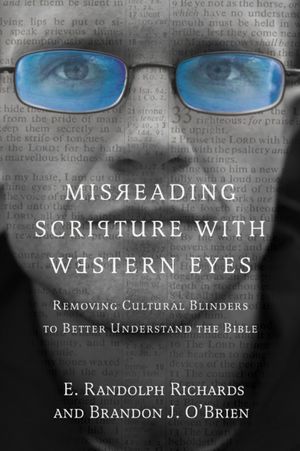
In his book, Misreading Scripture with Western Eyes, Randy Richards tells of his experience in Indonesia.  Richards tells how a number of students left questions unmarked.  When probed as to the reason that they did not even make a guess the students replied, “I didn’t know the answer”.  Richards wondered why they didn’t just circle something, that way they would at least have a 25% chance of getting it correct.  To this they responded, “What if I accidentally guessed the correct answer?  I would be implying that I knew the answer when I didn’t.  That would be lying!” 

Richards confesses that his “American pragmatism had been winning out over my Christian standard of honesty”.  He, and coauthor Brandon J. O’Brien, use this story to remind us of the benefit of looking at the world through a different set of eyes.  Without their eyes we might be ignorant of the blindness of our own.  There are undoubtedly, cultural mores that we simply assume. 

So, how can you read the Scripture with cultural sensitivity?  Richards and O’Brien suggest three things:

  1. Begin with yourself.  Pay attention to your instinctive interpretations.  Ask three questions of the text.  First, “Clearly, this passage is saying (or not saying) ______ is right/wrong.  Second, Is (that issue) really what is condemned?  Thirdly, Am I adding/removing some elements? 
  2. Look for clues in the text you’re reading.  For example in Luke 6:1-9 the Sabbath is mentioned six times.  Clearly that is the focus of the text not eating or healing. 
  3. Read the writing of Christians from different cultures and ages.  In other words read Scripture with a different set of eyes than your own. 

Just because something is read through Western eyes does not necessarily mean it is wrong. In the same way just because someone from a different culture adopts a different interpretation it does not mean that they are correct and we are wrong; either way seeing something with a new set of eyes enriches our own Bible study. 

I have benefited from the work of Richards and O’Brien and I believe you would too.  (I hope to give a full review of this book within the next couple of weeks) 

Today in Blogworld 10.30.12

Macabre and the Christian Psyche

I really enjoyed this article by Patrick Schreiner.  Here he reflects on our cultures increasing fascination with death and darkness, and considers whether or not Christians ought to engage in the horror genre.

Kathy Keller Reviews Rachel Held Evans’ Year of Biblical Womanhood

I have yet to read through Evans’ book and honestly I doubt I will.  Kathy Keller is pretty hard hitting in this review. 

36 Purposes of God in Our Suffering

With help from Joni Eareckson Tada and Steve Estes, Paul Tautges lists 36 purposes of God in suffering as revealed in Scripture. 

E-Book Deals (This Week Only)

Union with Christ by Michael Horton only 99 cents
The Kingdom and the Church by Michael Horton is also only 99 cents
Gospel Coach by Scott Thomas is $4.99

All E-books at Shepherds Press are only 99 cents. 

I really enjoy rock music combined with orchestra.  Here is Nirvana with a full orchestra: