Is Being Persecuted For Biblically Held Beliefs the Same Things as Sharing in the Sufferings of Christ?

Sometimes I am really glad to not have a blog that elicits a ton of comments. Actually, I’m lying. It makes me sad that I haven’t yet succeeded at creating a community here at Borrowed Light. But let’s pretend that I’m cool with it so I can make my next sentence. On days like today I wish that I had an active community here, because I would love to have a discussion.

My question is one that I don’t yet have an answer formulated for.

When the culture at large rejects biblical principles can we also say that they are opposing the gospel?

Or allow me to ask it a little differently.

Can we say that we are being persecuted for the sake of the gospel, when it’s really “biblical principles” (like the issue on homosexuality) that we are being persecuted for? Is being persecuted for biblically held beliefs the same thing as sharing in the sufferings of Christ?

What do you think?

I might attempt an answer to this later. But I need to have one first…

Today in Blogworld 02.22.13

25 Years of Evangelizing My Husband

I’ve seen it happen numerous times, focusing on the other persons faults makes us blind to our own. This is a tremendous testimony.

For You It’s Sin, For Me It’s Service

Grumbling probably isn’t a spiritual gift. I love this tongue-in-cheek piece by Tim Challies.

Listen to Your Critics

This is from the practical theology for women blog, but I’m a dude and it helped me tremendously. Pastors, I believe, can especially benefit from this article. \

Do You Still Want to Be Like Mike?

Everybody and their mom has already linked to this article. So, why not me too? There is a reason that so many have suggested this article, it’s really good. Michael Jordan doesn’t have peace. Matt Smethurst interjects the gospel into what is really the sad tale of Jordan.

Powerful stuff:

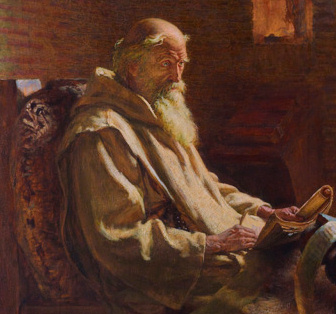
People You’ve Probably Never Heard of But Should: Bede

Bede (which rhymes with feed) lived his entire life in a monastery where he grew a beard which could house a flock of birds. Yet he is most known for his mind, which gave words to the history of England.

We know very little of Bede. We only know what he has recorded for us, which is not much. He was born in 672. He died in 735 while singing a hymn. He lived out most of the dash between those dates in a monastery in Jarrow (which is near modern-day Newcastle…which also doesn’t help me locate it any better).

Though the man himself is not much known his work is well preserved.

Why You Should Know Him:

Have you ever wondered why we use AD in our dates, or where this came from? Look no further than Bede. Actually, it wasn’t Bede who invented the anno domini but he did make it popular. Much like Justin Bieber didn’t invent bad music he just made it popular.

The anno domini is not why you should know Bede, though. We owe a great debt to Bede because of his Ecclesiastical History of the English People. Our information on the conversion of England would be dicey at best if it were not for this scholar, now known as The Venerable Bede. There are those that critique Bede’s work. And some of that criticism may be just. Yet his work has shaped history.

There is one other reason I believe we should know Bede; he seems to have really loved the Lord and passionately proclaimed the gospel. His commentaries are in Latin. Since the only Latin I know comes from Monty Python’s Holy Grail I couldn’t understand much. However, I was able to read a couple of sermons that were translated. One such sermon On the Meeting of Mercy and Justice is a wonderful exposition of the gospel (read an article about that sermon here).

Bede is an interesting figure in that he lived in the 700s and spoke of the world being round

Sample:

You can see his love for Christ in quotes like this:

“No words are able to speak,” he wrote, “that beauty, that virtue, that glory, that magnificence, surpasses every expression, every sense of human mind. And if to attain to that ineffable sight and to be made radiant with the splendor of Christ’s countenance it were worthwhile for you to suffer torment every day—if it were worthwhile for you to endure hell itself for a season, so that you might behold Christ coming in glory, and be joined to the number of the saints—is it not then well worthwhile for you to endure [mere] earthly sorrows that you may be partakers of such good and of such glory?”

This is a great quote for all students of history:

“If history records good things of good men, the thoughtful hearer is encouraged to imitate what is good: or if it records evil of wicked men, the devout, religious listener or reader is encouraged to avoid all that is sinful and perverse and to follow what he knows to be good and pleasing to God.”

Six Tips for Helping the Busiest of Pastors to Start Writing

In his book, 25 Principles for Leadership That Matters, Albert Mohler states that, “Leaders who want to make a difference, and to make that difference last, must write.”

I am passionate about writing. I’ve often wondered if I’m a pastor who writes or a writer who pastors. In actuality I don’t think these two can be easily separated. Writing is a huge part of my pastoral ministry. It’s easy for me to heed Mohler’s advice to write. Other pastors have to work harder at writing. For those of you that read my article yesterday on 7 Reasons Why Pastors Should Be Writers, and immediately thought to yourself, “no way, man”. This article is for you.

Here are Six Tips for Helping the Busiest of Pastors to Start Writing

  1. Write out your sermons and edit them for the public. You don’t have to go into the pulpit with a full manuscript if that isn’t your bag. But it does help to be intentional about your thoughts and really flesh out the right words. Once you write your sermons you could easily turn one sermon into a week of blog posts.
  2. Prioritize. It is essential that you are convinced that writing is a vital part of your ministry. If not it will get thrown aside quickly. Force yourself to write at least something every day.
  3. Make it part of your devotional time. Do your daily devotionals with a pen and paper. Write out your thoughts and prayers. Go back to them a week later and try to craft them into an article.
  4. Avoid procrastination, today. This is especially for those of us that have deadlines to meet. If you don’t take captive every moment then sure enough you’ll be called out for a hospital visit when you had planned on writing.
  5. It’s okay if you aren’t Stephen King. You don’t have to be the best writer in the world. Just write something. If it’s not good enough for publication then keep it between you and your aunt Maude. Or perhaps try a blog. That’s where us not-ready-for-primetime players get our feet wet and actually get gooder…I mean better.
  6. Read Good Writers. You will get better at communicating if you take the time to read those that have mastered the craft. Don’t spend all your time in commentaries. One of the most helpful things that you can do for your preaching and ministry is to read a good novel. (Please don’t misunderstand what I am saying. I know that the power is in the Word preached and not the preachers eloquence. But we don’t necessarily have biblical promises attached to the words that we choose in business meetings. Those can be made better by reading helpful communicators).