The sign of the cross is “a ritual blessing made by members of many branches of Christianity. This blessing is made by the tracing of an upright cross or + across the body with the right hand, often accompanied by spoken or mental recitation of the Trinitarian formula.”
This practice at least goes back as early as Tertullian (160-220) who said:
“In all our travels and movements, in all our coming in and going out, in putting off our shoes, at the bath, at the table, in lighting our candles, in lying down, in sitting down, whatever employment occupies us, we mark our foreheads with the sign of the cross.”
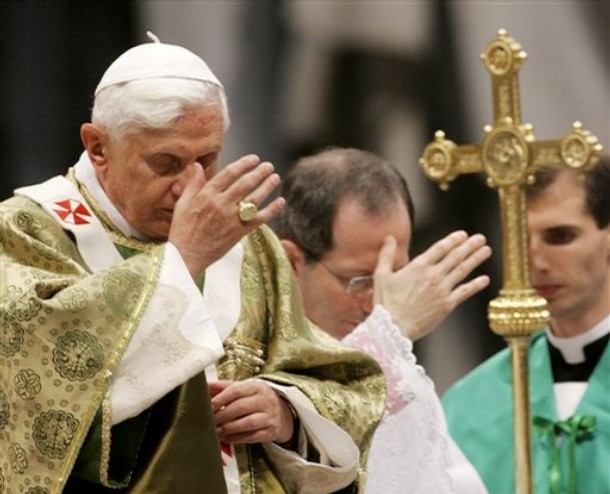 Because this is such an early practice it really causes me to wonder whether or not we ought to follow suit and do what these early Christians obviously practiced. As I read through early church history there are many such practices that can, at times, be unsettling.
A person in the second century lived closer to Jesus than I do. And they lived closer to the apostles—some of them even disciples of the apostles. I’ve had to give some thought to how I think through early church practices. When I come across one of these practices I ask a couple of questions.
1. Does it directly contradict Scripture? Is it expressly commanded in Scripture?
Just because somebody lived in the 3rd century it doesn’t mean that he has to be right. Even the apostle Peter abandoned the teaching of Jesus when he hypocritically refused to eat with Gentiles. That means that anybody who isn’t the incarnate Son of God is fair game for questioning. And we question ourselves and history according to the Scriptures. (In fact if the claims of Christ were held up “according to the Scriptures”).
If a practice contradicts Scripture then I had better avoid it no matter what tradition says. On the other hand if something is expressly commanded in Scripture (and not merely descriptive) then I had better be sure to practice it.
2. How does it translate into today?
There is a reason why I don’t encourage the women in our church to wear head-coverings. It’s not because I believe what Paul was saying in 1 Corinthians 11 has no meaning. It is because I believe the symbol of head-coverings has lost the meaning that Paul wanted to highlight. Therefore, it’s pointless to make a stink about the shadow if the substance is retained in something else.
So if I see an early church practice I’m left to wonder whether it has that same meaning/symbolism in our day. If it doesn’t can that be recovered? Would it require a ridiculous amount of teaching to recover a 2,000 year old practice? Is there really a point in doing that—especially if it’s not something commanded in Scripture?
Also under this question I ask myself whether or not this practice would cause others to stumble. Is it possible that this practice is something that is associated with a former life that would cause my brother or sister to stumble?
What about the sign of the cross?
On my first question, I do not believe that it directly contradicts any Scripture. Unless you want argue that somehow the sign of the cross confers grace upon someone, then we’ve got a problem with sacramentalism. I also believe that it is not directly taught in Scripture. (I’m not persuaded by the instances in Revelation of marking the forehead with the sign).
Based upon this I’m not going to throw a massive stink if someone is using the sign of the cross as mnemonic tool to remind them of the Trinity, Christ, and His gospel. But am I going to do it myself?
No.
That is because it doesn’t pass my second test. I believe that the practice has become superstitious for many. Most of those that I’ve asked about doing the sign of the cross (which is a small sample size) have not really known what it means. “It’s just something we do”.
For most people in my Southern Baptist congregation making the sign of the cross is a “Catholic thing”. We live in a very Roman Catholic community. One in which people are brought up in the church but many do not have a vital relationship with Jesus*. When they truly come to know Christ they associate things like “the sign of the cross” with their former way of life—which to them was nothing more than superstitious idolatry. For me as a pastor to make the sign of the cross it would, I believe, cause them to stumble.
Therefore, I do not make the sign of the cross, but I don’t make a stink about those that do it—especially if they actually know what it means.
My major point in this article is actually not about making the sign of the cross but only to use that as an example of how I think through early church practices. I believe this is a grid by which we can decide whether or not an early church practice ought to be adopted in our congregations.
—
I’m not saying that a Roman Catholic cannot be saved. My answer to that question is similar to that of Doug Wilson.
Like this:
Like Loading...
 Yesterday I proposed a grid for thinking through early church practices. I believe it partially works for how to apply early church theology too. Following a similar grid is why I am tentatively a historic pre-millennialist.