Review of Interpreting the Pauline Letters by John D. Harvey

“Designed as a handbook for seminary and graduate students, the book provides a go-to guide that will also serve seminary-trained pastors, upper-level college students, and well-motivated lay people. As readers work through this handbook, they will begin to see and interpret the narrative writings as Paul intended them to be understood.”
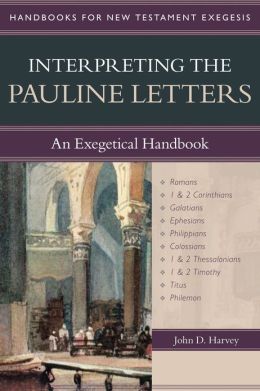
That is a brief snippet from the back of John D. Harvey’s, Interpreting the Pauline Letters. I provide it here because it lets you know what type of books this is intended to be. It is not a book that you casually read on the bus home from work. This book is one that is better used as a resource for preachers and students as they work through a text of Scripture.

When I first read the title I immediately thought of Dr. Schreiner’s excellent work Interpreting the Pauline Epistles. Schreiner’s work is one that has been influential in shaping my reading of Paul’s letters. Therefore, I was anxious to see how Harvey’s work compared to Schreiner’s.

At present I am preaching through 1 Thessalonians and so I thought it would be beneficial to use this as a resource to see exactly how valuable it would be in preaching through a text.

As I picked up this book to begin my study of 1 Thessalonians I immediately noticed that a general index and a Scripture index is missing from the back. That would have been immediately helpful. In fact the absence of such an index makes this almost too time consuming to use as a preaching resource. I have to scan through the entire work to find things on 1 Thessalonians.

What I do find is helpful. There is a section on the major themes of each of Paul’s letters. Here I get help in placing the text in it’s historical context. (Here I think Harvey is a little more in depth than Schreiner). I notice also that there is a section on the structure of the passages. Here Harvey helps the reader layout the structure of a given passage. (I immediately note that Schreiner’s treatment tops Harvey in this section).

I really appreciate Harvey’s sixth chapter, here he gives valuable homiletical tips on interpreting and preaching/teaching through Paul’s letters. The seventh chapter is also helpful in that it gives a couple of examples of preparing and communicating a sermon from one of Paul’s epistles.

Overall, I’m not exceedingly helped in my study of 1 Thessalonians. I learn some background information but that is information I could find elsewhere. I like the help that Harvey gives on structure but I can find that in Schreiner. So what I find that I am left with, is a book that is good to read, helpful in shaping the way that I do exegesis, but ultimately not one that I will continue to consult.

A scripture index would have made this a much more valuable resource. As it stands it is a book that I will probably read through once and not consult much more. And that is sad, because there is valuable information in here. But without having a helpful index I doubt I will think to pull this book out when preparing a sermon. This is simply because I will have to almost re-read the entire book to glean a few salient points on the passage I am preaching. I can get most of this information out of a commentary.

In summary this book provides great content but is lacking in one very needful tool to make this book more accessible through all seasons.

It’s a great book for the beginning seminary student or motivated lay-person trying to learn how to better interpret passages of Scripture. For this reason it has value and I’d encourage you to purchase it. But sadly not as much value as it could have had if someone had taken the time to add 4-5 pages of an index.

Buy it here.

Knock, Knock. Who’s There?

I’ve decided to ask a few people to write occasional articles for me to use at Borrowed Light. Nick Horton is one of those fine souls to agree to do this. He blogs at http://nicholashorton.wordpress.com/and you can follow him on Twitter @NickHorton

I walked towards the first door of the evening. My heart was beating a touch faster. My mouth was dry. I worried about what they would say. How would they take it? Would they shut the door in my face? Turn me down cold? Argue with me? I thought through what I was going to say. Prayed a quick prayer and then…

*knock knock knock*

The door opened. A young woman peered out at us, a bit suspiciously, it seemed.

“Hi, I’m Nick, we’re from First Baptist Church, right over there.” I turned and gestured toward the church, mostly visible a hundred yards away. “Do you have a few minutes to talk? We’re trying to get to know our neighbors.”

“Ok,” she said.

So began my first experience with door-to-door evangelism. Pastor decided we needed to get out of the church building and reach our neighborhood, and beyond that, our city. He was right. Often we retreat within the walls of the church as though it is some fort, a bastion against the world. Us versus them. Is this how it should be?

Christianity lives and dies on the sharing of news. “Gospel” means good news. We have the good news of Jesus Christ’s substitutionary sacrifice for sinners, and His resurrection and offer of eternal life for the same. We have the best news in the world! We have the very words of life; news that applies to everyone without exception.

Yet, we don’t often share it. Why?

Christ commanded that we go and make disciples. Can that happen without sharing the gospel? Paul said in Romans 10:14-15; “How then will they call on him in whom they have not believed? And how are they to believe in him of whom they have never heard? And how are they to hear without someone preaching? 15 And how are they to preach unless they are sent?” Indeed, how will they believe in Him whom they have not heard, if we don’t tell them?

There are many reasons we don’t share the good news. Lets lay our cards on the table and name just a few:

  1. Unbelief. This is really the root of many others. Somewhere in us there is unbelief in the promises of God, His truth, or perhaps His goodness. We are being disobedient. Evangelism is not only for the gifted. Christ made no such distinction in the great commission.
  2. Fear of man. I had this as I walked up to the first door, and still do. We’re afraid of what people will say, that we will be rejected. Perhaps we’re worried they won’t approve of us. Our focus, then, is on our performance. We’re worried we won’t do it right. We’re worried something we say will keep them from Christ. This is selfishness because it’s not about us. Yet, our fears and worries betray our self-centeredness. God draws sinners, not us. (John 6:44) This is not about how awesome we are, how many bible verses we know, or whether we’re the next Billy Graham. This is about God saving sinners using a message communicated by sinners.
  3. Laziness. There are many distractions in life. Technology, TV, movies. Endless gadgets and things to do. It’s not that you can’t ever do those things, but when will you make time to share the gospel? Which master holds sway over your heart?

There will likely never be a time when there isn’t some sense of nervousness, inadequacy, unbelief, rebellion, laziness, fear, or any other number of feelings seeking to derail sharing your faith. The very faith you share is the only thing God has given you to share. Meaning, armed only with our faith in God, we share His gospel.

This is by design. God has removed our performance from His success, which is incredibly freeing. Consider; all you are to do is release the word and leave the results to God. He is faithful. After all, we’re not seeking to win people to us. We’re seeking to win them to Christ.

One day a lady criticized D. L. Moody for his methods of evangelism in attempting to win people to the Lord. Moody’s reply was “I agree with you. I don’t like the way I do it either. Tell me, how do you do it?” The lady replied, “I don’t do it.” Moody retorted, “Then I like my way of doing it better than your way of not doing it.”

Today in Blogworld 07.22.13

The King in His Beauty; an Interview with Tom Schreiner

Dr. Schreiner is my favorite professor at SBTS. He has written a new book, The King in His Beauty. This is an interview with him about the book—which you can purchase here.

Predators in the Pew: Protecting Against Child Abuse in Your Church

Every church needs to take this seriously.

I haven’t got a chance to watch this yet, but I’m looking forward to it. The SBC 2013 Calvinism Advisory Committee:

9 Struggles of Being a Pastor’s Wife

Pastor’s for sure need to be aware of this…but so do congregations.

Packer: Too Many Churches in North America Are Playing the Number Game

Speaking of numbers…J.I. Packer turns 87 years young today.

SBC 2013 Calvinism Advisory Panel from CP SBC on Vimeo.

The Epic Head vs. Heart Showdown

“How far is heaven? Not far really. Just 18 inches, the distance from your head to your heart.”

I’ve heard variations of that statement quite a few times. I recently saw it in a witness tract, encouraging people to not only know about Jesus but to come to know Him personally. And that is a good and valid point. I appreciate that emphasis.

But I kind of wonder where the complimentary tract is to be found. You know the one that talks about having all heart and no brains. After all isn’t it true that a person can be very sincere in their beliefs–giving their whole heart to them–and still end up in hell because they very sincerely worshipped a pig-god named Steve?

In actuality that guy doesn’t exist*. The dude who sincerely worships a pig-god named Steve doesn’t do it because he’s an idiot. He worships a pig-god because he is a rebel. And in the same way the guy that intellectually understands the gospel but just can’t bridge that 18 inches—he’s a rebel too.

The Bible does not like to create a chasm between head and heart. We do.

And in our culture we like to pick heart over brains. We are as Os Guinness has noted like the Tin Woodman, in L. Frank Baum’s The Wonderful Wizard of Oz,

“Why didn’t you walk around the hole?” asked the Tin Woodman.

“I don’t know enough,” replied the Scarecrow cheerfully. “My head is
stuffed with straw, you know, and that is why I am going to Oz to ask
him for some brains.”

“Oh, I see,” said the Tin Woodman. “But, after all, brains are not the
best things in the world.”

“Have you any?” inquired the Scarecrow.

“No, my head is quite empty,” answered the Woodman. “But once I had
brains, and a heart also; so, having tried them both, I should much
rather have a heart….”

“All the same,” said the Scarecrow, “I shall ask for brains instead of
a heart; for a fool would not know what to do with a heart if he had
one.”

“I shall take the heart,” returned the Tin Woodman; “for brains do not
make one happy, and happiness is the best thing in the world.”

We have, says Guinness, made the Tin Woodman’s choice. And it’s a choice that the Scriptures do not make. The biblical picture is that head and heart are interdependent. One serves the other. We are whole people that are wholly redeemed by God.

If there is a chasm between your head and your heart it doesn’t really matter from which end you started the dig. If you’re all head then you need to repent of a cold and dead orthodoxy. After all Satan could ace every doctrine test a seminary through at him. But he doesn’t treasure truth—and it doesn’t cause him to break out into doxology.

So also if you are somehow “all heart” but don’t care much about digging out the Scriptures you are just as rebellious as the cold yet orthodox guy. The Bible says that it’s both/and.

Love and dig.

Dig and love.

We shouldn’t put friends like this in the boxing ring.

—

*Not the pig guy…he might exist.