People Don’t Become Angels And You Shouldn’t Want Them To


If you’ve been to more than five funerals in your life you’ve likely heard a touching poem about God taking an angel home. The mourning onlookers are often assured that the fella laying in the casket is now one of God’s angels in heaven.

It’s a warming sentiment but I always think to myself, “poor sap”. You see, not only is the idea that people become angels not a biblical concept—it’d be a terrible step down.

It’s Not Biblical

I’m really not certain of the origin of this concept. It’s certainly older than Clarence the Angel from It’s a Wonderful Life. Clarence, by the way, would make a terrific Mormon angel (at least until he gets his wings). Mormons believe that angels that visit us could be spirits of people that are not yet born, spirits of those that have been resurrected, or spirits of those that have already lived on earth.

So the concept is at least as old as Mormonism. But it’s likely much older than this. It certainly doesn’t come from the Scriptures. The closest thing that you could find would be Luke 20:34-36

“The sons of this age marry and are given in marriage, but those who are considered worthy to attain to that age and to the resurrection from the dead neither marry nor are given in marriage, for they cannot die anymore, because they are equal to angels and are sons of God, being sons of the resurrection.

Clearly, though, the point that Jesus is making is not that people become angels. Instead he is saying that people become as angels are—immortal.

Other Scripture makes it clear that we don’t become angels. In fact we will judge the angels (1 Corinthians 6:3). Because of our union with Christ—the second Adam–though we are “for a little while lower than the angels” (Hebrews 2:7) eventually everything will brought again under our subjection. Hence we will judge the angels.

When you die you don’t become an angel. And you don’t want that anyways.

You Don’t Want To Be an Angel

Now, don’t get me wrong. If God had created you as angel then you’d delight in this fact. You aren’t ripped off in the least. But God has made you a human. And as such you have a preferred status.

In 1 Peter 1:12 we read that angels long to look into the things pertaining to salvation. Part of this longing is certainly our mystical union with Christ. He’s not afraid to call us “brother”. That’s not true of angels.

Consider this from John Flavel:

Great is the dignity of the angelical nature: the angels are the highest and most honorable species of creatures; they also have the honor continually to behold the face of God in heaven, and yet, in this one respect the saints are preferred to them, they have a mystical union with Christ, as their head of influence, by whom they are quickend with spiritual life, which the angels have not.

You won’t be an angel when you die. And thank God for that. Angels aren’t in union with Christ. But real flesh and blood people like you and I are in union with Christ. We’ll enjoy Him forever in a way that an angel cannot.
Today in Blogworld 01.22.14

A Lesson in Grace

Alicia Gray is a former math teachers that was fired for inappropriate relations with a student. Here is her story and a lesson on grace.

How to Make Accountability Work

This is helpful. I think we’ve neglected accountability because it is sometimes poorly done. Hopefully Tim’s work here will encourage us to not neglect this discipline.

Confessions of a Reluctant Servant

I love articles like this. Partially because it helps to confirm that I’m not off my rocker in pieces like this.

7 Warning Signs Leaders Are About to Crash

If you’ve got a couple of these signs consider hitting the breaks.

I had never heard this song. Good stuff:

(HT: Dane Ortlund)

Pray For Your Daughter: 31 Day Challenge—Day Twenty-Two

Day Twenty-Two: That she would be modest in character and conduct

… likewise also that women should adorn themselves in respectable apparel, with modesty and self-control, not with braided hair and gold or pearls or costly attire, but with what is proper for women who profess godliness—with good works. (1 Timothy 2:9-10, ESV)

Our daughters are living in a culture saturated with lies; that their value is determined by their looks, by their career, by their social status. Whether growing up or as an adult, our daughters are taught the importance elevating themselves above others. This takes many forms: boastful talk of personal or kids’ achievements; seeking positions of power; undercutting others through gossip; and yes – revealing clothes. Let’s pray that our daughters embrace humility and a modest character in order to glorify Christ, letting Him in turn be the one to exalt them in the proper time.

Father, you have said that we should seek to humble ourselves, and that women in particular should pursue modesty in their lifestyle. I pray that you would enable my daughter’s heart to believe your truth, not the lies of this world that teach the prideful idolatry of self-exaltation. Please help her to consider others first, to love others more than herself, and to seek to let her life shine as an example of gospel love – so that Christ Jesus would be the one exalted through her words and deeds, and that nothing she says, does, or wears would distract others from Him. Amen.

—

Ryan Freeman is husband to Janis, father of Wesley, Jaedyn and Tobias, and a Deacon and founding member of Grace Fellowship Church of West Toronto. He is the president of Strider Search Marketing, a small online marketing firm serving SMBs, non-profits, and churches.

Wesley Freeman is the proud protector of his sister, Jaedyn, and cousins Susannah, Caitlyn, and Madalyn, and mentor to younger brother Tobias.

Some Sheeps Is Mean

sheep

Several years ago, a student asked me where I lived. Upon hearing my house was in the country, he looked at me, eyes wide, and in an alarmed voice implored, “You shouldn’t live there, Miz Hartley!”

Bewildered, I asked him why.

“Because,” he replied. “Sheeps live in the country, and some sheeps is mean.”

I chuckled then, yet now in hindsight think he may have been on to something.

Some sheeps is mean.

Now you may be thinking that sheep could be called cute, fuzzy, timid, or perhaps even stupid. But, mean? Honestly, I had never considered sheep to be particularly vicious. The child must have had sheep confused with those aggressive, little pigmy goats that greedily jump on children in petting zoos. Or had he?

Some sheeps is mean.

Perhaps more precisely – sheeps is mean.

The metaphor of God’s people as sheep is well known throughout the Old and New Testaments. We are the “people of his pasture, and the sheep of his hand.” Jesus is the “good shepherd”, and we are reminded that it is because of his role in this capacity that he gave up his life for his sheep.

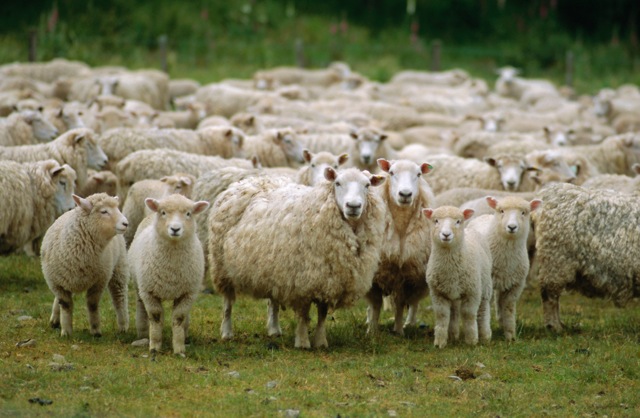
So where does this leave us? Did Christ rescue us because of our cuddly, innocent nature? Of course not! Cute and fluffy as sheep might appear from afar, truth is if you get close enough they will be revealed for the often dirty, matted, smelly creatures they are. Flocking together to survive, they hoard the grass upon which they graze, consuming it to the very root, even while trying to take over territory from other sheep who, in their minuscule brains, are sure to be gorging themselves on more delectable morsels.

Yes, sheeps is mean.

Blessedly, however, the metaphor does not leave us here, for Christ himself did not and does not leave us here. In 1 Corinthians 6, Paul writes to the church in Corinth about the grievances and disputes among her members. He cautions them about all sorts of sin, listing everything from sexual immorality to greed, but then ends with this statement in verse 11: “And such were some of you. But you were washed, you were sanctified, you were justified in the name of the Lord Jesus Christ and by the Spirit of our God” (emphasis mine). And that, dear lambs, is the point. Though we are, by nature, “mean sheeps”, once lost. We are now his sheep, for Jesus Christ the Good Shepherd not only called to us, searched us out, laid down his life for us that we might enter the sheepfold through him, he also has begun the work of our sanctification as we dwell with him within the fold.

Sadly, it seems increasingly popular these days to discount the Shepherd because of the sheep. Even among professing believers, the Church is often maligned. Some justify withdrawing from the fold by pointing to the failings of the flock. But, we would be wise to remember, never is a sheep more vulnerable than when it leaves the sheepfold. Why should it be any different for Christ’s lambs? The Church is not comprised of wolves in sheep’s clothing. No, we are sheep in sheep’s clothing, and we need our Shepherd to wash us, to feed us, to care for us. A shepherd with but one lone sheep would be a poor one at best. But our Shepherd is rich beyond measure and desires his flock to be the most glorious of all. And so, perhaps it all boils down to a matter of humility.

Admitting we are but sheep – sometimes even mean sheep – who collectively are in need of a Shepherd

“For you were straying like sheep, but have now returned to the Shepherd and Overseer of your souls.” 1 Peter 2:25