When Should a Pastor Read the Text?

photo-1470686164816-830d3688f62cAs soon as he is ready.

And if you aren’t ready—rather than making the Word of God central to the sermon–something else will take it’s place.

I am grateful for the resurgence of expository preaching. I believe it is absolutely correct to make the main point of the text the main point of the sermon. We’ve all had to endure “sermons” which were no more than the preacher’s opinion; an opinion which, at best, is loosely related to a text read at the beginning of sermon time.

The Importance of a Scripture Introduction

But I believe even expository preachers can inadvertently eclipse the text by not spending enough time placing the text. I’m indebted to Bryan Chapell’s excellent work, Christ-Centered Preaching, for developing the practice of preaching a scripture introduction and a sermon introduction.

The purpose of the scripture introduction is to place the text. I begin every week by announcing the text and then I attempt to not only create interest for the text but I also work to place the text within it’s context. I think Chapell explains the preachers task quite well:

Those eager to read, those scared to read, and those calloused to reading all sit before the minister, who must draw each within the confines of the Word. (Chapell, 250)

But how long does such a thing take? It is here where I probably diverge from a good number of preachers. Chapell says, “if the Scripture introduction labors beyond four or five sentences, it is usually too long”. According to my Logos sermon editor I’ll be twelve minutes into my sermon this week before I read from 1 Peter. That’s a bit longer than normal—but it’s not incredibly unusual for me. And that’s not sloppy it’s intentional.

I believe these four ideas from Tim Pollard are correct:

  1. People are overwhelmed with information.
  2. As a result, they filter aggressively, rejecting as much as they can.
  3. The filter will tend to let in information based on its relevance.
  4. If you lose them at the beginning, you’re probably not getting them back. They judge quickly and move on. (source)

I’m not for one moment suggesting that God’s Word is not relevant. It is incredibly relevant. But I don’t entertain the assumption that everyone listening to a sermon both believes Scripture is relevant AND understands how it is relevant. Numerous studies have shown that a majority of Americans are biblically ignorant. They aren’t even sure what the Scripture says much less do they have the ability to know why it is relevant.

If Pollard is correct, then what is happening in those first few moments is that folks are aggressively filtering. And they are doing this with only a faint understanding of what the text might possibly be saying. By the time the pastor prays after reading the text a good percentage of the audience has already checked out. Or by the grace of God he is able to get their attention back—but now the driving force is his exposition of the text and not the text itself.

I agree with Chapell if you are laboring (I read ‘spinning your tires’) then you probably are droning on and would do better to just start reading from God’s Word. But what if rather than spinning your tires you were using this crucial time to set up the problem which the text will answer (thus creating interest). And using the time to place your 21st century audience into the world of the biblical author. Your scripture introduction needs to be as long as it takes for you to engagingly position your audience into a place where they are ready to hear that particular text.

I will have done my job in the scripture introduction if at the moment I read the Scripture passage our people can hear the waves of the Sea of Galilee lapping up against the shore as they feel the same nervousness as Peter’s elect exiles facing persecution and wondering if the dishonor they are experiencing is a sign of God’s displeasure. I want them to experience the wonder of being tied to the same story which Peter’s audience was tied to. I want them to feel the anxiety of Isaiah the prophet and the pull of conspiracy theories during the reign of King Ahaz. When we read Isaiah 8 or Isaiah 28 I want them, in as much as possible, to experience that same sigh of relief.

Sometimes you can do that in 4-5 sentences. At times you cannot. But so long as you are building towards that moment take us much time as you need. It’s not time to explain the text. Nor to tell more facts than necessary to paint the picture. It’s certainly not the time to spin your wheels and get your thoughts together. You just need to get your 21st century audience into the lap of the biblical author, to feel what they felt when those blessed words first came upon them.

Then…after you read the text…and you pray…that’s when you start walking your audience back into the 21st century. 

Photo source: here

9 Ways Faith and Hope Work Together

8dcf83cbI’ve been spending a good amount of my time studying the biblical doctrine of hope. In doing so I uncovered this gem from John Bunyan and thought you might enjoy. (I’ve tried to modernize the language or summarize where necessary)

Here are nine ways which faith and hope are different and yet work together:

1. Faith comes by hearing (Rom 10:17), hope by experience (Rom 5:3, 4).

2. Faith comes by hearing the Word of God, hope by the credit that faith has given to it (Rom 4:18).

3. Faith believes the truth of the Word, hope waits for the fulfilling of it.

4. Faith lays hold of that end of the promise that is next to us, to wit, as it is in the Bible; hope lays hold of that end of the promise that is fastened to the mercy-seat; for the promise is like a mighty cable, that is fastened by one end to a ship, and by the other to the anchor: the soul is the ship where faith is, and to which the hither end of this cable is fastened; but hope is the anchor that is at the other end of this cable, and which entereth into that within the vail. Thus faith and hope getting hold of both ends of the promise, they carry it safely all away.
Bunyan is saying that faith is connected to what is seen and already grasped whereas hope lays hold of that which is yet in the future.  

5. Faith looks to Christ, as dead, buried, and ascended; and hope to his second coming (1 Cor 15:1–4). Faith looks to him for justification, hope for glory (Rom 4:1–8).

6. Faith fights for doctrine, hope for a reward (Acts 26:6, 7). Faith for what is in the Bible, hope for what is in heaven (Col 1:3–5).

7. Faith purifies the heart from bad principles (1 John 5:4, 5). Hope from bad manners (2 Peter 3:11, 14; Eph 5:8; 1 John 3:3). (Bunyan is connecting faith with right believing and hope with right living).

8. Faith sets hope on work, hope sets patience on work (Acts 28:20; 9:9). Faith says to hope, look for what is promised; hope says to faith, So I do, and will wait for it too.

9. Faith looks through the word to God in Christ; hope looks through faith beyond the world to glory (Gal 5:5).

Bunyan, J. (2006). Israel’s Hope Encouraged (Vol. 1, p. 578). Bellingham, WA: Logos Bible Software.

Photo source: here

Our Kids are Watching Our Stay-at-Home Response

ZOAA4TMV4BC3XE7GZVJJCGR7YII live in a county where we have only had 9 positive cases of the Corona virus. Six of those have recovered. Two are recovering in the hospital and one is self-quarantining at home. We aren’t personally feeling the impact of this virus. And yet for the next couple of weeks we will still be shut down.

I’ll be honest, it’s hard to keep following social distancing rules. It’s difficult to see our church not able to physically gather while liquor stores stay open as essential. I get it. I understand that it’s apples to oranges. But it’s still emotionally taxing to continue not meeting together when we aren’t feeling a real danger “out there”.

But we’re going to keep obeying our governmental authorities as well as experts in the medical field who call us to remain cautious. And one of the big reasons we are going to do this is for our children. Not that they are particularly susceptible to this virus—but because they are susceptible to learning from really bad examples.

We teach our children that their obedience to us as their parents are not dictated by whether or not they agree with our decision. We’ll allow them to discuss, we’re fair parents. But their first step needs to be one of obedience. There’s a difference between agreement and obedience. And it’s absolutely vital for our walk with Christ that we are “obedient children” and not just “agreeable children”.

So if we rail against the government, communicate that we think these rules are stupid, thumb our nose at their spoken desire to protect us, and refuse to heed their orders or guidelines, then we are telling our children that we only listen to authorities whenever we agree. If we do this, we’re setting a horrible example.

I hear the contrary argument too. What about the constitution? What if the government oversteps? In our system of government it is the constitution which is our authority and therefore we aren’t rebelling from our God-given authority but from governmental overreach.

Fair enough. I disagree in part, but I’ll concede that point for a moment. Even if that is true there is also a way in which you teach your children to properly rebel from an authority. And it’s not based upon whether or not you agree. We don’t rebel because we disagree with their decisions. We rebel whenever they are actively working apart from our best interest and especially apart from the best interest of Christ. Our rebellion absolutely must come with mourning. We need to have a desire to obey and be broken-hearted when we cannot.

Our kids are watching and learning from us. The way we respond to this—especially if we don’t necessarily agree with every decision—is speaking volumes to how they’ll obey us as parents and their Father in heaven. There will come a time when the Word of God confronts their fallen inclinations. In that moment it’ll be vital for them to have established a pattern of thinking which defaults to trust and obedience.

Conspiracy Theories and the Hijacking of Evangelicalism

photo-1536639240649-1f0979e7993dI don’t know much of anything about Jack Reacher. But the other day I came across this quote from the book. And Anglican priest says this about the book of Revelation:

Most of the original is lost, of course. It was written in ancient Hebrew or Aramaic, and copied by hand many times, and then translated into Koine Greek, and copied by hand many times, and then translated into Latin, and copied by hand many times, and then translated into Elizabethan English and printed, with opportunities for error and confusion at every single stage. Now it reads like a bad acid trip. I suspect it always did. (Child, 434-35)

I stumbled upon this quote not by reading Child but by reading a great book on textual criticism (Myths and Mistakes). But it got me thinking about the way we often react to conspiracy theories and fake news.

Read that priest’s argument about the book of Revelation one more time. What are you feeling? What are you thinking? What’s happening in your mind as you read through that?

If you’re like me, then you immediately start poking holes in his argument. And you might even have a little bit of anger and passion. And that happens because what he’s doing here is kicking my core narrative right in the groin. The Bible is trustworthy. It’s the Word of God and not a “bad acid trip”. My life is centered upon the veracity of God’s Word. To accept what this priest is saying I’d need to fundamentally change my core narrative.

Hold that thought for a moment.

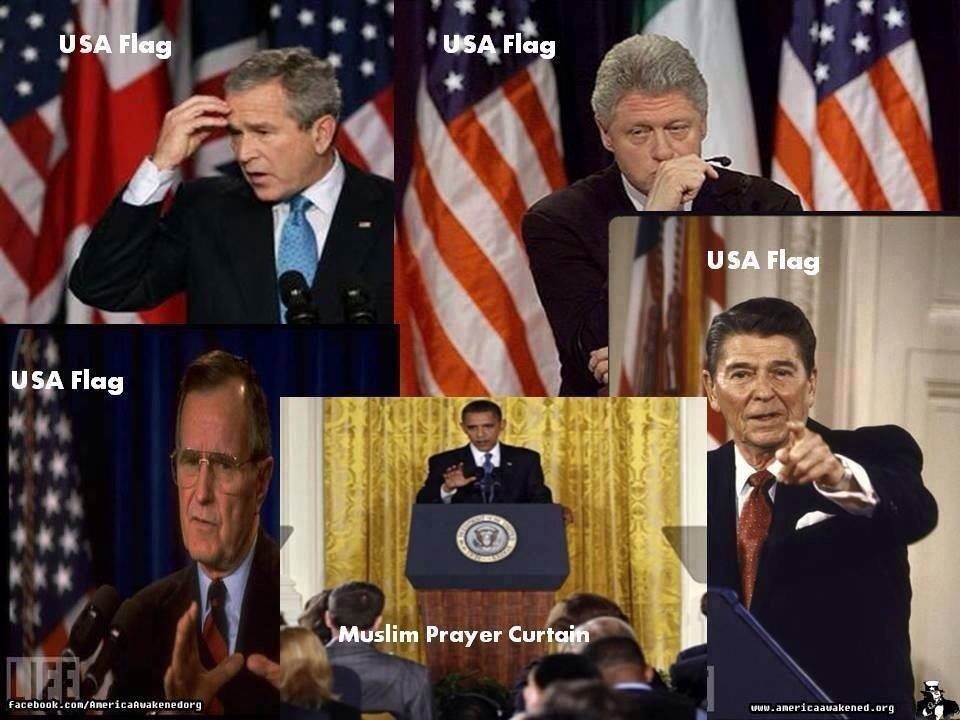
Did you know that during the Obama administration he changed the red, white, and blue decor from the Oval Office and replaced it with a Muslim prayer curtain?

You can see the picture for yourself. I’ll post one but I’m sure it’ll get deleted so you’d better screenshot it. Notice the American flag behind previous presidents. Then notice the golden curtain with Arabic symbols on it behind Obama.

obamacurtain

Now if you’re a conservative evangelical (as I’d consider myself) what is happening in your mind and heart in this moment? There is still passion. It’s maybe even white hot anger. Maybe even a little fear. But are any caution lights flashing in your mind?

Maybe not. And that’s why you’d share this. It fits within your core narrative. It doesn’t matter if this is true. It seems true. And even if these particular facts aren’t 100% accurate it still throws shade on President Obama and pushes back darkness.

Of course all this ignores the fact that you can find pictures with a golden curtain behind every president from Nixon to Trump.

Organizations talk about having a core narrative. A core narrative dictates how you organize beliefs, facts, and truth to tell your story. It’s who you are—or at least who you say you are.

For an evangelical, at least historically, the key part of our core narrative is that God saves sinners. The gospel is the core. David Bebbington has done a fair job of identifying four evangelical distinctives. Evangelicals believe that one must be born again, we believe the Bible is our authority, Christ’s death was for us, and we’re called to share this gospel. This is what Bebbington calls “conversionism, biblicism, crucicentrism, and activism”.

That has been our core narrative. But our core belief of conversionism and activism means that we’re always going to have an uncomfortable relationship with the world. We’re always going to be prone to develop an us vs. them mentality.

So what happens, then, when you live in a culture of outrage? What happens when the cultural tide shifts and in response we exchange parts of our core narrative for something else? What happens when nationalism subtly replaces biblicism? When evangelicals consume more conservative talk radio than Scripture our core narrative has slowly transformed into something else.

When evangelical activism loses one of it’s legs it begins to totter. And rather than strengthening our biblical resolve it seems to me that we’ve propped it up with things like conspiracy theories and faux outrage. Suddenly our activism is no longer about gospel mission but it’s about preserving a certain way of life. Our activism then morphs into having a core narrative that could actually be threatened by a President with a Muslim prayer curtain. The core of evangelical Christianity isn’t threatened by pagan rulers.

I only use that Muslim prayer curtain as an example. My point here isn’t about that conspiracy theory. My point is about conspiracy theories altogether and how they’ve become especially attractive to evangelicals. It’s deadly to the evangelical mind and and to the evangel itself. As I heard another person say, “I don’t think we realize what we’re doing when our Facebook wall is covered with conspiracy theories and simultaneously the declaration that He is Risen”.

If you want to find a conspiracy theory it’s that the god of this age has conspired to fool many believers into fighting the wrong battle. They’ll use gifts of discernment, meant to guard love, strengthen faith, and infuse hope, for the sake of preserving a kingdom that’ll perish. We’ve been duped into thinking that truth and ethics matter less than winning a culture war. The darkest of cabals is scheming to convince believers that they have more investment in unbelieving political pundits than a third-world brother in Christ meeting in a dank shelter. And his greatest conspiracy of all might be to convince us that truth is nothing more than fake news.

Part of my own core narrative is that truth matters. And ethics matter. I absolutely refuse to compromise on this. I am still an evangelical but I will not allow conspiracy theories to become part of my core narrative. And because of this, I fear that to many, I will look increasingly less and less evangelical. Sadly, I’ll also look less biblically conservative, even though my view on the inerrancy of Scripture has not changed. And soon enough I’ll be another one of those pastors canceled and consumed by this vast conspiracy. But I refuse to budge.

God saves sinners.

Photo source: here