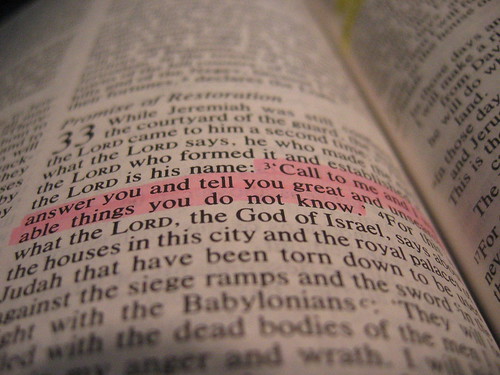
 Last year I looked at the Top 10 Most Shared Bible Verses from 2013 in their context. They have recently posted their 2014 list and to my surprise there are ten new most shared verses, so I figured I’d look at these ten popular verses in their context again this year. Today we will look Jeremiah 33:2-3, which is the fifth most shared verse of 2014.
The Verse:
“Thus says the LORD who made the earth, the LORD who formed it to establish it—the LORD is his name: Call to me and I will answer you, and will tell you great and hidden things that you have not known. (Jeremiah 33:2-3 ESV)
The Context:
Jeremiah is known as the weeping prophet. He prophesied during the time of the Babylonian exile. Jeremiah 33 takes place during the time when Jerusalem is being laid siege. The warnings had come, the people refused to repent, and Jeremiah is obediently being carried off into exile.
In Jeremiah 32 God commands Jeremiah to do something strange—buy land in Judah even though exile is just around the corner. This is a symbolic of the promise that the exiles will one day return. This will not be a permanent exile. In Jeremiah 32 and 33 the Lord encourages Jeremiah and his people that peace will come to them again.
What we have in Jeremiah 33, then, is a second word of the Lord to Jeremiah. Though God says Jerusalem will be “filled with the dead bodies of men whom I shall strike down in my anger and wrath” that is not the end of the story. Though a symbol of reproach at present (586BC), Jerusalem will once again be a testimony of the Lord’s goodness to her.
Jeremiah 33:2-3 is the introduction to this word of the Lord. It is grounded in Creator God—the one powerful enough to overthrow Babylon—and gracious enough to reveal Himself to those who call upon Him. But more specifically in the context these are words spoken to Jeremiah. The “you” in this passage is singular and not plural.
The Meaning
Everybody likes a good secret. What better than to have secret and hidden knowledge from the mouth of YHWH? This, certainly, is why early Gnosticism had such an appeal. The idea that one could get secret words from God that only the initiated would be part of appeal to our basest of desires for juicy gossip. Is this what type of “hidden things” the Lord is promising to reveal to people if they only call upon Him and ask?
I imagine that many share this verse because they have taken it as God’s promise to them that if they only trust in the Lord he will reveal His future plans to them. In the context, though, I don’t believe this view can be defended. This is a specific communication to Jeremiah. What follows after verse 3 are some of the great and hidden things.
If you put yourself in the place of Jeremiah you can see this. All around Jeremiah is destruction. His beloved city is being laid bare. He and his fellow countrymen are being hauled off to a foreign land. If you can place yourself in that type of destruction then it would be hard to imagine a day when Jerusalem would again be a symbol of God’s blessing.
We have the advantage of knowing the whole story and so we don’t feel Jeremiah’s pain as deeply. But he, and his countrymen, needed this word of peace. They, like we in our day, need to know that we still have hope even in the midst of ashes. Here, God is telling the Israelites that beauty will emerge from the ashes because he is faithful to His covenant.
But as far as claiming Jeremiah 33:2-3 as a promise for you and I, I just don’t see it. There might be a general principle here that God will continue to show himself and His purposes to those who call upon His name, but even there I think we’d be more certain to find this principle in other places.
Conclusion
So how do we apply this verse? We apply it by thanking God for these great and wonderful things that He has done. Consider all that is wrapped up in these great and hidden things: the restoration of Israel, God Himself becoming a babe in a manger, the precious gospel going to Gentiles—even those of the line of Babylon, and even the day and age in which we live.
If we find ourselves in ashes like Jeremiah we too can hope in our all-powerful Creator. He is able to make beauty from ashes. Someday there will be no more ashes—only beauty. And in this we hope.
Like this:
Like Loading...
 I’ve written in the past about the cultural references from my childhood that I can no longer use. People who were once wildly popular are now unheard of. If this happens within a couple of decades then certainly there are characters from the past whose buried story deserves to be unearthed.