 I decided to do a series on the Minor Prophets. It had went pretty well in Hosea and Joel and Amos. Then I came to Obadiah.
As I read through this short book over and over again I was plagued by the pressing question of the week, “How in the world do I preach this?” How do I preach to a 21st century audience about God’s judgment upon Edom?
Any preacher worth his salt is concerned with being faithful to the biblical text AND showing the relevance of the text for today’s audience. This is why the question of “how do I preach this” so pressing. What we preachers are really looking for in these moments is a Big Idea that is faithful to the text and will prove relevant to our contemporary audience.
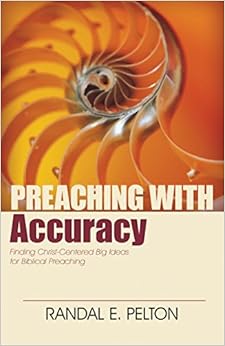
In his book, Preaching With Accuracy, Randall Pelton hopes to assist preachers in finding Christ-centered big ideas for biblical preaching. The astute reader will notice a combination of Haddon Robinson’s classic work Biblical Preaching and Bryan Chapell’s Christ-Centered Preaching. Pelton argues that we find the big idea in a passage when we consider the text in its three contexts.
Pelton titles these three contexts the textbi (textual big idea), conbi (contextual big idea), and canbi (canonical big idea). This is what other interpreters have called the three horizons of biblical interpretation. He gives a good example of how these interact by looking at Exodus 22:31. In that passage the textbi is that “God’s people will be totally separated to Him through obeying a dietary restriction”. (44) That is the direct point (near application) of the text at hand.
The conbi will look at the passage in light of the overall context. Here we see how Exodus 22:31 fits in with the broader context of the establishment of the law in Exodus. Pelton’s conbi is this:
“When God’s people obey the dietary restriction, they meet the conditions of God’s covenant, become His own possession among all the peoples, and function for Him as a kingdom of priests and a holy nation” (44)
But the preachers job is not yet done if he has not viewed Exodus 22:31 in light of the whole story of Scripture. This text must be viewed with a Christocentric lens. That lens is what Pelton calls the canbi. For the passage at hand the canbi would be this: “As a result of faith in Christ, Spirit-controlled Christians who eat to the glory of God fulfill the requirement of the Law and function as a kingdom of priests and a holy nation.” (44)
The rest of the book is just further explanation and tips of how to find the big idea in each of these contexts. In the last chapter Pelton argues for a faith-first application. He argues that looking for application and big ideas early in the week of preparation will give shape to our sermons.
My Take
I’m having a terrible time reviewing this book. If I had not already been trained in looking for three horizons I think this book would be a helpful introduction to that concept. But I also think it’d be most beneficial as a book on biblical interpretation.
The process of interpretation is a huge step in preparation of a biblical sermon and so I can see how even getting the concept of these three big ideas would help with sermon prep. I’m trying to picture myself having this book a few years ago when I was preaching through Obadiah, and I believe it would have been helpful. It would have kept me from simply preaching about the Edomites.
But for a book on preaching I feel that something is missing. I think if I had this book while preaching through Obadiah I would have had a few general concepts but I think I’d need to turn elsewhere to really get help with crafting the sermon. Perhaps a bit more meat on how to use these big ideas to help craft sermons would have served the reader better.
As it stands this book will be a helpful introduction to placing a text in its three contexts. I am grateful that Pelton shows preachers how to preach Jesus and to do a faith-first application.
In sum, I find this too be a quality introductory book that could have delivered a bit better on its claim to “guide the preacher through appying a Christ-centered hermeneutic that results in biblical sermons…”
You can get the book here.
 I love reading. There are times when a quote in a book is so stellar that I just have to share it with all my loyal blog readers. And besides its quick and can