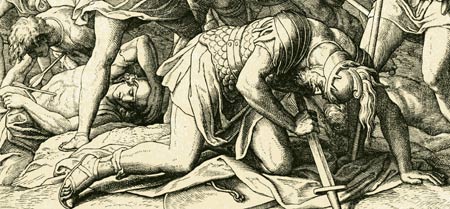
Did Saul Kill Himself Or Was It An Amalekite?

“Your Bible is full of contradictions…”

As a good Bible-believing Christian you hear such a statement and balk. And then in the quiet of your bedroom you stumble upon a few of these “contradictions”. As a bit of shame fills your heart, you begin to wonder if maybe those who deny the Bible might have a point.

After all, this is a pretty obvious contradiction. You’d think an omniscient God would have caught such a discrepancy. But there it is in 1 and 2 Samuel.

1 Samuel ends with the death of Saul who “took his own sword and fell upon it” (1 Samuel 31:4). Suicide. Rather than be shamed and tortured by the Philistines, Saul took his own life.

2 Samuel begins with an Amalekite telling David the sad news of the demise of Israel’s king. But his story is a bit different. Rather than suicide the Amalekite says that he “stood beside him and killed him, because I was sure that he could not live after he had fallen” (2 Samuel 1:10). So in this version it wasn’t suicide, it was a mercy killing. Saul didn’t fall on his own sword as 1 Samuel says, he was killed by an Amalekite.

It cannot be both.

Now before I attempt to unravel this supposed mess, let me give you a couple of principles for dealing with these contradictions.

Principle #1: The Jews Weren’t Idiots

The author of 1 and 2 Samuel is the same person. He’d be a really terrible author to miss such a contradiction. Even if you take the more liberal route and believe that these two histories were written by a group of editors, you’d have to admit that somebody is an idiot to let such a glaring contradiction go unedited.

The Jewish people considered this to be God’s Word. And as such they viewed it as accurate—without error. In order to take the position that this is a glaring contradiction that disproves the Bible we’ve got to be willing to do a couple things.

First, we have to believe that for hundreds of years people just flat out missed this error, or we have to believe that they knew about it and just didn’t care.

If we go for the second option, we have to believe that these same people (or those they discipled) taught that the Bible was God-inspired, all the while knowing full well that they had an obvious contradiction in the text.

In order to perpetuate such a myth they would have to change the text. Unless of course you believe that people were too stupid to call bull on a blatant contradiction. But they didn’t change the text. They kept it how it reads today. And so we are only really left with one conclusion…

There isn’t a contradiction in the text. Which leads to our second principle.

Principle #2 You Don’t Know Everything

Or to put that another way, just because it seems like a contradiction to you it does not mean that it is necessarily so. It is possible that you are lacking in understanding on a key point somewhere along the way which makes you think something is a contradiction. But truth but told the dissonance isn’t in the text, it is in your understanding of the text.

This reminds me of the man and his son who are in a terrible car wreck. The father dies and the son is about to join him—the only thing that will save his life is a risky operation. But when they put the boy into the operating room the doctor says, “I can’t operate on this boy…he’s my son”.

Many people are baffled by this because they are assuming that the doctor must be a man—and hence the boy’s father. But the doctor is his mother. No contradiction. It just seems that way.

The Death of Saul

That same type of thing is happening in our little conundrum with Saul. Keep in mind that 1 and 2 Samuel were originally one book. And so the original audience would have read the end of our 1 Samuel and the beginning of 2 Samuel within a very short span of time.

Doing so, they likely would have picked up on the character of this Amalekite. The narrator—who we’d assume is being truthful—has just told us about Saul’s fate. But then this Amalekite comes in and tells David another story. The audience would be in on the fact that this guy is lying in order to gain favor with David. He’s trying to pretend like he did something noble. But his lie cost him his life.

The whole point of this—and the reason for bringing the Amalekite into the story is to once again reiterate that David is above reproach in ascending to the throne in the place of Saul. He did not take the throne by force—but it was ripped from Saul by the Lord. This little scene at the beginning of 2 Samuel further reiterates that point.

Saul killed himself. The Amalekite was a liar. No contradiction.

—

Photo source: here

Today in Blogworld 05.13.15

The Heresy of Indifference

“When people tell me they are into Jesus but not into doctrine, I tell them that if they are not into doctrine, they are, in fact, not into Jesus.” Burk Parsons

Your Student Ministry Needs Expository Preaching

Amen. I’ve done expository preaching in youth ministry for over a decade now and I can attest to what Jason Kees is saying here.

Passive Aggressive Dissent: It’s a Trap

Wow. I think John Mark N. Reynolds is really on to something here.

When the Ministry Hits the Fan: The Day You Walk in the Door

Dave Miller helps us novices with a few tips on how to start your new pastorate.

Glad to  know my “jump at the last second” plan isn’t a good idea:

The Most Shared Verses in Their Context (Galatians 6:7-8)

Last year I looked at the Top 10 Most Shared Bible Verses from 2013 in their context. They have recently posted their 2014 list and to my surprise there are ten new most shared verses, so I figured I’d look at these ten popular verses in their context again this year. Today we will look at Galatians 6:6-7, which is the sixth most shared verse of 2014.

The Verse:

Do not be deceived: God is not mocked, for whatever one sows, that will he also reap. For the one who sows to his own flesh will from the flesh reap corruption, but the one who sows to the Spirit will from the Spirit reap eternal life. (Galatians 6:7-8 ESV)

The Context:

Galatians 6 is part of a much larger section where Paul outlines what it means to live by the Spirit. Paul spent a great deal of Galatians arguing that believers are freed from the law. One could wrongly conclude, then, that we are freed from any obligation to one another. In order to combat this potential error, Paul shows us that life in the Spirit will mean a life of serving one another (5:13).

In all of Galatians, Paul is contrasting the way of the flesh (which includes things like flesh-only circumcision) with the way of the heart. Those who live for themselves are living according to the flesh. In contrast, those who live sacrificially for the sake of others and for the glory of God are said to be walking in the Spirit.

As we often see throughout the Scriptures, our wallet is a wonderful indicator of which kingdom we are for; the kingdom of self or the kingdom of God. In Galatians 6:6 we are told to materially provide for those who teach. If you benefit from the instruction of someone then you should support them.

You can see how the way of the flesh vs. the way of the heart plays out in this area. The one who feeds his flesh will take the instruction, benefit from the help, but never think about providing for the one who has benefited him. But the one who “sows to the Spirit” will “share all good things to the one who teaches”.

This is why Paul says what he does in verses 7-8. In the forefront of his mind is how we sow and reap in financial matters. But it is so much more. Financial matters are only one way to apply this principle of verse 7-8. What Paul is really wanting the Galatians to see is the big picture of how eschatological reward/judgment impacts our lives—and fundamentally our giving.

And so the context for Galatians 6:7-8 is centered upon the question of whether we will live according to the Spirit or live according to the flesh.

The Meaning:

I’m not terribly shocked that we like this particular verse. People love a reward based system. Most Americans (even professing Christians) believe that karma is true. We hear this with phrases like “pay it forward”. We love the principle that if I do good things then I’ll get good things given to me in return. Bad things are given to bad people.

But is Galatians 6:7-8 a biblical type of karma? Is it saying, as some prosperity teachers proclaim, that if I sow spiritual seeds (giving him $50) then I’ll reap a grand reward ($500)?

It is true, I believe, that Paul is thinking here in terms of finances. But it extends far beyond that. God is not mocked. If you live a life of selfishness you will not reap a reward. But what is this reward?

Verse 8 helps us see that what is chief on Paul’s mind is eternal life. Paul is thinking in terms of final judgment. This isn’t saying “do good in this life, get something good in this life”. This is saying, “Don’t be weary in doing good in this life” because at some point (“in due season”) we’ll be rewarded.

Notice the tense of the reaping in verse 8. Paul’s use of “will reap” points to final judgment. What Paul is saying in this passage is further defined by verses 9-10. It is easy to become weary in doing good when people around you who seem to be sowing bad things are being rewarded. But if we see things with God’s eyes—through the lens of eternity—we know that an eternal reward is so much greater. Therefore, we shouldn’t become weary in doing good, but we should do good in every opportunity we have, knowing that God will reward.

Conclusion

We butcher this text if we make it a Christian version of karma. This concept of reaping and sowing cannot be divorced from the greater context of Galatians. It is only through Christ and what He has done that we are able to “live according to the Spirit”.

But we also don’t allow this text to speak if we pretend like our actions don’t have consequences (both good and ill). And eschatological consequences at that. A life which constantly sows to the flesh is an indicator that one has not been transformed. Such a one has no valid reason to expect to hear “well done good and faithful servant”. But the converse is also true—those who are, by grace, sowing to the Spirit have reason to believe that we’ll hear “well done” and this motivates us to not be weary in doing good.

—

Photo source: here

Today in Blogworld 05.12.15

Crucifying Defensiveness

Defensiveness is part of being fallen. Jared Wilson encourages us to crucify our defensiveness.

Don’t Sacrifice Your Ministry for Your Family

We are often told not to sacrifice family for ministry, Craig Thomspon believes we can err on the other end too.

What To Do When You Lose Your Pastor

Here are four tips. 

I’m Glad Jesus Doesn’t Take Joel Osteen’s Advice

Stephen Altrogge takes one of the many ridiculous Osteen tweets to task.

I think the worst thing to taste after brushing your teeth is either orange juice or lemon-lime Gatorade. Here’s why they are so gross: