Today in Blogworld 07.15.15

Why It Is Beneficial to Learn Greek and Hebrew Even If You Lose It

That third reason has been the most beneficial for me.

Should You be a Pastor or a Professor?

I’m somewhere between a 2 and a 3.

3 Errors of Musical Style that Stifle Community

I really appreciated this.

An Embarrassing Week for Christians Sharing Fake News

I feel like this article has appeared several different times, but we keep having to read them because Christians keep sharing fake news without checking on it. Such is the world we live in.

Wow. The dad is a pretty solid beat-boxer too—but the girl…phenomenal:

On Those Missing Verses In Your ESV and NIV Bible


I’ve noticed several people post this on Facebook:

I’m sure you know that NIV was published by Zondervan but is now OWNED by Harper Collins, who also publishes the Satanic Bible and The Joy of Gay Sex.
The NIV has now removed 64,575 words from the Bible including Jehovah, Calvary, Holy Ghost and omnipotent to name but a few…
The NIV and ESV and other versions have also now removed 45 complete verses. Most of us have the Bible on our devices and phones.

Try and find these scriptures in NIV or ESV on your computer, phone or device right now if you are in doubt:
Matthew 17:21, 18:11, 23:14; Mark 7:16, 9:44, 9:46; Luke 17:36, 23:17; John 5:4; Acts 8:37
…you will not believe your eyes.
Let’s not forget what the Lord Jesus said in John 10:10 (King James Version)
THE SOLUTION
If you must use the NIV or ESV
BUY and KEEP AN EARLIER VERSION OF the BIBLE. A Hard Copy cannot be updated. All these changes occur when they ask you to update the app. On your phone or laptop etc. Buy and KEEP EARLIER VERSIONS AND STORE THEM.
There is a crusade geared towards altering the Bible as we know it; NIV and many more versions are affected.

While one cannot deny the affiliation between Zondervan and Harper Collins, there is not a “crusade geared towards altering the Bible”. I guess I should say, there is not a crusade towards altering the Bible that Crossway’s ESV and the original NIV are part of. So why the missing verses on your app or in your Bible?

Simple. Every one of these “missing verses” were not part of the original manuscripts.

Consider Matthew 17:21 for example. You will notice in your ESV a little note which says, “some manuscripts insert verse 21: But this kind never comes out except by prayer and fasting”. If you read this in a KJV you’ll notice it simply says, “Howbeit this kind goeth not out but by prayer and fasting”. No footnotes or anything. So what gives?

In 1881 Westcott and Hort published a Greek New Testament using numerous ancient manuscripts which were not available to the original translators of the KJV—way back in 1611. When we discovered these ancient manuscripts we see that in a few places they didn’t square up with the existing manuscripts. In some places—like Matthew 17:21—the text was omitted in the older manuscript. When you run into one of these differences it is called a textual variant.

When you encounter one of these textual variants the interpreter/translator has to attempt to figure out why there is a difference in the text. And so why would newer manuscripts have Matthew 17:21 but older manuscripts not? Which would should we trust more?

Look at Mark 9:29 (even in your ESV and NIV Bibles) and you will notice a verse that sounds very similar to what was omitted in Matthew 17:21. Now is it possible that a copyists would have inserted material from Mark 9:29 to make it square with Matthew 17:21? Absolutely. In fact we find that this was actually a somewhat common practice.

So what most likely happened is that a well-meaning copyist somewhere along the way put Mark 9:29 here at Matthew 17:21 to get the two gospels to square up. And his error here was copied and copied and copied from that point forward. And so we conclude that Matthew 17:21 was quite likely not part of the original text. In order to be accurate to the original you won’t find it in your ESV Bible.

There is no plot to undermine the word of God. These are very conservative scholars that are doing the work of textual criticism to help us have the most accurate translation of the Bible as possible. And lest anyone think, with all this talk of textual variants, that your Bible cannot be trusted heed these words of David Alan Black:

“No biblical doctrine would go unsupported if a favorite reading was abandoned in favor of a more valid variant…a doctrine that is affected by textual variation will always be adequately supported by other passages.”

Rather than causing us to lose confidence in the reliability of Scripture the work of textual criticism helps us to be able to say with at least 95% accuracy that we know exactly what the original manuscripts stated. So don’t freak out and think that the NIV and ESV are being taken over by a group of people trying to hide God’s Word from you, in fact the opposite is true.

—

Photo source: here

Today in Blogworld 07.14.15

A Garden, A Sword, a Healing Savior

“Too often we aim for their ears instead of their hearts”. That line is worth the price of admission.

8 Signs You Are a Discipleship Bully

Nobody wants to be discipled by a bully. Here are 8 signs that you might be crossing that line.

‘Tetris’ Might Help People with PTSD

Interesting.

How Weekend Church Services Will Change in the Future

I’d welcome these.

You’ve got to keep watching but this dog is a total nark.

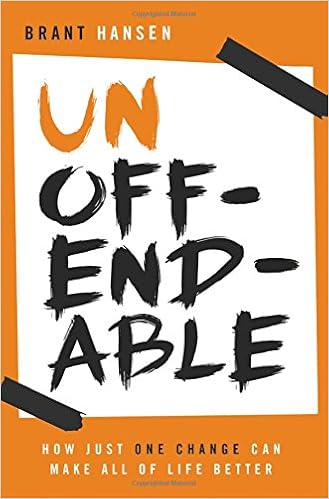
Review of Unoffendable by Brant Hansen

I loved listening to Brant Hansen on my way to seminary (or Chick-fil-A) when I lived in Louisville. His sense of humor is similar to my own and so I loved to laugh with him. But I also appreciated his understanding of the gospel. He would ask through provoking questions and do so in a loving manner. I didn’t always agree with Brant but I still figured that if I knew him we’d get along wonderfully.

My experience with his new book, Unoffendable, is very similar. I still love his sense of humor—I laughed several times throughout the book. And just as on his Morning Show, Brant made me think. I still don’t agree with everything he said in this book, but at the end of the day it’s been a helpful book. It has caused me to stop and I think even in some places where I don’t agree, Brant might be closer to the truth than I am.

So, let me get those couple feisty points out of the way first and then I’ll tell you why this would be a good book to add to your collection. Brant’s major thesis in this book is that Christians can choose to be “unoffendable” and this is the very thing that we ought to do. In other words—there really isn’t justifiable anger and so we should stop pretending as if there is. He summarizes his book this way:

Choosing to be unoffendable means choosing to be humble. Not only that, the practice teaches humility. Once you’ve decided you can’t control other people; once you’ve reconciled yourself to the fact that the world, and its people, are broken; once you’ve realized your own moral failure before God; once you’ve abandoned the idea that your significance comes from anything other than God, you’re growing in humility, and that’s exactly where Gods wants us all.

I can say “Amen” to every one of these statements. It is only when Brant veers a bit away from this vision that I find myself shaking my head a bit. For instance, in a few places throughout the book Brant seems to be saying that Christians never have a right to be angry. He might very well be correct but I’m just not convinced by the arguments here. They just don’t go far enough nor really do justice to the other side.

What Brant I think is saying is that Christians shouldn’t engage in stupid anger. But isn’t there something to be said for being angry with the things that grieve the heart of God? Is it possible for anger to ever be a good emotion? I believe we have gone so far the other way—being offended by everything and calling silly things justifiable anger—that this book is needed. We could use a pendulum swing in the other direction, but at the end of the day there is likely a side to anger that isn’t considered here.

There are also times in which it feels like the suggestions might fall into the trap that I spoke of here. I see this especially in the fourth chapter when Hansen talks about artists seeing what things could be instead of what they actually are. Here it is suggested that we choose to be unoffended because it “frees us to love people in risky but profound ways”. And the motivation for doing this is because we don’t know what this person might become.

It is argued that God, being an artist, loves us because he sees what we can become. But that doesn’t really seem like the motivation for the gospel. God loves us. Period. He doesn’t love us and save us because He knows he can change us. He changes us because He loves us. This is why I say that at times it seems like what is motivating the call to be unoffendable isn’t so much the gospel but more of the backwards hanging out with sinners that I’ve spoken of previously.

But I actually don’t believe Brant believes what I’ve just accused him of saying. In truth I just think the analogy falls a bit flat in chapter four. And this really is the only other downside to the book. It’s a bit scattered and for a book tackling such an important topic a bit more systematic of an approach might have been helpful.

All in all this book is really good. It caused me to stop and think. Brant has a phenomenal point here and in our culture of outrage we ought to heed what he is saying. There is so much anger in our lives that we are not entitled too.

I really appreciated his chapter on the pressing question of the book, “What About Injustice?” Though, I think a bit more could have been said on this I absolutely loved what he did say. Especially this, “We’re positively in love with ‘taking stands’ that cost us absolutely nothing. We even get to be fashionable in the process”. This is social media. We fall into the trap of thinking that just because we write about something or angrily tweet something that we’ve somehow accomplished something. But what does it really accomplish?

 Get this book. It’s needed in our present landscape. It’s a breath of fresh air. It’s not the last word on the topic but it certainly needs to be chewed on and lived out. You’ll be blessed by reading this book.