No One’s Watching

Christopher opened his car door and stepped out. He was at the grocery store for a few quick things on the way home from work. He noticed a small bag on the ground between his car and the next one over. It didn’t look like trash, he thought, as he picked it up. He gasped as he looked at several stacks of money bundled together. 100’s, 50’s, and 20’s filled the small bag. His pulse quickened and he looked around. Did anyone see? What should he do, he wondered. There were no obvious markings or anything to identify it.

He knew he should turn it in, yet the temptation to keep it was strong. Untraceable cash could go a long way to helping he and his wife with their financial struggles.

——————–

The legendary basketball coach John Wooden said “The true test of a man’s character is what he does when no one is watching.” The decisions you make when there is no one there to keep you accountable show who you are. We are alone an awful lot. Commuting to work, time at work, time spent alone shopping, being home alone sometimes when our families are gone, or being home alone always if we live alone. We are faced with numerous decisions every day hidden from public view.

Don’t think you’re ever alone? There’s no one else in your head. (I hope) We are always alone with our thoughts whether we are close in proximity to others or not. No one’s watching, or so you think. What goes through your mind in these supposed times of solitude, whether mental or physical? If no one could ever find out what would you most want to do?

Someone Is Always Watching

Here’s the thing,  as we stroll down the potentially dark boulevards of our minds. Someone is always watching. We are never hidden from the view of God. Not simply visually, he knows our every thought. There is no time of total solitude, for God is there. Wherever we go and whatever we do, he is there. Far from this being oppressive and crushing, this should be comforting.

God sees and knows all that we go through. He understands our every temptation, situation, and contemplation. We pray and cry out to him for things he already knows. Our Father is a good and gracious and will take care of his children. When we walk through dark valleys of suffering, despair, depression, and grief he is there with us, sustaining us. When we walk on mountains of joy he is there with us, sustaining us.

Jonathan Edwards realized this fully and resolved to live accordingly in resolution #5 “Resolved never to do anything which I should be afraid to do if it were my last hour of my life or before the last trumpet blew.”

He resolved to live justly before God, knowing full well that everything he did is answerable to One of above all. But we have grace, you say. Grace that is greater than all our sin. Yes, we do. God also tells us, “You shall be holy, for I am holy.” (1 Peter 1:16) Christ is our righteousness and holiness, yet we are still called to obey and pursue holiness.

My illustration above and these words are trying to remind you that you live before the face of God. Nothing you do or think escapes him. You can shrink back in fear at the awesomeness of the thought. I do. Yet rather than collapsing in despair at my sin every day, I collapsed in despair into Jesus Christ seven years ago.

Today is the day of salvation. You live before the face of God and nothing is hidden from him. Repent of your sins and believe in the Lord Jesus Christ. He alone can save you.
Today in Blogworld 07.23.15

Police or Pastor?

If a wife is abused by her husband should she call her pastor or the police first?

6 Things Christians Can Do About SSM

Christians can still make a difference in this conversation (though I think it’s a bit beyond a conversation at this point).

4 Really Good Money Questions

Yes, these are really good.

Textiquette for Teenagers

It’s wise to train our children in how to properly use media.

This dog totally lands a front flip:

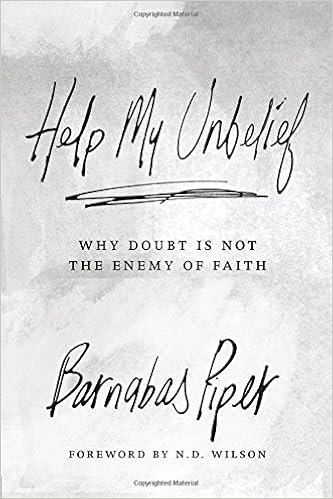
Review of Help My Unbelief by @BarnabasPiper

I’m convinced that doubt has become a sexy virtue in our culture. Our generation has rightly understood that the Bible invites us to an authentic expression of doubt. But we’ve wrongly assumed that being in a state of doubt is an attractive virtue or somehow the summit of Christian experience this side of Eden. I have to confess I’m often tempted to keep doubt around a little longer than I should.

Given my repulsion at doubt being considered a sexy virtue, I was intrigued by Barnabas Piper’s new book Help My Unbelief. The subtitle is what really grabbed my attention: “Why Doubt Is Not the Enemy of Faith”. Part of me wondered if as I read this I’d be disappointed that Piper had went the way of those who now consider doubt to be a virtue. But the other part of me wondered if this book might help to fill in some gaps in my own mind about the relationship between faith and doubt.

You see part of my repulsion at making doubt a virtue has to do with my own struggles. I go through periods of darkness in my mind and soul. During these times the virtuous doubters are very appealing to me. Hearing the “doubt is okay” mantra can cause me to stop putting up a fight and just be comfortable with muddy belief. I know that a weak faith can lay hold of a strong Christ. This precious balm for my soul, but it can also be an enemy to my growth because I can wrongly assume there is no difference between a weak faith and a strong faith. As a result, rather than crying out “Help my unbelief!” I just sit and wait out the storm.

This is where Piper’s book was exceedingly helpful. His central argument is that there is a type of unbelieving doubt which leads to idolatry and apostasy. But then there is also a good type of doubt—akin to the questioning child—which questions in order to believe. This kind of doubt is not the enemy of faith—in fact its is just the opposite. In fact not wrestling with the tension between belief and unbelief might indicate that we are either infantile Christians or not Christians at all. (28)

There is a type of faith which might outwardly seem to be strong but inwardly it is pretty void. This is the type of faith which Piper confesses to having had, and which I too have struggled with. This paragraph hit me like a ton of bricks:

When all we have is the mental-assent part of belief, though, we base our actions on some other standard: our emotions, our happiness, our stresses. We know there is a higher standard, but only cognitively, not transformationally. What we know about God is not the same thing as believing in Him and having that transforming faith. In fact, it can even be a deterrent because mental assent so easily substitutes for real life change. (49)

The most real type of faith acknowledges our finitude and our limits. It is even honest with the struggle of doubt, after all “we are prone to practice it” (96). But authentic faith will find itself crying out “help my unbelief”. Piper is certainly correct, “the desire to believe can stem only from belief”. And this is why doubt as virtue simply doesn’t work. Jesus responded to this type of doubting faith because it came from a heart which wanted to believe. He didn’t want to stay in his state of unbelief. Doubt isn’t a virtue—but it’s not decisively negative either.

At the end of the day the most important thing is our relationship with Christ. I appreciate how throughout the book, Piper unblushingly points to our union with Christ. In his afterword he says, “what I hope readers take from these pages is a clearer vision of God and the wonderful reality of relationship with Him. There really is hope nowhere else…” (151)

As far as I’m concerned Piper achieved his goal. Reading through this book challenged me and it strengthened my faith. It helped establish an ecosystem in which my faith was able to grow organically. (117) I appreciate so much about this book. It was one of those books where you can feel your mind and your heart lean towards Christ just a little more. This isn’t a how-to book and I’m glad. This is a call to embrace Christ as we wrestle through the tension between belief and doubt.

You can (and should) pick up a copy here.

Today in Blogworld 07.22.15

Bare Skin! ‘Hussies’

I found this article on the beginnings of the Miss America pageant to be interesting. Seeing where we are now perhaps those “prudes” in the 1920s say something we didn’t.

How to Really Be Inclusive

Jesus is inclusive—but maybe not in the way you think.

5 Tips for Spotting Fake News

Please read and apply.

Dear Franklin

Marty Duren tackles Franklin Graham’s comments on Muslim immigration.

I think John Newton would have appreciated this: