Herod’s Will Build You Temples, But Here Is What They Cannot Endure…

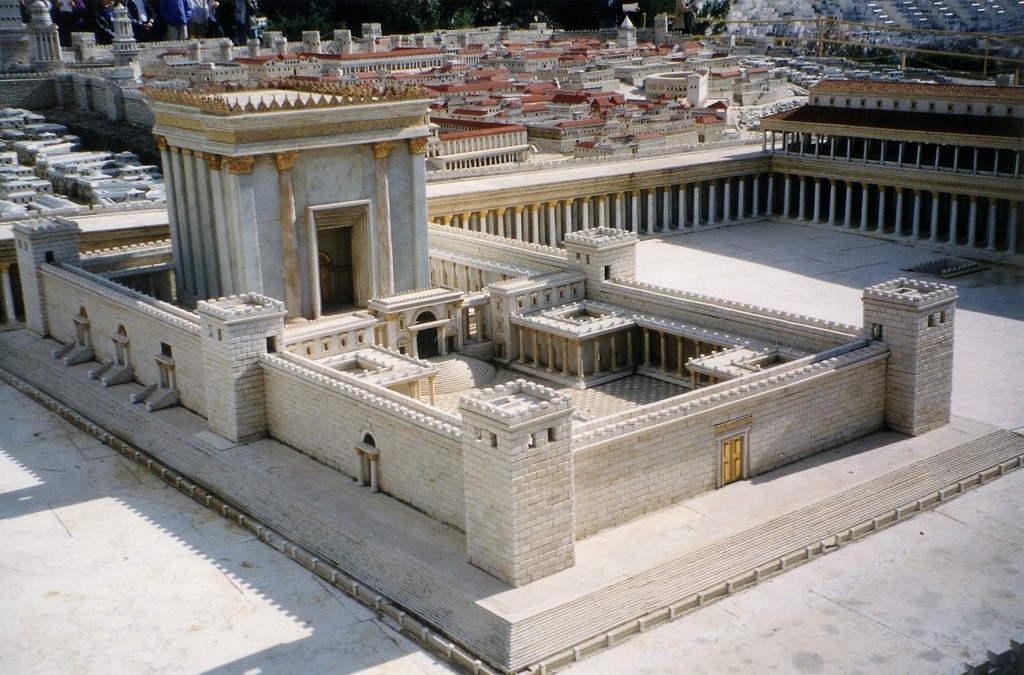
02-herods-templeHerod’s temple was glorious. Built from quarried stones and spanning some 1600 feet the Western wall of Herod’s temple is still standing to this day. It was his crowning achievement.

In the time of Jesus, Jewish people from all over would have traveled to this holy site to worship, offer sacrifices, and celebrate Yahweh. With Herod’s massive renovations they had a splendid temple with which to worship God.

Herod built the Jews a beautiful temple.

Let that sink in for just a moment.

Herod was a tyrant. This is the same guy who slaughtered babies when he heard the Christ was born. This temple wasn’t out of dedication to YHWH, it was a political strategy. Some historians even believe that Herod pretended to convert to Judaism to gain even further advantage from the Jewish people. His actions were motivated by politics…but the Jews had a beautiful temple because of it.

9But when John rebuked Herod the tetrarch because of his marriage to Herodias, his brother’s wife, and all the other evil things he had done, 20Herod added this to them all: He locked John up in prison. –Luke 3:19-20

This is a different Herod than the one who had built the temple. This is one of the sons of Herod the Great, this is Herod Antipas. But the guy is cut from the same cloth. Powerful. Politically expedient. Great at building stuff. But even though a little more tolerant he was just as murderous. John the Baptist would end up beheaded by this Herod.

This is why I say that Herod’s will build you temples but they cannot endure the authority of the word of God. John was prophetically speaking into Herod’s life and rather than change he labored to shut John up. This same Herod would do the same thing to Jesus. And the Herod’s of our day will do the same.

There are several lessons for us in this. One is to note that the murderous Herod’s didn’t see a temple as a threat. Religious systems are never a threat. You’ll never have to fight demons to become more religious. All the forces of hell won’t come against your Christian values, they might even pave the way for them. They’ll certainly co-opt our religious talk to serve their political ends.

What they’ll never tolerate is the prophetic. They will not endure a gospel declaration which claims authority over lives. You want to see the forces of hell stirring then proclaim a gospel which cannot be hijacked but a gospel which bids us to come and die. The biblical gospel will always make Herod’s uncomfortable. If it doesn’t then it’s either not the biblical gospel or your Herod’s dragon scales are starting to peel.

We can labor for temples. We can posture to get friendly Herod’s to buy into our religious system. Or we can be prophetic. I doubt we can do both. There is an unshakeable kingdom which might put our necks within the range of Herod’s sword but it’s the only kingdom without end. It’s the kingdom that causes devils to tremble.

Herod can endure a religious system full of solemn assembly, new moon celebrations, and Sabbath keeping, offerings, and incense to a God he doesn’t worship. But he cannot endure a gospel which lays claim to his marriage bed, his ethics, or called him to a different standard of justice.

Meanwhile, the Lord calls us to follow him with our marriages, our ethics, and our standards of justice. All the while he turns over tables in Herod’s temple because like His Father he cannot endure iniquity and solemn assembly.

It’d be a shame if we tremble at the wrong kingdom…

Learning How To Achieve a Prophetic Reasonableness

download (2)

“Let your reasonableness be known to everyone. The Lord is at hand.” –Philippians 4:5

I cannot get this verse out of my mind. Reasonableness could easily be translated gentleness or meekness. It’s the same word used in 2 Corinthians 10:1 in reference to the meekness of Christ. The word is often connected to response in the midst of persecution. Rather than retaliating we respond with gentleness. It’s not weakness but rather actual power which is under control.

But the part of that verse which is giving me such a stir is the phrase “let…be known”. It seems to me that it’s not only a call to consistently respond to persecution in this fashion, but it also has a “don’t hide it under a bushel” quality. Here I think of that Edmund Burke* quote, “All that is required for evil to triumph is for good men to do nothing.” It’s a quote that’s been hijacked by the militant. It’s a great flaming arrow to pick up if you want to torch somebody. But I think it belongs better in the hands of someone like myself who shies away from conflict—often to a fault.

If I’m being honest I’ve been silenced. I tell myself that I’ve gone local and I hope to combat error on a personal face-to-face level rather than writing hot-takes. That’s true. I still believe this and this is still a good part of my strategy. But I believe there has been a cost to my public silence. I believe God has called me to a ministry of prophetic reasonableness. It’s a painful ministry in a season when we are so divided. More times than not I’ve chosen personal comfort over truth speaking. I’m still learning the balance here. I’m still healing from my own trauma’s and knowing when and how to speak. But there has been far too much resignation on my part, and the Lord has convicted me of this.

Consider this illustration from Debra Hirsch:

“No one would blink an eye at a woman bringing a Women’s Day into church, yet there would be an uproar if a man arrive with a Playboy under his arm! Aren’t both types of magazines pornographic? I put women’s magazines into the category of “social porn,” because they can be just as damaging for women as “soft porn” can be for men. Think of all the faulty notions of beauty it breeds, the covetousness it generates, not to mention the gossip that ensues…Porn is porn, no matter what form it comes in.” (Hirsch, 77)

In the same way I think of all those who bring outrage porn into the church. And we don’t bat an eye. In fact, in some circles we produce the porn.

Philippians 4:5 is set within a context. On one end it’s part of how “true companion” is called to “help these women”. And 4:5 also leads us into the beautiful garden of Philippians 4:8. Letting your reasonableness be known to all is connected with unity and beauty. So how does one who is called to prophetic reasonableness respond to the ugliness of outrage porn? Is it as simple as telling a better story? Or would you respond with the same vigor as the meek Christ who flipped over tables and crafted a whip to run people out of the temple?

I’m not certain the answer, but I believe I’ve been a bit too silent. And that’s not okay. I feel a bit like that dog in the picture–fires all around me and hoping that my calm will somehow put out the fires. It won’t. I need to stop pretending like it will.

*This probably isn’t from Edmund Burke: https://checkyourfact.com/2019/06/05/fact-check-edmund-burke-triumph-evil-good-men/

Why We Need to Break-Up With Our Angry Friend

photo-1587653811766-99e6caf4e0d6

“Make no friendship with a man given to anger, nor go with a wrathful man, lest you learn his ways and entangle yourself in a snare.” –Proverbs 22:24-25

Twitter can’t be my buddy. Neither can talk radio.

This Proverb is simple, really. Anger in others tends to be repulsive, but when it comes from within our own tribe it’s justified. If we makes friends with angry people we’re going to be trapped in their snare, and we’ll become angry people ourselves. Charles Bridges says it well:

Common intercourse with a furious man is like living in a house that is on fire. His unreasonable conduct stirs our own tempers. One fire kindles another. Occasional bursts of passion soon form the habit. The habit becomes our nature…We learn anger easier than meekness. We convey disease, not health. (Bridges, 420)

I try to read through a chapter of Proverbs every day. I read Proverbs 22 on a day when I had a steady diet of Twitter conversations. I was feeling deeply discouraged. It felt as if the world around me was burning (and indeed it might be). There was so much anger. So much injustice being exposed. So many tweets pointing out hypocrisy. Some I agreed with—others made me hot with the rage of disagreement.

Then I read this Proverb and thought about Twitter as an angry friend. If this “friend” is fueling this type of negativity in my life then it’s not a friend. An angry friend probably has a few redeeming qualities, but this proverb calls us to not befriend a person given to anger. Never. Ever. Period.

The Lord convicted me about 15 years ago concerning talk radio. I was working for a parts store, delivering parts, listening to angry talk radio during the day then being a youth pastor at night. This proverb was playing out in my life and I didn’t like it. I’m thankful the Lord deeply convicted me in this area. I turned them off and haven’t looked back.

I also looked back over some of my sermons during those years. It pained me to see how tainted they were by a bubbling rage. I didn’t view people with hope. I viewed them with suspicion. I was a cynic and it occasionally peaked through the pages of my sermons. I”m grateful for the Lord’s grace in tempering me.

I had to break up with my talk radio friend. And I’m beginning to wonder if I need to do the same with Twitter. It’s not apples to oranges though. You’re entirely passive when it comes to your talk-radio buddy. Social media is more given and take. So, I’m trying to figure out how to engage but to not be sucked into the negativity. If I find that I cannot, I suppose we’ll need to break up.

One thing I do know, we cannot tolerate angry friends. If we aren’t speaking into their lives then we’re being influenced by them and being sucked into their rage. We have to keep our pulse on this. We will not drift into holiness in this area. We are bent towards negativity. The gospel calls us to something higher.

I write this the day of angry protestors stormed the Capitol building. I also write it the day after God providentially had me teaching out of Philippians 4:4-8. Watching the news and having Philippians 4:4-8 encouraging my soul provided a sharp contrast. David Murray is correct when he says,

we are what we think. If our minds constantly feed on all this negativity, our moods will inevitably darken, taking everything else—our words, actions, health, relationships, and so forth—down with them into the abyss.” (Murray, xv)

Philippians 4:8 is also true. When we challenge ourselves to cast our cares upon the Lord and think about His goodness and grace it transforms our thinking. It’ll cause you to be a bit more off-put by that angry friend. There is goodness and beauty in our world.

I believe this challenge from David Murray is fitting for our day. “Don’t look for what you can critique; look for what you can admire and invite others to enjoy it with you.” (33)

I realize the irony of this post being about the potential need to “break-up” with social media. But that’s actually what I’m attempting to say here. If I cannot find the goodness and beauty in social media, if it doesn’t lead to a greater enjoyment of God, then it’s not serving it’s purpose. It’s only an ensnaring friend.

Social media cannot be our friend. It’s too angry. The same goes for talk radio. Redeem them, speak truth to them, try to infuse beauty into them, but don’t befriend them.

Source: here

Why Those Who Are Concerned With ‘Strange Fire’ Should Be Leading The Charge for Justice

photo-1510772314292-9c0ad420734aGod is serious about worship.

Just ask Nadab and Abihu. These men were the next in line to follow Moses’ brother, Aaron, as the high priests. We read in Exodus 24 that they had a unique experience of seeing a vision of God. Perhaps this led to an inflated view of their importance, because in Leviticus 10 we read that they offered “strange fire” before the Lord.

There is some debate about what specifically these guys did. Some have offered the theory that they were too drunk to do it correctly. Others have said they offered sacrifices presumptively and assumed the Lord would accept whatever they brought. It could be a combination of the two. What isn’t debated is that God immediately struck these men dead.

The point of the story, then, is that if you worship in a way not prescribed by God—you will invoke His wrath. If you offer strange fire then God isn’t going to be pleased. Therefore, it’s only fitting that we ask, “what is strange fire?” The story of Nadab and Abihu calls us to assess the ways we worship and what we believe about worship. An application point, then, is to say I don’t want to be Nadab and Abihu, so I’m going to watch my doctrine closely.

Keeping Us From Strange Fire

In his book, Strange Fire, John MacArthur compares charismatic theology to Nadab and Abihu. His criticism is sharp and pointed:

Here’s the point: we can’t make God into any form we would like. We cannot mold Him into our own image, according to our own specifications and imaginations. Yet that is what many Pentecostals and charismatics have done. They have created their own golden-calf version of the Holy Spirit. They have thrown their theology into the fires of human experience and worshipped the false spirit that came out—parading themselves before it with bizarre antics and unrestrained behavior. As a movement, they have persistently ignored the truth about the Holy Spirit and with reckless license set up an idol spirit in the house of God, dishonoring the third member of the Trinity in His own name. (Strange Fire, xiv)

MacArthur goes on to make the argument that this “strange fire” is infiltrating churches much as a trojan horse. Therefore, we ought to “take a stand” and “rise up” and “condemn everything that assaults the glory of God”. (xvii)

I’ll show my cards from the beginning and say there is much within MacArthur’s book that I find unhelpful. I believe he paints with far too broad of a brush to give a substantial critique of charismatic theology. I agree with him on plenty of points throughout, but ultimately I find his work here unhelpful.

God Does Care About Worship and Theology

But a critique of Strange Fire is not why I’m writing this today. In fact, I believe there is a core to what MacArthur is saying here which is true and correct. God does care about how He is worshipped. Doctrine does matter. And we do need to have a proper theology of sacrifice. There are implications to this which are incredibly important for our walk with Christ.

Yet, I wonder if MacArthur has really gotten to the central point of Nadab and Abihu. The way I see it the story is saying “we must take the holiness of God seriously”. To which MacArthur seems to be responding, “therefore, we need to make certain we believe the right things about God”. That’s a fine point, but it’s not the point of the narrative.

Was this about flippant sacrifice and shoddy belief? Or was this more about knowing the right thing and doing the wrong thing, and doing so as a leader of people?

Consider Proverbs 21:3.

“To do righteousness and justice is more acceptable to the LORD than sacrifice.”

Let’s concede MacArthur’s overall point for a moment. God takes sacrifice (right worship) very seriously. To not sacrifice correctly cost Nadab and Abihu their lives. And let’s assume that part of the application of this is to make sure that our doctrine of “sacrifice” (and how to properly worship) is all part of this.

How then should Proverbs 21:3 inform us? If God cares THAT much about matters of sacrifice then how much more does he care about matters of righteousness and justice?

What this tells me is that those who are passionate about doctrine, those who firmly believe it is important to know God and to know Him rightly, ought to be the ones leading the charge in matters of righteousness and justice. Proverbs 21:3 tells us about the heart of God. He takes pleasure in us doing the right thing and ordering our communities fairly. If you care about believing right things about God and leading the charge in presenting God rightly, caring about righteousness and justice should be at the forefront.

Conclusion

Some will hear that last statement and immediately begin arguing doctrine. What “type” of justice? What “type” of righteousness? Are we arguing for an embrace of a secular philosophy like CRT/I?

This type of response tells me that we’re not asking the right questions nor doing the right thing. This response actually betrays that I’m empty handed—except for the rocks I have to throw at those attempting to do justice. What I mean is that what ought to be happening here is that we have two groups of Jesus-loving people saying, “I’m doing justice and righteousness this way” and another saying “I’m doing justice and righteousness this way, and I think mine represent God better”. But what we have are those saying, “I’m doing justice and righteousness this way” and the other group shouting, “strange fire!!”

To our brothers and sisters who love theology, who fight for a right theology of righteousness and justice, who are diligent in making certain nobody is deceived by strange fires, may I plead with you to lead the charge in actually doing righteousness and justice.

Those who are passionate about preserving the church from strange fire should be at the front of the line in preserving us from the strange fire of a Christianity that doesn’t “seek justice, correct oppression; bring justice to the fatherless, or plead the widow’s cause”.

Photo source: here