Pray For Your Church 31 Day Challenge

A couple years ago we launched a 31 day challenge for husbands to be intentional about praying for their wives. We followed this up with a challenge to pray for sons, daughters, and for wives to pray for their husbands. We even partnered with Tim Challies to do a 31 Days of Purity challenge. You can check all of these out by going here.

I say “we” because this really has been a group effort. I started the pray for your wife challenge anticipating about 50 guys to join me. I was amazed to see that number reach the thousands. Our format was simple.

First our intention is to put a FACE on praying.

  • Focus—I need to know what specifically to pray or I’ll just keep praying the same things over and over again.
  • Accountability—I need a group of people to keep me accountable and remind me daily to passionately pray.
  • Challenge—I need to be challenged to go deeper in the way that I pray. A community of other people praying will help shape my prayers.
  • Encouragement—Sometimes we pray for things and God’s answer is slower than we like. We need encouragement to keep praying.

If you need these things too I want to invite you to join us in prayer. Starting on Monday November 9th we will begin a new 31 day challenge of praying for our local church. Whatever local church God has placed you in, I want to challenge you to spend the next 31 days praying for the local body of Christ where God has placed you.

Here are steps to take in joining with us:

First, join the 31 Day Pray For Your Church Facebook group. It is a closed group so you’ll have to ask for an invite. If you have any problems email me ( mleake792 [at] students [dot] sbts [dot] edu)

Secondly, get the word out. All of our churches need prayer. This is one way to encourage you to do just that. Retweet this post, like it on Facebook, do whatever you can to involve more and more people. Friends, we need a community like this to put a FACE on our prayers.

How Will it Work?

Every day I will post a particular focus for our prayers along with a sample prayer. You can comment with your own prayers, etc. Also you will be challenged to “like” that status if you prayed for your church that day, as a means of accountability. I also would love to share testimonies of what the Lord does through our prayers for our church.

Will you join us?
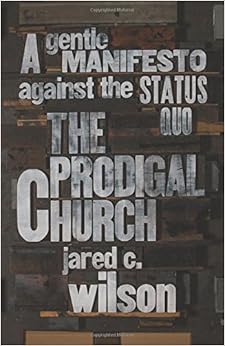
A Review of The Prodigal Church By Jared Wilson

“You fool, you can’t do it that way…”

Give criticism like that and not many people are going to respond. Likewise if you simply show people what they are doing wrong without giving them a better alternative, they’ll likely keep doing it the way they have always done it. To properly give criticism you need to do so as a friend. And you need to show them a better way.

To the attractional church, Jared Wilson is such a friend, in his book The Prodigal Church. Having come out of that mindset himself, Jared is well-positioned to offer his critiques as a friend. And there are plenty. Sometimes he is hard-hitting. He makes a compelling argument that the attractional system is broken. And then he proceeds to show the better way—through faithfully proclaiming the gospel.

That wouldn’t be well received if Wilson came at this from the position of an enemy. But because of his tone, I believe those who have bought into the attractional model will at least hear him out. When they do hear him out they will hear the heart of a pastor who bought into a system which broke him. And they’ll hear the heart of a pastor who has become gripped by the unchanging and cross-cultural gospel of Jesus. I pray that what they see is a vision of God so attractive that they consider unplugging the fog machine and reorient their churches around beholding God.

For those of us that began the book in agreement with the author, there is plenty to feast upon. For one, I believe Jared models how to talk through these issues. If you are a pastor attempting to slowly change the mindset of your attractional church, this book is a great model for tone as well as content.

I also found this book deeply encouraging. When your church loses folks to the sexy church down the street and people in your congregation are clamoring to compete it can be both tempting and discouraging. Reading this book was an encouragement to me to stay the course and to use faithfulness as the tool to measure success. It was also encouraging to realize that I’m not alone. I’m not just a lonely and crazy loon who believes that the gospel is sufficient. This was a powerful defense for what I believe to be true about the way we are to do church.

So, if you believe the attractional model is best I invite you to set down with a cup of coffee and enjoy this conversation. If you are already convinced that something akin to a gospel-centered way of doing church is the best way—then be encouraged. If you don’t really know what either mean, you’d do well to read through the book as well.

Marx’s Communist Manifesto changed the world (for the worst). I’m praying that Jared Wilson’s Gentle Manifesto Against the Status Quo will change our churches (for the better).

Pick up your copy today.

Theology Thursday: God

Last week we asked, Are you made in God’s image, or is he made in yours?

Most people would scoff at this and say, of course we’re made in his image. How would he be God if he were made in ours? I agree, and yet there are many theological disagreements that boil down to “How could a good God ever do such and such?” What we may not realize in asking such questions is that we are in danger of sitting in judgment over God.

Then we ask, what does the question mean?

In Genesis 1:26-27 the Scripture reads,” Then God said, “Let us make man in our image, after our likeness. And let them have dominion over the fish of the sea and over the birds of the heavens and over the livestock and over all the earth and over every creeping thing that creeps on the earth.” So God created man in his own image, in the image of God he created him; male and female he created them.”

The question is answered. We are made in his image. Does that mean that God is humanoid, with flesh and blood and occasionally bad breath? No. God is without parts. God is spirit. (John 4:24)

But what of Jesus Christ? Jesus “put on” flesh at the incarnation. He took on flesh at his birth, but as an eternally existing member of the trinity he existed, and still exists, as spirit in his divine nature. He is fully man (with parts and faculties) and fully God (without parts or passions.) We’ll talk more on the hypostatic union, divine impassibility, and the trinity in more depth throughout this series.

God is eternally existent. He always was, always is, and always will be. He refers to himself as “I AM,” a declaration of divine existence. We cannot similarly declare our eternal existence as there was a time when we were not. Before God created us, we did not exist. Yet there is a permanence now to our souls. We will now exist eternally from our creation forward though only because God upholds his by his power. (Colossians 1:17; Hebrews 1:3)

Our existence is contingent upon God. We exist because he created and sustains us. God is not contingent upon us. He does not depend on us, is not derived from us, and does not need us. We do not share these attributes with him as we depend on him, are derived from him in his act of creating us, and we need him. Our eternal existence will continue after our bodies die in either Heaven or Hell. Again, we are dependent upon God for our continued existence in either place.

So we do not share most of God’s attributes. There are yet more we will cover.

We share shadows of some. One of those is our morality. We have a knowledge of right and wrong inherently. All cultures of the world share a code of conduct based on lawful and unlawful actions. The standard of that code shifts a bit depending on time and place, yet the code remains. Why? Because we are made in the image of God. In creating us he imparted upon us a moral nature which has categories for right and wrong.

When we sin, we shift the categories and ignore what God says is right and wrong in favor of our own standard. Make no mistake, when you sin you are fully convinced that you are right in committing the action when you do it. You may feel conflicted and in anguish as you wrestle with temptation, but when you give in you have decided it is best to do the sin than to not. In these times, god is made in our image. How so? Because we call ourselves god, in a sense, by deciding we know better than God what is right and wrong.

If you feel tension with the Bible’s clear commands and yourself, the problem is not with the Bible, but with you. I’ve felt this tension and wrestled through it. Being made in the image of God, I must submit to the image maker as an image bearer. He made me, not I him.

“But wait! I have more questions!”

Next week, my friends. We are far from done. We haven’t even scratched the surface of God and his divine attributes.

Why Ramble?

I’ve been reading an interesting little book that I picked up at a used Christian bookstore, The Thought of the Evangelical Leaders: Notes of the Discussions of the Eclectic Society London During the Years 1798-1814. The book had John Newton on the cover and so I knew it was one I needed to add to my collection. It is proving to be pastor-nerd paradise.

The eclectic society was a group of pastors who started meeting together in 1783. It was formed by Newton, Richard Cecil, Henry Foster, and Eli Bates. If I’m not mistaken, some of their earlier meetings were formative in talks about ending the slave trade in England. The notes, unfortunately, are picked up in 1798. That’s only eight years before the death of Newton and so we miss some very valuable information by not having those notes from 1783-1798.

The format of the meetings were simple. One of the pastors would propose a topic—give a bit of his take on it, and then the other pastors/leaders would comment on the topic. There are things in this book ranging from theological questions to practical questions such as, “the duty and importance of punctuality in all our engagements”. It is interesting to read what these pastors had to say on some of these topics.

I’m only a little ways into the book but I have already uncovered some terrific gems for preaching and also for how to live the Christian life. But there is one thing that I’ve noticed that has really ministered to me, and it is more in what is not said than in what is said.

I bought this book because it was interesting and it would give me a bit more information on Newton. But one thing I’m noticing is that Newton usually only speaks a few pithy lines. Yet, this is speaking volumes to me as a pastor and as a man.

What I’m noticing is that some of the younger men in the eclectic society will speak for a couple of pages on a peculiar topic. One such question was on the temptation of our Lord. A thirty-year old minister gave what appears to be a mini-sermon. He had about nine-points with three or four sub-points under each of these nine. We only have the notes of this but even still it goes on for a solid three pages. To which Newton simply responds, “I was never troubled with these doubts.” And then he gives a few sentences as to why.

This speaks loudly to me. Newton, as an elderly pastor, was mature enough to know what was significant. A younger pastor can ramble on and on and on about disputable matters. And he’s probably correct in many ways. It might even be a topic of relative importance. But there is something to be said for Newton’s swift and concise answers. I want to learn from him. I want to ramble less and quietly speak a few words into a situation. I’m convinced that the few well-timed words of Newton weighed a ton more than the 35 minute mini-sermon of this younger pastor.

Such a thing comes from knowing what is important. Having confidence in the Lord to administer His truth as well as a disregard for making ones name significant. I can think of three times when I’m tempted to ramble on:

1. When I don’t really have anything to say but I feel as if I ought to.

2. When I want to make a name for myself and thus try take control of the room. 

3. When my youth passion takes over. As I’ve discovered some truth which is new to me, I act as a young kid but with a foolishness which assumes I’m the first guy who has ever seen this thing.

Rambling, I’m convinced is conquered by having a confidence in Christ and a passion for His name alone. Humility breeds a bit more reservation in opening of the mouth. I pray I learn from Newton and speak only what is necessary.

—

Photo source: here