Touching Trauma

jesusthomasdoubt-300x223I always dreaded taking a shower after playing baseball. It wasn’t because I didn’t desire to get all the dirt and sweat off my body. I was fine with being clean. It was the fact that when I played baseball it was rare for me to leave a game unbloodied. Either my knees, my elbows, or my side would have wounds from sliding or diving for ground balls. A shower is painful on open wounds.

Trauma doesn’t like being touched.

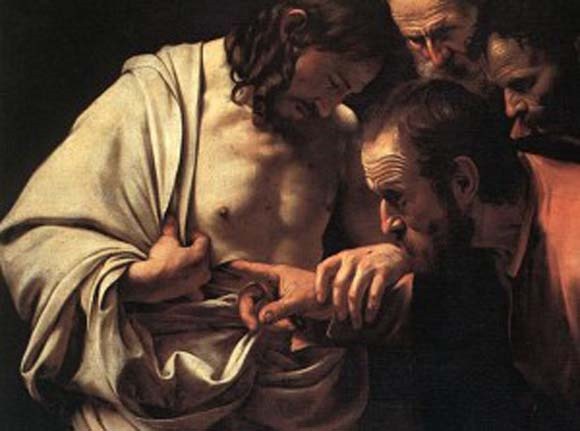
That’s why I’m really taken aback by these words of Jesus to the unfortunately monikered Doubting Thomas: “Then he said to Thomas, ‘Put your finger here, and see my hands; and put out your hand, and place it in my side. Do not disbelieve, but believe.’”

“…place it in my side.” Are you kidding me?!?!?

There has been much made about whether or not Thomas actually did touch Jesus’ body. The text doesn’t tell us that he did. In fact, there is a pretty decent argument made that his belief without touching is an integral part of what is happening here. The point would be that Jesus knew Thomas’ heart, knew his ache, and offered to fulfill that need. This very fact is enough for the doubting Thomas to believe.

This text has also inspired copious amounts of ink on the relationship between doubt and belief. Should Thomas be rebuked? Is he a model for us all? How does Jesus respond to such doubt? Is he rebuking Thomas or is he inviting him into faith? Such questions are important but I think they cause us to miss one really important part of the story. Trauma.

“Unless I see the nail marks in his hands and put my finger where the nails were, and put my hand into his side, I will not believe.”

This is trauma talking. It’s disappointment. It’s the pain of dashed hopes. “You idiots can believe what you want, but I’m not about to trust again unless I can see with my own eyes and feel with my own hands.I won’t be fooled again. I’m not hoping back on this little merry-go-round.”

Thomas asks for the impossible. And he sits with it for eight days. Eight days where the other disciples are filled with hope and possibility. Eight days where all of his questions and all of his pain rise to overwhelm his bitter palate. Eight days, not for his wounds to heal but eight days for them to fester. Thomas hurts to the touch. 

Then Jesus appears. His hands still bearing the marks of trauma. Barely closed. His body split open. His wounds still raw. It’s certainly not a sanitary scene. It maybe an overstatement at this point to say that it’s a bloody mess. But that’s actually where trauma is the most pernicious. It’s often not in the moment itself, it’s in the eight days later. It’s when scabs are starting to form. It’s when others around us are moving on to a new normal but we still bear the pain in our bodies.

For Jesus this isn’t merely the marks of a spear piercing his side. This isn’t only the physical wound of having a nail driven through your hand. These wounds, this trauma, holds with it a message. His body would remember the mocking crown of thorns. That hole in hand is a symbol of rejection—crucified as a would be King. The whole world assuming that He is an imposter. His own beloved disciples having abandoned him. His side absorbing the blow of Thomas’ doubt.

And what does Jesus do?

Touch my trauma.

The son of God wounded. Betrayed. Shamed. Mocked. Scorned. All of those horrendous things we read of in Deuteronomy 28. The cursedness of being hanged upon a tree. Crucified outside the city. He bore it all. And now he invites Thomas to touch the wound.

Something about this heals Thomas’ own doubt—his own trauma—his own cynicism. All the bitterness seems to be washed away in that one moment as hot tears fall down upon his cheeks and he realizes that the resurrection is true. It’s so true that you can touch it. But now he doesn’t need to touch it.

I don’t know if he actually touched the wound or not. But that’s kind of the point. There is something in this where Jesus became more human than any of us have ever been. And he took upon himself more pain, more trauma, more shame, more of all the yuck and muck and grime of being human. And somehow in this moment when he says, “touch my trauma” it’s healing. We don’t have to touch the gaping side with our own fingers because the presence of those holy wounds does something within us. By inviting us into the trauma of His own resurrected body we taste not only our sorrow but also His resurrection and our own. 

Jesus isn’t inviting Thomas only into the purulent, the blood, the germs, the savagery of the thing. He’s also inviting Thomas into the healing. He’s inviting him to touch a resurrected wound. This truth transforms all of our trauma. Gaping wounds are not the climax of the story when the resurrected son of God comes to town.

When Jesus is telling us to “touch his trauma” he’s inviting us to do so with our own wounded fingers. He doesn’t tell Thomas to wash his hands, put on sterilized gloves, and touch him from a distance. He invites him to really feel. Examine the wound with your own dirt covered appendages. Take your trauma to My trauma.

In all of this Jesus is not only owning his own wounds but somehow those of Thomas as well. Here, and only here, in this wounded side of Jesus will we find ultimate rest and healing for our own trauma. This invitation of Jesus tells me that His trauma invites our own trauma. He’s big enough for our dirty hands to touch His wounds. And he calls us into His wounds with our own.

I’m indebted to my buddy, Matt, for inspiring these thoughts. 
The Freedom Of God Knowing You’re Full of It

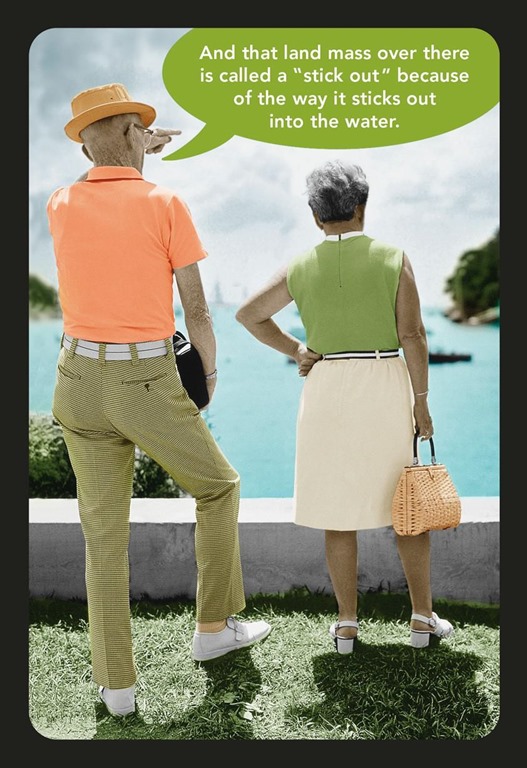
making-it-up-funny-birthday-card-root-349zzb2220_1470_1“It’s a stick-out”, that’s what my wife and I say to one another whenever one of us (usually me….okay, always me) is trying to sound smarter than we really are. I’m thinking of that card when I read 1 John 1:6-7.

6 If we say we have fellowship with him while we walk in darkness, we lie and do not practice the truth. 7 But if we walk in the light, as he is in the light, we have fellowship with one another, and the blood of Jesus his Son cleanses us from all sin.

When John talks about walking in darkness he means more than morality. We would be missing the full thrust of this verse if we tried to paraphrase this as, “if we say we have fellowship with God but we are living in sin, then we are lying and are not walking in truth.” Darkness points to more than just a sinful lifestyle, it’s really about sincerity. To say that “God is light” not only means that he is morally pure it also means that He isn’t hiding any of His character. A paraphrase such as this would get closer to John’s original meaning:

“If we say we have fellowship with the self-revealing God while we are hiding our sin behind fig leaves, we are lying and not walking in truth.”

I say this because the false teachers of John’s day had developed a rather deceptive theology that separated their physical bodies from their spiritual bodies. If you caught them with a prostitute at the temple they’d respond by saying, “this isn’t who I really am. This is just my flesh. My spirit remains pure.” That’s a fig leaf.

I don’t think it’s an accident that it’s a fig-tree which receives the curse from Jesus in the gospels. A fig tree—filled with fruit—was a sign of prosperity. But fig leaves on a barren tree is a lie, just as fig leaves on a naked Adam is an act of deception. The temple system of Jesus’ day was claiming fellowship with God but inwardly was a rotting corpse. It was a barren fig-tree with beautiful leaves to cover its nakedness.

But notice the beauty of verse 7. “If we walk in the light…” This is why I say it’s important for understanding John that we don’t simply conflate the meaning of darkness in verse 6 to mean “sinfulness”. Because if we do this then we’ll treat verse 7 as if it’s saying, “if we live a life apart from sin…” But that’s most certainly not John’s argument. It wouldn’t make sense to say, “live a life apart from sin…if you do…Jesus’ blood will cleanse you from all sin”. But what if it’s saying something like this:

But if we put down the fig leaves and come naked as we really are, just as God Himself reveals Himself authentically, we will have real fellowship with others, and the blood of Jesus his Son will cleanse us from all sin.

This is incredibly good news. It means that God knows that you are full of it. Just as with Adam in the Garden he knows all the shame that is hiding under that fig leaf. He knows the guilt. He knows the stain. He knows all those places where you and I are inconsistent and where we don’t square up. And he’s calling us here in 1 John to just be honest.

Don’t hide behind a theology that denies your real being. Don’t cover your twisted desires to visit a cult prostitute with some complicated theology of the body. And don’t pretend like it was the hand of God that moved Charismatic Pastor Dude from one location to another when in reality it was because he was about to be charged with fraud. God sees through all this.

This is meant to be freeing. God loves YOU. You as you really are and not some dolled up version that has perfected the art of making fig leaves look like the work of the Creator. You and I probably feel as if we have to hide because of all the other humans around us who are trying to perfect the art of hiding. But God sees. He sees you. And he’s calling you out of the darkness and into the light.

It’s here in the light where we can experience real authentic Christian fellowship. And it’s only here that we can have real fellowship. Because if you come wearing your fig leaves then you aren’t really coming at all. And if we try to relate to Jesus out of our fake selves then we’re really not much different than those heretics in the first century who split their flesh and their spirit. Walk in the light.

I’d be remiss here if I failed to note that God does cover our nakedness. He strips the fig leaves but he doesn’t leave us naked. He gives us new clothes. He cleanses us of all sin. The light is transformative. He may love us naked but He doesn’t leave us there. His love clothes us and cleanses us. His provision means that even though we might define ourselves by our brokenness or the shipwreck we’ve made of things—He doesn’t. His calling us into light isn’t all there is to the story. The gospel calls us out of darkness and transforms us by His light.

I don’t know if you call that land mass a peninsula, or what. But it certainly isn’t a “stick-out”.

A New Kind of Biblical Hero

photo-1590363763899-f0b78a7bb968I think I have a new biblical hero. I just wish I knew his name. He appears in Matthew, Mark, and Luke. He’s the leper whom Jesus touched. And I want to be like him.

I’m going to tell you a story today that’s one of about a dozen stories that I’ve never really shared. A few months ago I stumbled upon an old stack of papers from my childhood. It was a little notebook filled with the names of basketball players with tally marks underneath them. Judging from the tally marks Shawn Kemp had dominated Charles Barkley in a one-on-one matchup.

As I poured through the pages I felt incredible shame and sadness. I had entire basketball leagues that I’d invented. Tournaments played out in my imagination. Just me. A hoop. And a basketball. That part isn’t incredibly sad. It’s that these seasons were played out on one end of the court, while my classmates played against each other on the other end. I didn’t get to play. For some reason my short stature made me repulsive. So, I became Shawn Kemp dominating Charles Barkley.

That notebook had seasons of these names and tally marks. Meticulous stats. And I remember when somebody discovered my secret stat book. I endured even more mockery. What a weird little kid I was, playing out basketball seasons by myself when all the other kids were playing together.

And each tally mark carried a message. “They’ve rejected you, Mike. They are going to reject you. You are less than.” I’m realizing more and more these days how much I carry those messages around with me. I’m realizing that it causes me to keep others at a safe distance. It keeps me from pursuing things as well. And, I even try to keep Jesus at arms length (though he doesn’t seem to cooperate, thankfully).

This is what shame does. I’ve found Ed Welch to be correct:

Shame has a natural affinity with self-protection and unbelief. It hides form others, feels undeserving of anything good, and believes it will contaminate whatever comes close. (Welch, 137)

“They are always going to reject you….eventually.” This is the message my shame tells me. I’m fighting against that message these days. I’m trying to believe the gospel enough to pursue unguarded relationships with others. I’m trying to trust in Jesus enough to be authentic; authentic with others, myself, and ultimately with Him. The leper in Luke 5 helps me with this.

Jesus wasn’t doing ministry in a leper colony. That leper broke the Law in order to get to Jesus. He shouldn’t have pursued him. He shouldn’t have left his leper colony. He shouldn’t have been so close to Jesus. He shouldn’t have had the audacity to ask the Teacher to heal him. Leprosy doesn’t get healed—it was compared to raising the dead.

You can still hear shame in this guys voice when he says, “If you will, you can…” He doesn’t doubt for one moment Jesus’ ability. But does he want to?

But I think he knew the answer already. That’s why he left the leper colony. I say that not because this leper had some unheard of confidence. I say this because this is the type of response that Jesus brings about. Again I find Ed Welch insightful:

But look at what happened when Jesus came. Unclean people suddenly were filled with hope. Instead of hiding from the world, they became indifferent to the derision of the relatively clean townspeople and boldly went out to see Jesus. When they saw him, they felt compelled to touch him because they understood that their salvation was near. They came alive! (137)

I want to learn from this leper. “They will reject you”, is not a message that is definitive to that leper. He knew that Jesus was different. He left his shame and went boldly to Jesus. That’s a huge step, too. It’s much easier to believe the message, accept the rejection, and create a fantasy world where you can dunk on Charles Barkley.

We weren’t made for leper colonies or fantasy worlds. We were made for reality. Even if at times painful. 

I would also note that even still Jesus had to “stretch out his arm” in order to touch the guy. He was still keeping himself at arms length. But Jesus crossed that barrier. And that touch carried so many words. “I’m not going to reject you” was chief among them.

Let’s follow this leper into the touch of Christ.

Photo source: here

When a Pharisee Becomes the Victim

146cadb120b5a51d99f677486628e326They tie up heavy burdens, hard to bear, and lay them on people’s shoulders, but they themselves are not willing to move them with their finger. –Matthew 23:4

This is what it looks like when a Pharisee is in power. They load you down with rules and expectations. And these are distant rules. They don’t feel a single ounce of the weight of their biblical interpretations. This is arm-chair quarterbacking at it’s zenith. They have zero experience being a day-laborer but they are still able to use the Scriptures to bog down their daily tasks. The Pharisee can comfortably hypothesize about whether or not you can save a lamb who fell into a pit on the Sabbath. But they don’t have to bear the anguish or financial burden of losing a lamb. They are distantly opining on other people’s problems.

Have you noticed, though, reading through the Gospels that this schtick doesn’t work on Jesus. He doesn’t bow to their authority. He plucks grain on the Sabbath. He heals the lamb that falls into a pit. He gives life, not rules. He’s out of control. Or rather He’s out of their control.

Do you notice the posture they pick up when they are interacting with Jesus? They are victims. I can almost hear the Pharisee giving their defense.

“You all claim that Jesus was preaching a message of good news, that has not been our experience. We asked for signs, so we could know if he was from God, and he simply refused to give them. We tried asking questions to further understand his positions and he either didn’t answer them or he dodged our questions. Then, he goes on the attack. He calls us brood of vipers. He had the audacity to say that we don’t actually have Abraham as our Father. And he threatened to destroy the temple, to take away our livelihood. Then, completely unprovoked, he came into the temple and started flipping things over. This is hurting the economy. And he blocks all temple work on that day. Jesus is destructive. He preaches about love and blessedness and caring for the poor while at the same time causes a farmer to lose a whole herd of pigs.”

Pharisees are masterful at flipping the script. Jesus says, “blessed are the poor, blessed are the meek” and the Pharisees then weasel themselves into those titles. Jesus says that his ministry is about giving sight to the blind, freeing captives, rescuing the vulnerable, etc. This rescue mission causes difficulty for the Pharisees. It exposes their blindness, their captivity, their vulnerability. But rather than coming to Jesus they flip his words and make him out to be a false teacher. “He says he’s about rescuing the vulnerable and then he makes us vulnerable. You aren’t really about good news, because your mission is nothing but bad news for us.”

If a Pharisee is in power they will put impossible burdens upon you. This is an effort to keep power. They will beat you down with expectations. They will make you feel as if you are a failure, not enough, weak, and incompetent. When Jesus captures your heart and you rise above this by refusing to believe their message they will then put impossible burdens upon you as a victim. Your freedom will hurt them, and they’ll let you know it.

Don’t apologize for walking in the freedom of Jesus. If another person refuses to walk in the light of Christ their darkness isn’t your fault. But beware of our own inner-Pharisee. Our “vulnerability” can really just be a ploy for regaining power. Be wary of the impossible burdens our hearts desire to put upon others. Jesus is the only anchor to keep our hearts from being pulled in by this deception.