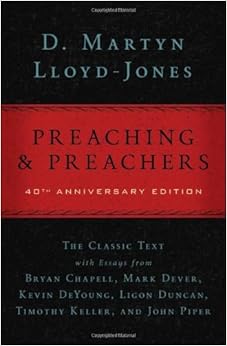
Reading Preaching & Preachers Together: Chapter Two

In the first lecture Lloyd-Jones made the argument preaching is the primary task of the church—and therefore the primary duty of the minister. In the second lecture he extends that thought a bit further. As he says, “the ultimate justification for asserting the primacy of preaching is theological.”

Given the nature of the gospel and man’s greatest need it doesn’t take much to realize that the greatest need then is for man to be preached the gospel. Lloyd-Jones then takes on several arguments which argue against his main point.

First, man’s trouble is not a mere sickness. His problem is that he is spiritually dead. And how do the Scriptures say that God fixes this disease? It is by bringing men to a knowledge of the truth. And the Church alone who can bring men to a knowledge of the truth. Though there are several other things a church could do well this is what makes her unique, this is her calling, and therefore this is what should be the primary business of the church.

It’s interesting that the arguments given in the 1960s sound very similar to the arguments of today. Look at the trajectory of those who were promoting the ideas Lloyd-Jones was speaking against in the 60s. Did it work? Or did they eventually abandon the gospel and try to solve the worlds problems through other means? It was the latter. This is why we should heed Lloyd-Jones’ words even today. We must not get away from the fundamental task of the Church.

Tweet Note for Chapter Two:

At the end of every chapter I like to put together what I call a Tweet Note. A simple 140 character or less summary of the chapter. Here is the Tweet Note for chapter two:

Regardless of changing times, proclaiming the gospel is still the primary business of the Church.

Quotables:

Sentences change lives. I always read with a pen in hand and underline money quotes that I hope to go back to. Underlining helps my brain store the quote. Here are some of the things I underlined in chapter two:

  • There are so many people trying to diagnose the human situation; and they come to the conclusion that man is sick, man is unhappy, man is the victim of circumstances. They believe therefore that his primary need is to have these things dealt with, that he must be delivered from them. But I suggest that that is too superficial a diagnosis of the condition of man, and that man’s real trouble is that he is a rebel against God and consequently under the wrath of God.
  • The moment we realize man’s true need and see the only answer, it becomes clear that only those who are in possession of this understanding can impart this message to those who lack it.
  • …by palliating the symptoms you can conceal the real disease.
  • When you depart from the primary task of the Church and do something else, though your motive may be pure and excellent, [harm to the Church] is the result.
  • The Church has been trying to preach morality and ethics without the Gospel as a basis; it has been preaching morality and ethics without the godliness; and it simply does not work. It never has done, and it never will. And the result is that the Church, having abandoned her real task, has left humanity more or less to its own devices.

Discussion Questions:

  • In your reading of Lloyd-Jones, what similarities does the modern liberal church have with that which Lloyd-Jones dealt with in the 60’s? How is it different?
  • What things tempt churches to get distracted? What about you personally? How do you go about giving the time needed to this primary task?
  • Do you agree with Lloyd-Jones’ conclusion on the primary task of the church? What would you say is the primary task of the church?
  • In your experience has “true preaching saved a great deal of time for the pastor”?
  • If anyone is familiar with the ministry of Richard Baxter, it would be interesting to compare and contrast his philosophy of ministry with MLJ.
  • “If a man is not a Christian you cannot give him spiritual help.” Agree or disagree?
  • Lloyd-Jones believed that preaching was the primary need of the Church. Also consider his words on the nature of the visible church in the section “But Aren’t There Other Ways?”. Putting these two things together would MLJ support the influx of online preaching? Would he be for or against multi-site?

You can still follow along here. Or log your comments below.

Today in Blogworld 02.26.16

Why “You Can Be Anything You Want to Be” Is Bad Advice

I’ve been saying this for awhile, Mike Foster says it better.

Will Following Jesus Make You Liberal?

Jim Hamilton does a terrific job responding to a recent article which suggested following Jesus would make one a liberal.

The Most Used But Least Understood Phrase in the Church

What do you think it is?

Self-Identify

Yep.

I’d really like to know just how much trouble these peeps got into. I’d give it a try:

Bent Necks and Broken Words

How many times a day do you check your smartphone?

How many times a day do you check your email, facebook, or twitter regardless of device?

How much of your time is spent with your head bent downward and your face washed in the warm white glow of an electronic device?

Do you have a desire to accomplish something, study something, or read something, but the ease and draw of digital amusement brings you back?

Heck, do you want to remember what it was like to talk to your spouse or your friends?

A New Drug

We’re in a peculiar place. Smartphones are these “gotta have it” things that we pay a lot of money for. We use them to “stay connected” to people yet they cause us to be disconnected in meaningful ways. I’m old enough to remember the emergence of cell phones and to have witnessed the change in attitude toward them. It used to be that answering a phone when talking to people, at dinner, etc. was frowned upon as rude. (Because it is.) Now, we expect and accept these interruptions as our drug rings in our pocket and we can’t help but take a hit by answering.

“A little over the top there, Nick!” I’m sure some of you are saying that. I have not one, but two smartphones. I have an iPhone as my personal phone and a Samsung Galaxy S4 for work. I am not anti-smartphone, I am pro-human interaction. I first got a cell phone nearly 17ish years ago. They’re great tools and the advent of smartphones has made them powerful. I now carry in my pocket my music, my notes for college courses, my email, social platforms for engaging others, a camera, and numerous podcasts to listen to. I’m not saying we ought to get rid of smartphones.

What I am saying is that we ought to control them. I’m firmly convinced at present they control us. Next time you go out to dinner, look around and see how many people are staring at phones. Look at tables where only one person is doing it and the other is sadly staring at their dinner guest. I see this often in what looks to be marriages or relationships. Usually the guy is engrossed in their phone while the lady stares sadly at him.

Look at a group of young people who are hanging out. Most of them will be on their phones.

Talk To Me!

When did interpersonal communication become such a task that we can’t tolerate it? We talk until silence hits and then anxiously pull out our phones to studiously ignore someone sitting a few feet away. Are we so uncomfortable being who we are we can’t tolerate a lull in the conversation? On social media there is no lull. We are all awesome online. We’re exactly who we want people to think we are. Carefully crafted profile pictures. We “like” certain things to communicate our approval for things. We engage in conversation we wouldn’t dream to have in person. At least I hope so because if I’m wrong everyone is just really rude and ugly.

When you walk down the street can you bear to keep your phone in your pocket and keep your eyes up? When you sit down to dinner with your spouse can you put your phone in another room and simply talk to them? If you’re with a group of friends can you accept the challenge to actually talk to them rather than like another picture of food on Instagram?

We are humans. We were created by God for relationship. (Genesis 2) God is trinitarian so our need for relationship is not alien to us but natural as our Creator made us in his image. We are not trinitarian, but we desire and indeed need relationship.

Love God and serve Him always. It’s long past time we dialed back our unhealthy addiction to strange cat videos, stalking people on facebook, and trying to show the world how fabulous we are. We don’t need to know everything there is to know about making deck furniture from  shipping pallets or decorating the house for every hallmark holiday. We certainly don’t need to argue with everyone we think is wrong.

People are much more interesting when you can talk to them and be with them.

Don’t Just Sit There, Do Something!

“The road to hell is paved with good intentions.” Don’t just think about what it was like before you had a smartphone. Don’t think about what it would be like to control your use of it. Do it. Turn all the notifications off on your phone so you don’t know every blessed second that someone on the internet did something. If you put your smartphone down for a minute you might just realize it has you on a hamster wheel running nowhere. It’s time to get off.


Today in Blogworld 02.25.16

Reading the Challenging PG-13 Passages to Children

It can be tough to know how to read through these with your little kids. John Ellis provides a bit of assistance.

When Tough Texts Bury Us

Sometimes there are passages in Scripture which are super difficult. Here are four tips for navigating in those times.

3 Ways the Gospel Gives Life to the Weary

Needed to read this today.

Don’t Apologize For the Bible

I’m digging what Aaron is saying here.

Here’s a Simpsons/Making a Murderer mash-up you might appreciate: