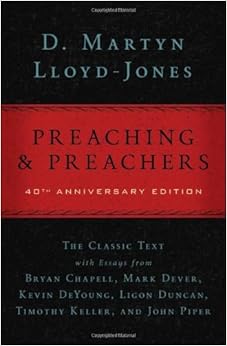
Reading Through Preaching and Preachers: Chapter Seven

In chapter seven of Preaching and Preachers, Martyn Lloyd-Jones laments the “new trend” of the pew dictating the pulpit. One cannot help but imagine what Lloyd-Jones would think of this “trend” if he were still alive today. With the rise of seeker-sensitive churches perhaps more than ever the pew often dictates the pulpit.

Lloyd-Jones notes the strange fact that some argue the people in the pew are unable to sustain thought for long enough to listen to a sermon, and at the same time it is argued that modern man is too advanced to simply listen to a preacher exposit the Scriptures. Instead, it is argued that we ought to spend more time in the newspaper than in the Bible to prepare our sermons.

Of course we must make our sermons accessible and speak in a language which even “servant maids and the children” can understand. But it is a great fallacy to “think that you need a gospel for special types of people” (141). If folks do not appreciate God’s Word it is not because it has somehow been lost in translation and if we only spoke their language they’d treasure it. No, the problem is that they are unregenerate and cannot treasure God’s Word as they ought. This is why Lloyd-Jones encourages us to “beware of barriers that aren’t”.

We must be contemporary and there is a place for a certain type of contextualization but there are limits to our ability to contextualize. “Or methods must always be consistent and compatible with our message, and not contradict it.” (149) In fact if you look at the ministry of Jesus he attracted people not because he looked and sounded just like them, he attracted people because he was different. You cannot reason people into the kingdom of God and I believe Lloyd-Jones would also say you cannot “cool” people into the kingdom.

Preaching has power and it always will. Keep your hand to the plow.

Tweet Note:

Contrary to contemporary thought the pew must not dictate the pulpit. God’s Word holds power not human opinion on what ought to be preached.

Quotables:

The wise preacher keeps his eye on the servant maids and the children. (140)

There is no greater fallacy than to think that you need a gospel for special types of people (141)

Because he knows that all the people in front of him are suffering from the same disease, which is sin—every one of them. (145)

We have to show them that though they get rid of that particular sin they are still in as great need as they were before, and that the business of salvation is not merely to get rid of particular problems but to put the ‘whole man’ right in his relationship to God. (145)

This idea that you can win the world by showing that after all you are very similar to it, with scarcely any difference at all, or but a very slight one, is basically wrong not only theologically but even psychologically. (149)

Our object is not merely to get decisions, it is to bring people to a knowledge of the Truth. (151)

Questions:

In what ways do you see in our day the pew dictating the pulpit? Is this right or wrong?

What areas are you tempted to let the pew have priority?

How hard should preachers strain to be relevant? Is there a way in which we can “overswing” and wrongly take pleasure in using archaic phrases? What does error look like on both sides of this horse?

On page 144 Lloyd-Jones talks about the different types of services we’d need to have to please all the different types of people. What do you think Llloyd-Jones would say about our church plants based around certain affinity groups?

Today in blogworld 04.08.16

15 Pieces of Writing Advice From C.S. Lewis

Justin Taylor restates fifteen great writing tips from one of the best.

Helping the Young Engage the Sermon

This is helpful, I’ve seen some a little more geared towards small children too.

Can I Ask a Dumb Question?

I think Tim is on to something here.

Are You a Self-Starter, But Not a Self-Finisher?

I struggle with

This might help explain the whole Batman v. Superman thing:

On Simplicity Of Our Words

Upon my inception into your residence, I made resolution to not materialize among you annunciating to the reception of your consideration the manifestation of All-Knowing Jehovah with prodigious elocution or perspicacity. I divulge this on the grounds that I predetermined to extirpate within my consciousness everything exempting the humble Galilean and this one was hanged upon that tortured Roman lumber.

That was 1 Corinthians 2:1-2 dusted up just a bit to make it seem a bit more educated. Of course if that verse actually appeared in your Bible it’d be rather hypocritical since what Paul was saying in 1 Corinthians 2:1-2 is this:

And I, when I came to you, brothers, did not come proclaiming to you the testimony of God with lofty speech or wisdom. For I decided to know nothing among you except Jesus Christ and him crucified. (1 Corinthians 2:1-2 ESV)

In other words in a world which took great pride in their big words and fine sounding arguments, the gospel shines brightest when it is simply spoken. Paul understood that if his turn of a phrase is what convinced someone of truth, then somebody else could turn a phrase better and then shatter the Corinthians faith. He’d rather their faith rest in the naked truth.

I thought about the truth of 1 Corinthians the other day when I had a conversation with another believer—a guy I had just met. Actually “conversation” is an overstatement since such a thing requires two parties. I couldn’t be part of the conversation because he lost me on one of his many-syllabled words. I couldn’t keep up with the poetry, the buzzwords, or all the big words which I should have written down to help me beat grandma in Scrabble.

We probably agreed on lots of theological points but I wouldn’t know. This leads to another problem with our tendency to use lofty words when the simple will do; namely, the wonderful ability to cloak error behind smart sounding words. I found myself reading a book from the 1960’s which was arguing for what amounted to a denial of the biblical gospel. Of course, the author never said such a thing clearly. He hid his heresy behind confusing sentences. I think this what Paul called “plausible arguments” in Colossians.

C.S. Lewis is correct when he encourages authors to, “take great pains to be clear.” But sometimes folks don’t want to be clear. Clarity would expose their false teaching. And so I’m always a little wary when someone is talking in buzzwords and lofty speech. It often means one of two things, either he’s trying to use big words to sell garbage theology or he needs a good dose of humility and confidence in God.

Really, friends, the gospel is far too important to muddy up with needless eloquence. I love art just as much as the next guy. But I love simplicity in the gospel even more. If I’ve learned anything in preaching through the gospel of Mark it’s that often you can say far more by just stating the straightforward truth. For Mark, Jesus wasn’t fastened to a bloody Roman cross. He says quite simply, “And they crucified him…” Simple. Straightforward. Powerful. (Not that there is really anything wrong with the first sentence—but there is something to be said for the bare simplicity of Mark’s gospel).

Keep your thesaurus but don’t use it to find bigger words. Use it to find accessible and precise words, the smaller the better. You can be poetic and clear at the same time. Yes, Jesus spoke in parables. But I’m convinced that the hour has come where Jesus has “told us plainly about the Father” (John 16:25). Speak as plainly as possible, far too much is at stake for us to be playing silly little word games.

I close with these words of John Newton:

To a sincere Christian, that deceit and cunning which passes for wisdom in the world, appears to be not only unlawful but unnecessary. He has no need of the little reserves, evasions, and disguises, by which designing men endeavor (though often in vain) to conceal their proper characters, and to escape deserved contempt. He is what he seems to be, and therefore is not afraid of being found out. He walks by the light of the wisdom that is from above, and leans upon the arm of Almighty Power; therefore he walks at liberty—trusting in the Lord, whom he serves with his spirit in the Gospel of his Son.

—

Photo source: here