Today in Blogworld 08.31.16

Four Types of Churches That Will Soon Die

What’s really sad about this is how many churches fit the profile of one of these.

Our Blanket-Fort Kingdom of Weakness

I too loved blanket-fort’s as a child. And I also struggle the same way as the author does.

When Do You Practice Church Discipline? And How Do You Do It?

Very helpful guide.

Ministry Is Discouragement

So what do we do with this almost constant barrage of discouragement?

Would you just look at this?

Why Did Martin Luther Have Such a Funny Haircut?

“Daddy, why does that man have such funny hair?”

If she wasn’t but a couple years old, the fact that she didn’t know who that man was would have caused me great shame in my parenting skills. “That man” was Martin Luther and my daughter had noticed his funny hair style. “Why in the world would he cut his hair that way?”

At the time I simply told her that it was because he was a monk and that is what monks do. But soon her curiosity had become my own. Why did that man have such funny hair? Where did this practice come from and what was it supposed to represent?

If you are inspired by Luther’s sweet hair cut and you want to go to your barber the name for this unique hair style is “tonsure”. To be tonsured means to be sheared. There were three forms of tonsure. The Oriental—which purportedly followed the practice of Paul and was practiced by the Eastern Orthodox required the shaving of the whole head. The Roman—which we are likely most familiar with and which graced Luther’s head, required the shaving of the top of the head.

The practice is quite old. It’s at least as old as 633 because there the Celtic form (the third form) was considered unorthodox by the Council of Toledo. (So apparently teenagers weren’t the first ones to wear unorthodox hairstyles). The Council of Trent, as to be predicted, actually dates the practice back to the apostle Peter. This, though, isn’t very likely as the early disciples likely wouldn’t have worn a hairstyle which would have immediately invited persecution. Some sort of the practice likely began around the time of Augustine and slowly morphed into the accepted form that we see demanded by the Council of Toledo.

But why? Why cut your hair this way?

Not every believer was to have this done. Some upon initiation would have a cross cut into their hair. When monks would receive their orders then they would have their hair cut in this fashion. It was a way of setting them apart. Some believed it marked them off as a slave of Christ, as slaves would often endure a similar hair cutting. Others saw this as a religious offering—a sacrifice which showed their dedication to Christ. We aren’t exactly certain of the origin but we do know that it was used as an initiation into being a monk.

Bede, a 7th century monk, taught that it modeled the crown of thorns which both Peter and Christ had taken. That which the world meant to shame them is now worn as a symbol of pride. It was also to model the Christ who wore a crown of thorns. The monk, above all, was to live a life which constantly reflected that of Christ.

So this is why Luther had “such funny hair”. He was a monk at the time of his conversion and many pictures of Luther show him with his cowl (hood) and tonsure. It’s interesting that not long after Luther’s conversion he eschewed the tonsure but hung onto the cowl (hood). The key thing for the reformer was not outward appearance but the heart. A monk wasn’t made a monk by his outward garb but by his faithfulness to Christ. Therefore, in his mind it didn’t matter if he wore the cowl and the tonsure.

Today in Blogworld 08.30.16

6 Things a Godly Dad Does

There are more, but here are six practices of a godly father.

Do You Pray Like a Nonbeliever?

There is a way that nonbelievers pray that is similar to how many believers pray. Piper considers what is unique about the prayer of the believer.

Learning to Do Less So Parents Can Do More

This is a really good principle for churches to think through.

Keep Teenagers Weird

I like what Samuel James is saying here.

D.A. Carson discusses the doctrine of inerrancy:

Twisting Scriptures As a Means to Your Congregation’s Joy

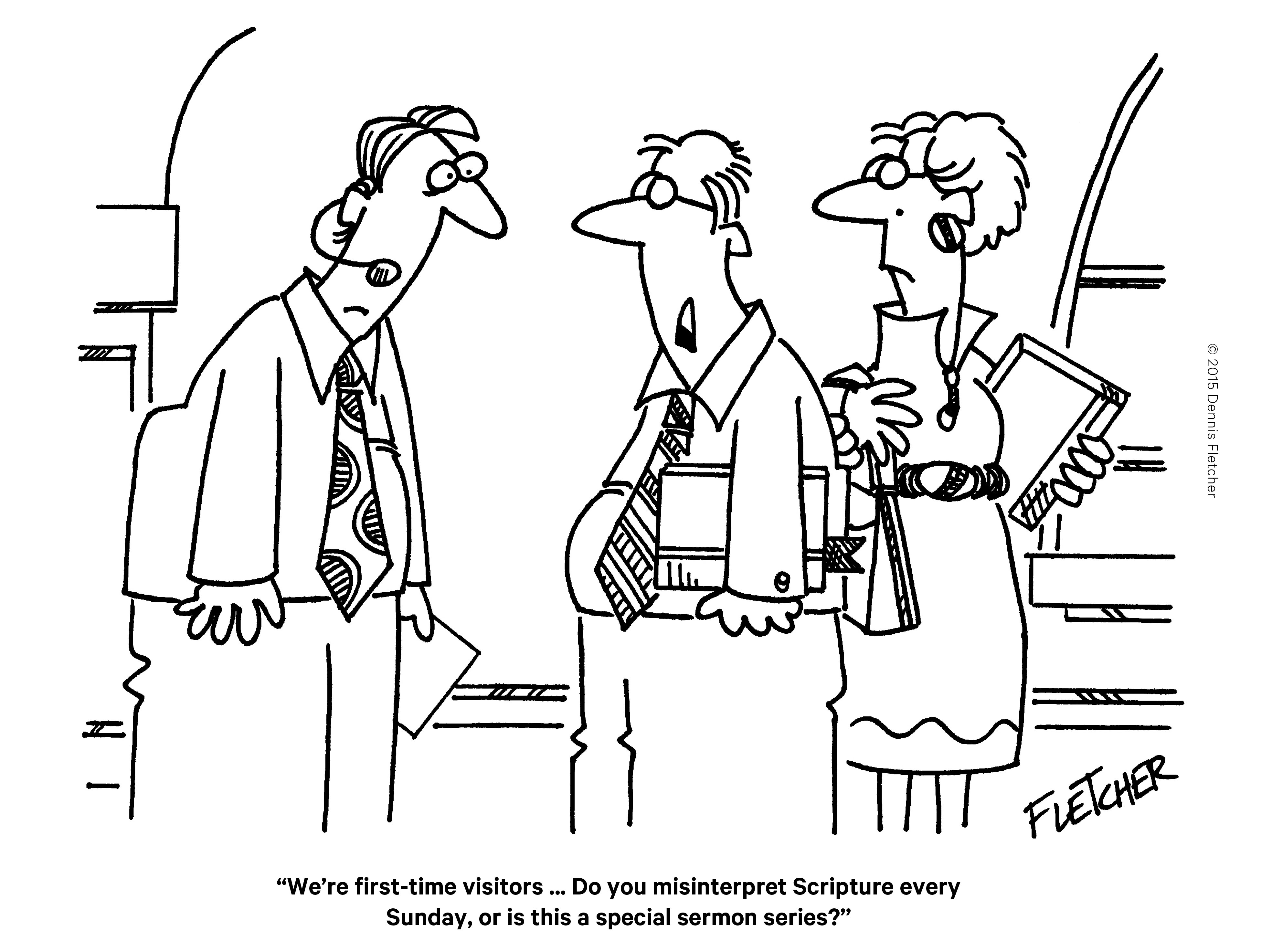
I’m one of those guys who gets incredibly annoyed seeing an athlete with a Philippians 4:13 tattoo. I’m happy when they give Jesus props for his help with their success—that’s certainly better than not giving God glory. I’m annoyed, though, because Philippians 4:13 means about exactly the opposite of what many athletes think it does. Scripture twisting is never a good thing…or is it?

I engaged in a bit of Scripture twisting yesterday. I’ve found that it is a great help with my preaching. I don’t want to overuse this tool, but if done correctly you can twist Scripture to the benefit of your congregation. Let me explain.

Yesterday, from Ephesians 4:31-32, I was trying to answer what does God’s forgiveness look like? Is it conditional or unconditional? How are we to forgive one another as God in Christ forgave us? I made the argument that the offer of forgiveness is unconditional but actually walking in forgiveness involves two parties and therefore is conditional. (See here).

In order to make this point I used Luke 17:3 and I quoted it as thus:

If your brother sins, forgive him, and if he repents, forgive him even more, and if he sins against you seven times in the day, you forgive him seven times per day.

If you grab your Bible and look up Luke 17:3 you’ll notice that this is not what that text actually says. But it’s the way we often read the text—at least it’s how we think about forgiveness. We assume that our automatic response to someone’s sin is to be unconditional forgiveness. They sin and we immediately forgive regardless of their response. But if you look at Luke 17:3 you’ll notice it says something much different:

If your brother sins, rebuke him, and if he repents, forgive him, and if he sins against you seven times in the day, and turns to you seven times, saying, ‘I repent,’ you must forgive him.”

That’s a big difference. So, I misquoted Scripture in order to emphasize the difference between the offer of forgiveness and actually walking in forgiveness. I noted that so often we don’t go that extra mile. We just emotionally forgive someone from our heart but we are never actually reconciled. But true biblical forgiveness always ends in reconciliation.

I also made the point that living by that first version of Luke 17:3 actually misrepresents God. So many in our culture believe they are forgiven by God even without seeking absolution. They take the position of Heinrich Heine who said, “Of course God will forgive me, that’s his job”. But God’s forgiveness of us is conditioned upon our repentance and faith.

So yesterday I stood before our congregation and at one point intentionally twisted Scripture, but I did it for their joy. I did it to highlight how we often misread a text and how we have developed a theology of forgiveness that is found more in psychology books and not in God’s Word.

It’s not a tool I want to use frequently, simply because I don’t want people to consider Scripture lightly. But this tool is effective mainly because the congregation believes Scripture is the authority. To misquote Scripture is a terrible thing in their mind. This is why it is so effective when you twist Scripture to support a theology that many hold, though wrongly. It helps us to see that our theology is inconsistent with God’s Word.

—

Photo source: here