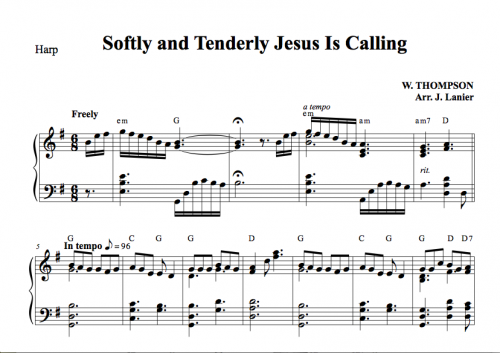
The Difference Between Softly and Tenderly and The Waiting Savior

I’ve noted in the past that I see Jesus as so much more than a gentleman. I’ve preached more than once that Jesus isn’t just passively sitting outside a door and waiting for unbelievers to open up to him. He is not a passive Savior.

There are two hymns that many churches use during their time of invitation. They seem very similar but I think there is a world of difference between them. One I will happily approve, the other…if I’m being honest, makes me cringe a little.

The one that I’m not really comfortable with is The Savior is Waiting:

The Savior is waiting to enter your heart
Why don’t you let Him come in?
There’s nothing in this world to keep you apart
What is your answer to Him?
Chorus:
Time after time
He has waited before
And now He is waiting again
To see if you are willing
To open the door
Oh, how He wants to come in.
If you’ll take one step
Toward the Savior, my friend,
You’ll find His arms open wide.
Receive Him, and all of your darkness will end
Within your heart He’ll abide.
Chorus:
Time after time
He has waited before
And now He is waiting again
To see if you are willing
To open the door
Oh, how He wants to come in.

I don’t prefer this hymn because it makes Jesus far too passive and puts the keys way too much in the hands of the sinner. As I read the New Testament I see Jesus working and wooing but I don’t often see him waiting. Furthermore, I think this song doesn’t really do justice to the omniscience of our Savior. “To see if you are willing?!?!?” As if the Lord of the universe does not already know the human heart. This song puts Jesus in far too passive and unknowing of a role for my comfort.

Though I still don’t care for the lyrics about the Savior “waiting and watching” I will gladly use Softly and Tenderly:

    1. Softly and tenderly Jesus is calling,
      Calling for you and for me;
      See, on the portals He’s waiting and watching,
      Watching for you and for me.

      • Refrain:
        Come home, come home,
        You who are weary, come home;
        Earnestly, tenderly, Jesus is calling,
        Calling, O sinner, come home!
    2. Why should we tarry when Jesus is pleading,
      Pleading for you and for me?
      Why should we linger and heed not His mercies,
      Mercies for you and for me?
    3. Time is now fleeting, the moments are passing,
      Passing from you and from me;
      Shadows are gathering, deathbeds are coming,
      Coming for you and for me.
    4. Oh, for the wonderful love He has promised,
      Promised for you and for me!
      Though we have sinned, He has mercy and pardon,
      Pardon for you and for me.

I see the waiting and watching here a bit more like the role of the Father in the story of the Prodigal, it’s a bit more poetic than theological. Though it’s a subtle difference I think this song has much less of a passive Savior. Notice the verbs used here that Jesus is “softly and tenderly calling” and he is “pleading”. There is something here that we must not lose. Jesus truly does plead with and for sinners. He isn’t passively sitting by as the hyper-Calvinist or Pelagian and semi-Pelagian would have us believe. No, he is active. He is pleading.

John Piper made a similar point at the close of his sermon at T4G a couple years ago:

So I suppose what I’m doing here is pleading with those who are in my theological camp to not cast aside the truth of Softly and Tenderly because we are uncomfortable with the waiting Savior of the other hymn. And I’d plead with those of other theological persuasions to consider the words they are singing and to ask if it truly reflects how they Savior relates to sinners in the gospel…why not use Softly and Tenderly to make the same point you are trying to make with The Savior is Waiting.

Today in Blogworld 10.11.16

That’s Not What I Ordered

I too have never sent a meal back. Love this reflection on prayer.

Why the Pastor Needs a Council of Historians

Church history is incredibly important.

Has God Called You to the Ministry?

There are ten questions in here that are important to ask.

Crossway Reverses Decision

I love the humility here and believe this was the correct choice.

Here is Martin Luther yelling at a few Anglicans trying to write a Christmas song:

How Our Unbiblical Views of Forgiveness and Grace Are On Full Display in the 2016 Election

Over the weekend a tape from 2005 was leaked to the media. On this recording Donald Trump is heard making lewd and sexually aggressive comments. They don’t need repeating, but they were so vulgar that many former supporters have abandoned Trump. One evangelical supporter, though, seems to have dug in with his support. Over the weekend, and undoubtedly in response to the Trump backlash, James Dobson tweeted this:

As I’ve been saying throughout this entire election my concern is not with my fellow believers who will cast their ballot for Donald Trump. I can’t do it personally, but I understand their reasoning (though, I must confess, a bit less every day). My biggest issue through this whole thing have been what evangelical leaders like Dobson, Falwell Jr., Jeffress, and others are doing to the gospel. And so whenever I see evangelical leaders make dangerous statements, like this one by Dobson, I cannot remain silent.

There are two major reasons why Dobson’s statement is dangerous.

First, Dobson reflects the common evangelical view of a therapeutic forgiveness divorced from repentance. What Dobson says in his tweet is absolutely true if the offending party has sought forgiveness. There is a difference between having a posture of forgiveness and actually living in reconciliation. The first is unconditional the second, though, is conditioned upon repentance. To not know the difference is to open wide the door for continual abuse.

Trump’s apology and dismissing his comments as mere locker room talk is not repentance. The Bible clearly outlines what repentance looks like—and it isn’t dismissive or apologizing because someone might have been offended. Biblical repentance will never hide behind an “at least I wasn’t as bad as the other guy”. It will instead see sin—even in seed form—as odious and offensive to a holy God. Trump has not repented of his comments and he certainly has not modeled repentance of a heart which objectifies women.

Therefore, for Dobson to chide folks for “withholding forgiveness” is not only inappropriate it is also dangerous. It is inappropriate because technically “withholding forgiveness” happens when the other party seeks reconciliation but the offended party refuses. Trump has not sought reconciliation. We can certainly encourage those who might have been offended and harmed by Trump to embrace a posture of forgiveness but they are unable to truly walk in the full expression of forgiveness until Trump repents.

I also say that Dobson’s statements are dangerous because this is the type of rhetoric which causes abused people to stay in abusive relationships. I’ve heard painful stories of church leaders—adopting this view of forgiveness—chide abused women because they refused to “forgive” their unrepentant husbands. Yes, we should consistently have hearts ready to forgive even our abusers. But we can only live in a reconciled relationship with those who are repentant. It’s not because we are “withholding forgiveness” it is because the abuser is “withholding repentance”. We are doing them a disservice by adopting cheap grace. Which is the second major problem with Dobson’s statement.

Secondly, Dobson is promoting a cheap grace. Part of the biggest way that many among the Religious Right has dragged the gospel through the mud is in their proclamation of Trump as a believer or “baby Christian” even though he has often stated he has nothing to repent of. Divorcing the gospel from repentance as these men have done is nothing more than happily promoting the cheap grace which Dietrich Bonhoeffer spoke so strongly against.

Consider these tongue-in-cheek words from Bonhoeffer and see if they don’t fit:

Let the Christian rest content with his worldliness and wit this renunciation of any higher standard than the world. He is doing it for the sake of the world rather than for the sake of grace. Let him be comforted and rest assured in his possession of this grace—for grace alone does everything. Instead of following Christ, let the Christian enjoy the consolations of his grace! That is what we mean by cheap grace, the grace which amounts to the justification of sin without the justification of the repentant sinner who departs from sin and from whom sin departs. Cheap grace is not the kind of forgiveness of sin which frees us from the toils of sin. Cheap grace is the grace we bestow on ourselves. (Cost of Discipleship, 44)

Dobson is offering cheap grace to Donald Trump. It certainly isn’t doing those he has objectified and victimized any favors. But such a thing is also not helpful to Donald Trump. And it certainly is not promoting the biblical gospel.

So once again I’m bothered by the way the gospel of Jesus Christ is being abandoned for the porridge of potential political power. It isn’t worth it.

—

Photo source: here

Today in blogworld 10.10.16

A Year In the Life…

Be sure to bookmark this one…it’s a year in the life of a minister.

You Know You’re Really Preaching the Gospel When…

It really is hard to measure our success as pastors.

Six Steps to Shield Yourself from Satan

I’d maybe add a seventh…don’t stop praying and fighting just because you’ve started to feel better.

Theology: The Price of Trying to be God

I love when Dr. Jones writes articles like this and connects the gospel to an Alice Cooper song.

In case you ever wondered how an astronaut would put on a space suit: