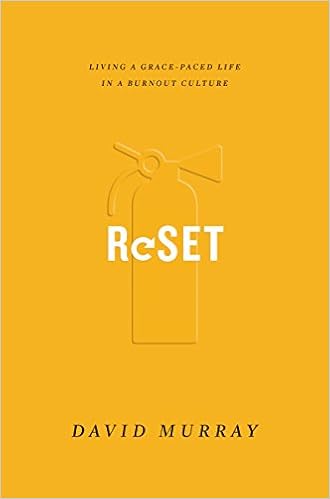
Review of Reset By @davidpmurray

You’ve heard of the blue car syndrome haven’t you? It’s when you buy a blue car—thinking there aren’t too many of them out there—and then noticing that everybody seems to drive a blue car. My experience with reading Christian books feels a bit like that blue car syndrome. I don’t know if publishers accidentally publish a handful of books on a particular topic in a given year, or if God is dealing with me in an area and I seem to notice lots of material on a particular topic.

Either way. Burnout has been my blue car lately.

It’d make sense because I’m still having a bit of difficulty transitioning into the role of lead pastor. Moving from the safety of an associate pastor in Southern Indiana to a lead pastor in Southwest Missouri, has left myself and my family a bit discombobulated at times. I have some symptoms of burnout and so I think God has graciously put these helpers in front of me.

One of these helpers has been Reset by David Murray. Over the past few years I’ve been convicted and encouraged by the works on pastoral ministry of Zack Eswine and Eugene Peterson. I’ve known for quite a season that I needed to slow down and that my wheels were spinning a bit too fast. The increasing frequency of my bouts of depression has been a warning sign to me that I need to look under the hood. But something I’ve been lacking, until Murray’s book, is an immensely practical tool to help me slow down.

Reset is convicting, balanced, grounded in the Word, but more than anything it is incredibly specific and practical. After reading this I genuinely believe that I’ve been given some tools in order to “live a graced pace life in a burnout culture”. Murray’s book takes the reader through ten repair bays. Some of them were far more needed in my life than others, but they are all very helpful.

I finished Reset a little over a month ago. I know that’s not a terribly long time to put some of these things into practice. But I’ve been attempting to put a few rhythms in my life that have helped. This book also led me down a path to purchase another helpful book—Deep Work by Cal Newport. Here are a few of the things I’ve started doing that I’ve seen benefit me.

1. Having specific and lengthy times when I put my phone down and disconnect.

2. Intentionally pursue being present in the moment.

3. Giving myself permission to actually pursue hobbies and things which help me relax and shut down.

4. Not doing intense deep work right before I go home for the day.

When I actually stick to doing these four things I have found tremendous help in my frame of mind. One of the most difficult things about these is that in order to pursue personal health you have to be okay with disappointing people. It isn’t that you are putting yourself above others—it’s that you are recognizing your God-given limitations. If people are disappointed because I have limitations that’s not on me.

There are a few things that I know that I need to put into action that Murray suggested but I’m finding myself having a difficult time doing. My diet and my exercise is one of the worst culprits to stealing my joy and contributing to burnout.

I also appreciate that Murray isn’t advocating for laziness or disengagement. This book is balanced. He acknowledges that there are seasons that are crazy and sometimes you do have to burn the candle on both ends. But those are meant to be seasons and brief seasons. Putting some of these caveats in the book helps me to feel like it is actually doable. It’s about pursuing a healthy pattern of living.

I’m still growing in this area and Murray’s book has been helpful for me in my growth.

You can purchase Reset here.

Read This! 06.08.17

An Open Letter to Those Apathetic About Their Sanctification

If this is you, perhaps this letter from David Powlison will light a fire under you.

Thoughts for Pastors Who Are Considering Quitting

It’d probably be a bit disconcerting to members to know that most pastors think about quitting about once a week (bet it’s on a Monday). This is helpful and encouraging though.

How Mr. Rogers Became Chuck Norris

Love this little cultural commentary.

Do You Believe the Whole Gospel?

I think this is a needed corrective.

5 Rules for Sermon Illustrations

That second one is something you might not think of.

Division Begins With the Departure From the Truth

This is so obvious, but so often in churches we forget this.

10 Keys to Being a Better Write for an Internet Audience

The seventh one is the most difficult for me.

Has the Gospel-Centered Pendulum Swung Too Far?

This is actually a summary of a helpful but lengthy article by Dane Ortlund.

Somehow I have just now discovered American Prodigal by Crowder. This might be my favorite song on the album:

Why I Think It’s a Bit Awkward to Welcome God Into Your Worship Gathering

So the other day we had a family over to our house for supper. Things were going pretty well but it got really awkward during meal time. My wife and I refused to serve them because they didn’t have the common courtesy to let us know we were welcome in our home. Until they gave us permission to do work and serve them we just awkwardly sat there.

You are likely confused by the previous paragraph. Why in the world would we be so offended that our guests didn’t let us know we were welcome in our own home? But for some reason you likely aren’t confused by singing worship songs (or praying to open the service) to let God know that He is welcome in the place. But that’s just as strange to me. Why in the world would we tell the One who owns the place that He’s “welcome in this place”?

I suppose I understand why we do this. It’s part of having a humble posture toward the Lord. It’s our way of saying that we don’t want to run from God but we want to have a relationship with Him. I think it’s also our way of saying along with Jesus, “Not my will but yours be done”. So, I get it…but it’s a bit awkward and probably a bit backwards theologically.

God owns the place, not us.

This well-meaning act of calling God into our presence betrays our man-centered theology. It assumes that we own the place and invite God into our world. But He isn’t the guest who needs to be welcomed, we are.

Thankfully this is what God does in the gospel. If it wasn’t for God’s grace mediated to us through Jesus, our prayers for God’s presence would be a terrible stupid thing to ask for. We’d be swallowed up by His glory. But because of Jesus the dwelling of God is now with man. When you show up to church on Sunday morning you aren’t making God your honored guest. You are gathering with others and celebrating the fact that the omnipotent and omnipresent God has reconciled Himself to us. If you are a gathering of believers you don’t need to invite God to show up because He is already there.

The way we speak in our worship gatherings should reflect a careful passion about proclaiming these truths. Because of the work of Jesus—God is never on the outside of our gathering. He doesn’t depart the gathering place every week and only come back when we invite him in. This isn’t our church, it’s His. This isn’t our stuff, it’s His. Our posture towards God should be of thankful and humbled beggar and not of host.

But wait…

Revelation 3:20 seems to throw a bit of a wrench into all of this. When Jesus says, “Behold, I stand at the door and knock…” he isn’t talking to the heart of an unbeliever. These words are written to a local church. And so it seems that what really needs to happen is that they do need to welcome Him in.

The picture given to us in Revelation 3:20 is that the church in Laodicea is so messed up and self-sufficient that they think they own the place. To use the analogy from the beginning, they showed up at Jesus’ house for supper and ended up booting him out and locking the doors of the house and then went about pretending like they owned the place. So, I suppose in this instance repentance would look a bit like opening the door and welcoming the Lord into His own home.

But if we were in such a place I don’t believe we would sound quite so triumphalistic and confident in our prayers of welcoming the Lord. Instead, we’d be snot-faced crying and repenting about the fact that we let our hearts get in such a self-sufficient state that we somehow managed to lock the owner out of His own house.

This is why I say as a general rule I think it’s a bit awkward to welcome the Lord into the presence of the people He has already purchased. Maybe instead of saying, “Lord, you are welcome in this place!” we could go for a humble prayer of thanksgiving. “Father, we thank you that because of Jesus we are reconciled, we acknowledge your presence and your work in us. Because you own this place, have your way in us.” I doubt it’d make a hit worship song, but it might be a little more faithful to the story of the Bible.

—

Photo source: here

Read This! 06.06.17

Mike Pence, “Orientation to Authority,” and Public Uses of Romans 13

I found this interesting to see how we’ve used Romans 13 in our nations history.

9 Things You Should Know About Ramadan

This is Islam’s holy month. Here are 9 things for believers to know about this Muslim practice.

The John Newton Letter Project

Oh, this looks phenomenal. I have a book idea on Newton that I really need to get to work on. Stuff like this inspires me to get to work.

Jesus Is Not Ashamed of You

This is encouraging.

How the Self-Esteem Craze Took Over America

This article seems to be saying that the movement is waning and giving way to another. I’m not seeing that as much. Are you?

Stop Using Your Personality Test as a Crutch

A million “amens”

Die to Yourself Without Losing Yourself

I think this strikes a pretty healthy balance.

Serial Killer Released…

This is satire done the right way

Nancy Guthrie gives counsel for a very difficult situation: