Why Turning Inward In A Season of Doubt Is So Deadly

“I think, therefore I am.”

This saying by Rene Descartes is foundational to much Western philosophy. His point, in the face of radical doubt, was that the very existence of doubt meant that he himself must actually exist. Descartes then reasoned from this foundation. His original intention was to argue for the existence of God, but he inadvertently built upon a shaky foundation which has caused many to sink into despondency.

You see, anytime we turn inward to find answers to our insecurities and doubts we are on shaky ground. Descartes made this statement in 1637. Obadiah Sedgwick, a contemporary, wrote a helpful little book called The Doubting Believer four years later. I don’t believe Sedgwick had Descartes in mind when he wrote what he did. However, the way in which Descartes reasoned captured the zeitgeist of the philosophy of his day. Sedgwick was a pastor picking up the pieces of such man-centered philosophy. Ideas have consequences. And “the life of sense” was creating many doubting believers. Sedgwick explains the life of sense, it is:

…to place the disposition of God, and the issues of our condition, in our feelings and sensible apprehensions so as to believe that God is my God because I find him so; that He is gracious because I find a sensible answer of my prayers; that He accepts my services because I find that life of affections; so, on the contrary, that He is not my God because I do not find those sensible reports of His favor. I do not find that quickness and former smartness of affections; I do find immediate answers to all my desires and requests; that I am not in the estate of grace because I do not feel the vigors and secret increasings of grace; that I do not believe because I do not rejoice or see my sins blotted out, etc; which kind of life must verily be exposed unto infinite and continual doubtings. (18-19)

What Sedwick is saying is that anytime we place our security in our outward frames and performances we are on shaking grounds and open to continual doubting. Your thinking does not prove that you exist. The fact that God said you exist proves your existence. I understand that in philosophy, logic, and such discussion that statement doesn’t win the day. But it’s certainly the proclamation of the Bible. And Sedgwick is correct that as soon as we pursue security and an end to our doubtings in evidence other than the work of Christ we are going to find ourselves in a world of trouble.

Sedgwick goes on to give three reasons why this is so:

  1. The soul here has no constant bottom to settle upon.
  2. The soul hereby advantages Satan in his suggestions, for the life of sense is open to all winds.
  3. It is a life which much dishonors God and, therefore, is exposed to many fears and unsetteldness.

In that last point what Sedgwick means is that it is foolishness to “measure the truths of God by our sense”. Christ was not dead, buried, and resurrected because Thomas could feel the wounds in his side. Thomas could feel the wounds in his side because Christ was dead, buried, and resurrected. To look for evidence on that first grounds is where much doubting comes from.

So what do you do? How do you cure this form of doubting? Sedgwick gives three truths to focus upon.

  1. Consider that feelings are not a fit judge of our condition.
  2. Remember that faith and feelings are often set at contrary. Sense sustains itself by something within us, and faith sustains itself by something outside us.
  3. Feeling is not the ground of believing but a fruit of faith. The Word of God is the foundation of our faith, not the way that we feel.

Here is why this is helpful. Take someone like William Cowper. Cowper believed the truths of the gospel but he did not believe they applied to him. He believed that those who trusted in Christ where saved. He believed that he himself and faith in Christ, yet he felt that he was uniquely damned. Poor Cowper, when doubt assailed him, trusted in his senses instead of God’s Word. Because of this error he spent many days in despair and doubting.

We must look outside ourselves for our comfort and security. We must believe that the Bible is true whether we at that moment believe it to be true or not. We must believe that our feelings of failure and doubt and such do not win the day. What matters is Christ. This is why the Puritans would say that a weak faith can lay hold of a strong Christ. The most important aspect of our faith isn’t the level of our faith but that we are taking hold of Christ. When doubts come upon you don’t take your gaze of Christ and His sufficiency. Looking to your snakebite won’t set you free. You’ve got to look at the one who hung upon the tree.

Photo source: here

Read This 07.03.18

Introversion as an Excuse

I think we could really say this of any personality type.

Clarity Not Charity

This is a helpful discussion on using worship songs that might have confusing lyrics.

Help Us Help Dave Miller

My friend, Dave, has been going through quite the ordeal. Things are looking positively on the health end but that doesn’t mean his bills are paid. Consider helping this brother out.

That Little Red Hen Was a Pharisee

Yep.

The Greatest Treasure of Church History

This is so good.

A Parent’s Guide to the 5 Skeptics Who Want to Shame Your Kids for Being Christian

I found this to be incredibly helpful.

The Challenges and Joys of a Young Pastor

This was a refreshing reminder.

7 Bible Verse You May Be Taking Out of Context

Yeah, I’ve seen about every one of these taken out of context. And I’ve probably been guilty of doing it to many of them myself.

I think this is a question we are going to see more and more in the coming days:

The Apostle Paul Had Many Great Stories, Why Did He Tell This One?

Indeed, I count everything as loss because of the surpassing worth of knowing Christ Jesus my Lord. For his sake I have suffered the loss of all things and count them as rubbish, in order that I may gain Christ…(Philippians 3:8)

That is Paul’s way of saying that he has found an inimitable treasure. When we speak like this we say things like, “Becoming a Christian is the best decision I’ve ever made.” We’ve found such a wonderful friend in Jesus that nothing compares. When we speak in such a way (and we should) it is understandable that some might think following Jesus means your life becomes full of rainbows, unicorns, and cupcakes.

This seems to be one of the significant errors that was taking place in Corinth. They rightly latched onto the triumph of Christ and his kingship and our adoption and all the blessings which come with being a follower of Christ. But they wrongly assumed that the crown could come without a cross. They fell victim to the third temptation that Christ faced.

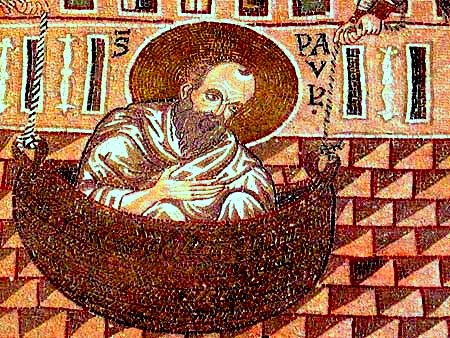
In order to combat this in 2 Corinthians Paul takes up the language of a fool and does a bit of boasting. He can barely endure it and cuts off mid-sentence as he shifts to what he really ought to boast in; namely, his weakness and the sufficiency of Christ. Reading down the list of all the things Paul went through is eye-opening. You’d love to sit down him and hear all the stories about the shipwrecks or the danger from robbers. But he doesn’t go into detail on those. Instead he tells the story of being let down a wall through a basket.

What, Paul?!?!? Of all the awesome stories you have of God’s deliverance the one you choose to give two lines to is this one:

At Damascus, the governor king Aretas was guarding the city of Damascus in order to seize me, but I was let down in a basket through a window in the wall and escaped his hands. (2 Corinthians 11:32-33)

Why does Paul spend two lines on this story?

When many people think of the apostle Paul they think of the guy who was saved on the road to Damascus. The guy who was headed there to persecute Christians but was then knocked off his horse and converted to Christ. Everything Paul wrote in Philippians 3 about finding Christ as the greatest treasure found its beginning in Damascus. So when Paul speaks of Damascus our minds go to the place where Paul found this great treasure.

The Corinthian understanding of the gospel is that when a person is a follower of Jesus their life of prosperity is only beginning. The abundant life begins at your Damascus. But Paul’s life tells an opposite story. Rather than an abundant life (of cupcakes and rainbows and unicorns) Paul was given an abundant life of suffering in Christ. It is this life which Paul would not trade for all the treasures in the world. His Damascus led him to descending in a basket to escape the hands of a tyrant, not exaltation into places of power.

I’m sure we could learn much from Paul’s stories of being in danger from robbers. They would make a tremendous television series. But what the Spirit wanted us to learn more than anything is that a life of following Jesus will put you in a basket to be lowered down a wall to escape people wanting to spill your blood. The gospel places us in a position of weakness. It is here that the greatness and power of God is displayed.

Yes, being a follower of Jesus is the greatest treasure you can ever have. But don’t assume that this treasure means you won’t suffer. We’ve got to let Paul finish his thought from Philippians 3:8 or else we’ll be duped by a false gospel.

…and be found in him, not having a righteousness of my own that comes from the law, but that which comes through faith in Christ, the righteousness from God that depends on faith—that I may know him and the power of his resurrection, and may share his sufferings, becoming like him in his death, that by any means possible I may attain the resurrection from the dead.

Photo source: here

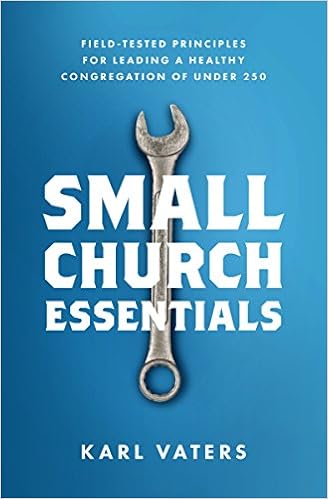
Review of Small Church Essentials By @KarlVaters

I’ve stopped going to almost every conference. When I get fliers in the mail I usually throw them away. I’ll freely confess I’m likely throwing the baby out with the bathwater here, but I simply got tired of shelling out $200 or more only to be told all the things our little church was doing wrong and how if we put into practice these principles from a mega-church or gave money to this celebrity preacher he could show us how to fix everything.

I’ve grown weary of that shtick. And my weariness extends beyond conferences to books as well. So, I’ll be honest and say I’m a bit surprised I even purchased Small Church Essentials by Karl Vaters. But as I flipped through the pages in my local Christian bookstore I discovered enough in there which made me shell out the $10 and give the book a go.

What I’m looking for is a book written from the perspective of a small church guy who knows how we function. I’m not looking for the perspective of a mega-church guy who was once a small church guy but has now entered the promised land of a big booming church and can give us the road map to get there ourselves. Don’t get me wrong, I’d be overjoyed by growth. But I’m more concerned with pursuing faithfulness than I am population increase.

This is why I’ve appreciated Small Church Essentials so much. It’s written as a helpful guide to help churches be faithful in who they are with what they have. It isn’t about busting through growth barriers. It’s about pursuing health. It was such a breath of fresh air to hear someone acknowledge that small churches function way different than big churches and the principles we so often hear at conferences just do not work when we try to bring them back home.

The book is divided up into four parts. The first part is Vaters’ defense of the principle that small does not equal broken. I appreciate that he also doesn’t dog on the mega-church. He doesn’t idolize it either. The second section is important. Here Vaters gets us into the mind and culture of the smaller local church. It’s helpful to parse out some of the reasons why we aren’t a mega-church. He asks some penetrating questions about the reasons why we are small, and ultimately (in the third section) challenges us to be strategically small. The third and fourth sections are given to more practical matters. The third deals more with assessing where you are at present and the fourth section gives ideas for growth.

There were a few key principles that I took away from the book. One is that you have to work with what you have and you cannot try to pastor a church that God hasn’t given you. Using Apollo 13 as an example, Vaters says it this way:

Putting a square peg into a round hole and using only what’s on the table with the lives at stake may be the perfect analogy for how leadership works in the small church. (Vaters, 69)

The second key principle was his parable of the archer. It went somewhere different than I expected. He spoke of an archer who kept missing the target and all of his arrows went in one place. Rather than getting frustrated he simply “picked up a small can of red paint and a paint brush, then proceeds to pain a bull’s-eye around each arrow”. He used this illustration to encourage small church to find the things that they are doing well and to focus on those areas. That is such a helpful point and principle. Certainly there are things we must be doing in order to be called a church—like preaching the gospel. But there is something to be said about knowing what God is specifically doing with your church at this moment in time. For us, we see that God is moving mightily through our children’s ministry efforts. So we are painting a bulls-eye around that.

The book is filled with practical helps and even chapters which will help you really identify who you are as a church. You’ll have a sense of camaraderie with the author and as you read this you won’t feel as if the guy talking doesn’t really understand what you are going through. This is a guy in the thick of small-church ministry himself. He’s writing to us as one of us. And that’s one thing which makes this book unique and worth the small-church pastor’s time.

You can buy the book here