Where Does My Disability Come From?

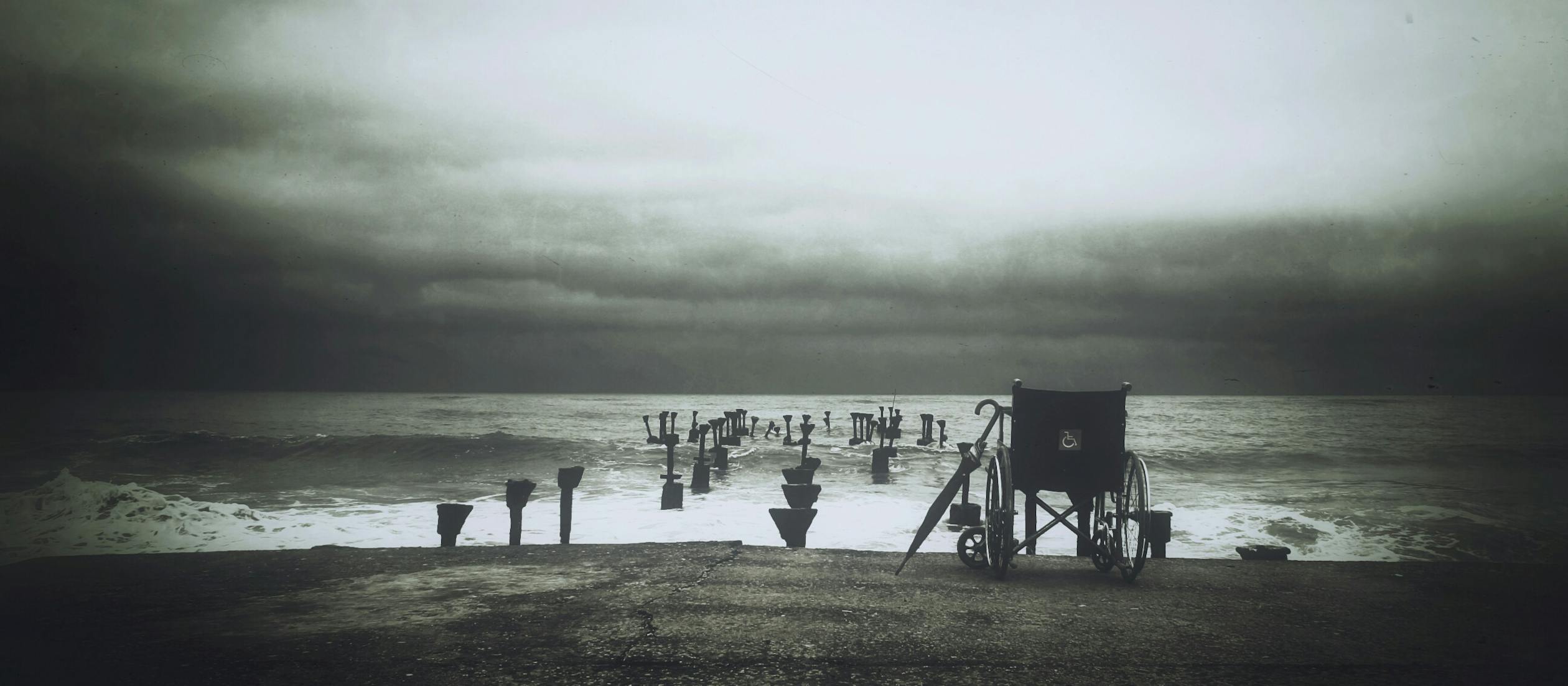
black-and-white-disability-landscape-93822I have shared with you in the past my bouts with depression and anxiety. I suppose according to the DSM-IV this means I have a mental disorder. That’s kind of a hard pill to swallow. Pastor’s aren’t supposed to be in that situation. This is what a nurse practitioner told me a few months ago when I went in for a routine check up. When I told her I was a pastor she said, “you aren’t supposed to be hurting, you are supposed to be helping people who are hurting.”

That hurt.

Part of me wants to hide behind the fact that if one uses DSM-IV standards everybody has some sort of mental disorder. But I won’t hide there. I’ll own up to the fact that I’m broken and being redeemed—ever so slowly it seems at times—by Jesus.

Here is my question. Is God the source of my mental disorder? (And frankly, I’m still not quite comfortable with that designation, but I’ll pick it up here for the sake of argument). And what if I extend my question out a bit further and ask if God is the source of physical and emotional disabilities as well?

I read something the other day that was supposed to be helpful. The author was encouraging his readers with the fact that every person is created in the image of God, and that we are all created with a purpose and plan. He was making the always powerful point that nobody is an accident. Then he said the head-scratcher. “We should not imply from this though, that God is the source of physical, mental, and emotional disabilities.”

I get what the author was trying to do there. But think with me about this a little further. Think about it emotionally before we look at it scripturally. Consider a person with Down Syndrome. Which statement is more affirming of their person: “Your down syndrome is not from God” or “you are fearfully and wonderfully made just as you are”?

I realize I’m walking out onto some thin ice here, but I’m convinced we have to stop viewing disabilities as if they are outside the realm of God’s sovereign care. If I said, “God is the source of physical, mental, and emotional disabilities” what Scripture would I be in danger of contradicting? We know that God is not the author of evil. We know that he is the source of every good and perfect gift. But aren’t we making a bit of a jump to say that physical, mental, and emotional disabilities are evil and cannot be from the hand of God?

Think about this with me. Scripture declares that every good and perfect gift comes from God. Do you know what that means? If it’s truly good, then it cannot come from the hand of anyone/anything but God. So follow the logic here. If a physical disability is not from God then it cannot be a good gift. This means that a child’s Down Syndrome—which gives physical and mental disbilities—cannot be a gift from God. Yet, I have heard from many parents of children with such disabilities that they now view their child’s Down Syndrome as a gift from God.

I appreciate the way John Knight uses Psalm 139 to make a similar point:

For you formed my inward parts with Down syndrome;
you knitted me together in my mother’s womb without eyes.
I praise you, for I am fearfully and wonderfully made with cognitive challenges.
Wonderful are your works in creating me without limbs;
my soul knows it very well though my ears will never hear a sound.
My frame was not hidden from you as you made me with Apert syndrome,
when I was being made in secret with autism,
intricately woven in the depths of the earth without Hexosaminidase A.
Your eyes saw my unformed substance with spina bifida;
in your book were written, every one of them,
the days that were formed for me with cerebral palsy,
when as yet there was none of them.

I understand there are theological implications to saying that God is the source of disability. And I know it raises questions about whether or not we would say that these things are a result of the Fall or not. Will disabilities be in heaven? Would we have had blindness or depression or Down Syndrome had the fall not have happened? And so I understand the complexity of what I’m saying here. But is it possible that disabilities can be a result of the fall but find their purpose in a different corner? Rather than seeing disability from a naturalistic (almost Deistic) perspective, wouldn’t it be better for us to believe that God has a very good purpose in these things? And not just that he makes something good out of them but that he is actively doing something good in them?

Consider this. If God isn’t the source of disability who or what is? Is it the fall? Is it human sin? Is it merely our finitude? In the first century they had a great answer. Disability was the direct result of sin—either your sin or the sin of the parents. Did they come to this theological position in order to protect God from being the source of disability? Either way Jesus gives us the answer. “It was not that this man sinned, or his parents, but that the works of God might be displayed in him.”

I will close with telling you my motivation for saying these things. I believe our view of suffering often puts us in the position of helpless victims. I think we even put God in the position of a helpless victim who would love for things like disability to not be present but that’s just the way it is. Of course he can make something good out of it, but we leave him powerless to have stopped it. I don’t find help in this. I find help in believing that God is actively doing something in and through any disability we might have. I also know that God is working towards full redemption in a world where disability won’t be present. But in the meantime His goodness is so unfathomable that we are able to walk through disability and somehow kiss this cross because it makes us more like Christ. God is fully in control and that gives me comfort. Though at times I cannot see His goodness it doesn’t mean He isn’t good.

Photo source: here

Read This! 08.14.18

The Deacon Every Pastor (Should) Love

I’ve got a few of these, and I’m so thankful for them.

12 Mistakes Pastors Should Make Only Once

I hadn’t even considered a couple of these.

3 Ways to Recruit Theologically Sound Group Leaders

Very helpful.

Sex on the Silver Screen: A Scenario to Consider

I tend to agree with Tim on these issues.

Being a Father Isn’t Easy, But It’s Simple

True.

Pew: Why Americans Go to Church or Stay at Home

This is rather enlightening.

What the Left and Right Both Misunderstand About History

This piece is filled with history nerd-speak, but it’s valuable to consider.

Moving Beyond One-Dimensional Sermon Applications

There is more than one way to apply a sermon.

Hmmm…I might go for this:

All Is Found in Christ

There is a paragraph in Calvin’s Institutes which might be the best in all of Christian literature (except the Bible of course):

We see that our whole salvation and all its parts are comprehended in Christ. We should therefore take care not to derive the least portion of it from anywhere else. If we seek salvation, we are taught by the very name of Jesus that it is “of him.” If we seek any other gifts of the Spirit, they will be found in his anointing. If we seek strength, it lies in his dominion; if purity, in his conception; if gentleness, it appears in his birth. For by his birth he was made like us in all respects that he might learn to feel our pain. If we seek redemption, it lies in his passion; if acquittal, in his condemnation; if remission of the curse, in his cross; if satisfaction, in his sacrifice; if purification, in his blood; if reconciliation, in his descent into hell; if mortification of the flesh, in his tomb; if newness of life, in his resurrection; if immortality, in the same; if inheritance of all blessings, in his Kingdom; if untroubled expectation of judgment, in the power given to him to judge. In short, since rich store of every kind of good abounds in him, let us drink our fill from this fountain, and from no other.

If something you are seeking isn’t found in Christ, then it’s not worth seeking. What a wonderful truth this is to mediate upon. This is why I say that really understanding our union with Christ is perhaps the key to living the Christian life.

How Do I Trust Christ with Healing Those I’ve Wounded?

michel-paz-258747-unsplashI battle depression. I haven’t really kept that a secret. One of the things that I’ve learned over the years is that on occasion the reason for my season of despondency isn’t merely chemical or the result of a stressful season. My depression likes to blame others, circumstances, or my own biology for the trial I’m going through. In truth, my depression is often do to stubbornness and unrepentance.

What I do, then, in order to combat this is take a bit of a sin-inventory. I will gather a sheet of paper and write out all the things I’m feeling crummy about. I write out ways in which I feel like a failure. At times it’s sin. Often its simply shortcomings. At the bottom of this paper (or papers) I try to rehearse the gospel. I remind myself of Psalm 103. I preach the gospel to myself. The depression doesn’t always immediately lift but it usually sets me on a more helpful trajectory.

But I had something interesting happen the other day. As I was doing this none of these gospel truths were really working over my heart as it usually does. It felt a bit cold and informal. It wasn’t hitting home. And I realized that what I was struggling with was not a cleansing between my fractured relationship with God. I knew that the blood of Jesus covered me and that my sin was not hindering my relationship with the Father.

I was grateful for the gospel applied to my own life but something was missing…

Then I realized what really had my heart all in knots was the impact my sin had upon others. I didn’t feel right simply walking away from this thing and declaring myself having clean hands. My sin was impacting others. What I wrote at the bottom of my paper was this: I don’t pay for these, but they still hurt people. How do I live with that?

And that was my question. That is what had me all torn up. How do I trust Christ with healing those I’ve wounded. I asked myself a few other heart-probing questions. Am I really grieved over this sin, or do I just want things “better” with no relational consequences for my sin? After exploring that a bit I dove into studying an answer to my question. Here is what I’ve come up with. Here are six ways we can trust Christ with healing those we’ve wounded:

1. Remember that I’m not their Savior. Part of the reason I was having a hard time trusting Christ with healing the wounds I created was that I wanted to be seen as a Savior not as a causer of wounds. But that’s simply not the biblical narrative. While I at times get to be the hands and feet of Jesus, I’m also a finite and sinful human being. I’m going to wound others. I’m not the Savior. I have to remember that Christ is their portion as much as he is mine. The same truths which I proclaim over suffering in my own life I must believe over them. What Christ can do with Romans 8 in my life he can do in theirs. I must trust him with bringing glory to Himself and good to others even if it’s my expense…exposed for the faulty savior I am.

2. Pray for their rescue from bitterness. Satan will look for an opportunity to use my sin against others to gain a foothold in their life. I prayed that bitterness will not creep into their hearts, not so much for my own benefit, but for the sake of the kingdom.

3. I cannot control responses and that isn’t my responsibility. I am not responsible for any sinful responses which might occur due to my own sin. That is not my guilt to bear. My duty is repentance and faithfulness. This is important because so often when we are sinned against we respond with sin of our own. This can create an awful spiral and create a bit of a fog of conflict.

4. Use this as an opportunity to truly grieve sin. How many people has God rescued from drug addictions and such because they finally opened their eyes to the impact they were having on their children? When we begin to feel the weight of our sin and we see how it impacts other we are in a position to truly see God’s grace mortify this particular sin. I want to use this as an opportunity to loathe the sin which has caused this pain. But also use it as an opportunity to trust the Spirit for healing and increased sanctification in my life. May I never forget how hideous sin is, and how every sin aims to destroy me and all those around me. I loathe it.

5. God can restore the wasted years. When I was studying this I was reminded of a great article written by Colin Smith. It’s a tremendous reminder from the book of Joel that God is able to fully restore the years that our sin has wasted. He can fully heal not only us but also the wounds we’ve created in the life of others. He can replace beauty for ashes.

6. Someday we will be as Christ and Peter. I have always loved the story of how Jesus restores Peter. I love the scene of Peter hopping out of the boat and running through the water, losing all inhibition. That’s what reconciliation looks like. And there is a day coming when not only will our sin be wiped away from our account but it’s hellish impact on others will be healed. Let us hope such a day is drawing near.

We need Christ to be our Savior and we need him to the Savior of those we’ve sinned again as well. He is mighty. He can handle all the weight of our sin. Oh, what a Savior!!

Photo source: here